
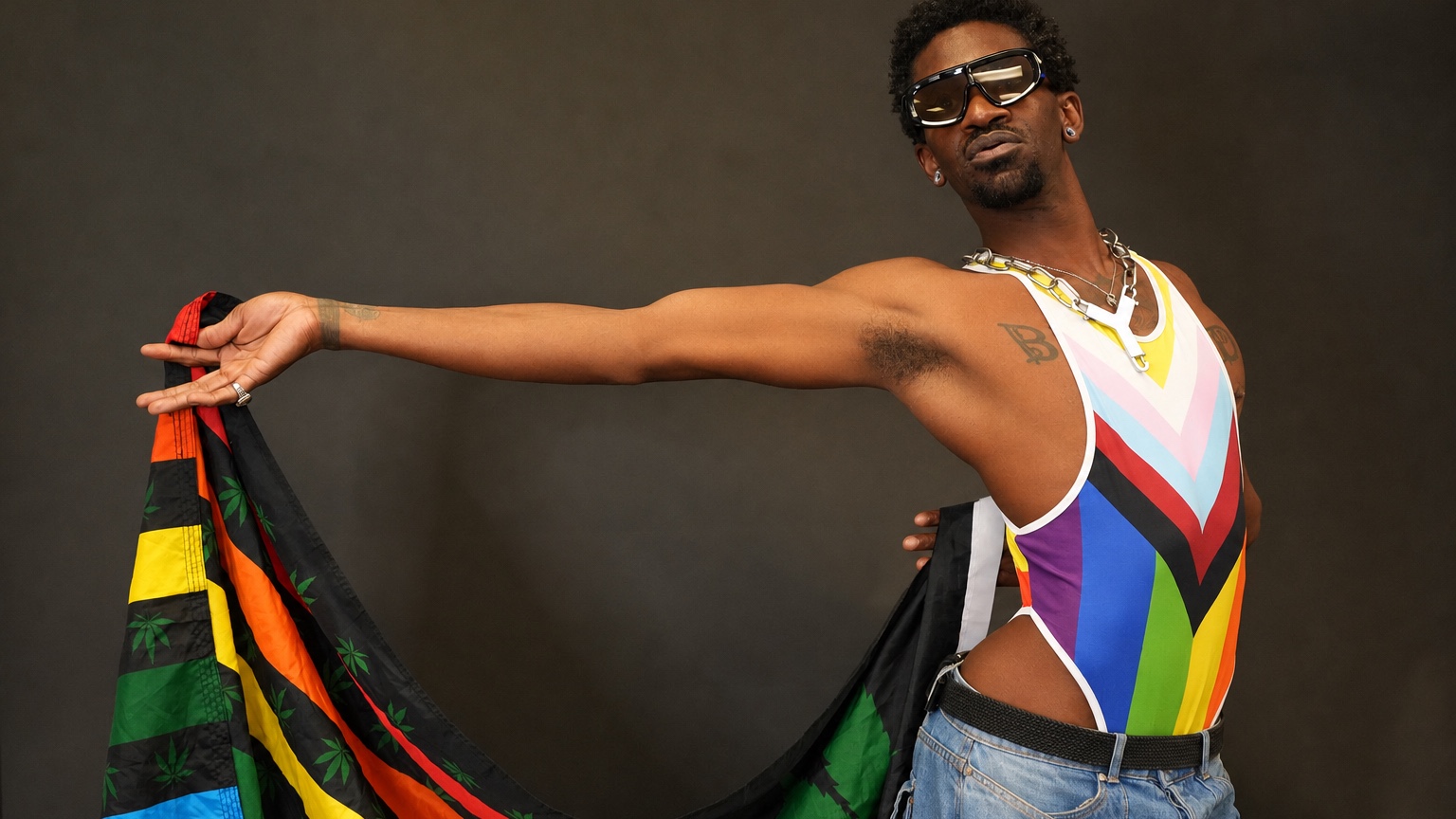
On a Thursday evening in late May, Dale Blackheart Revlon sits down to talk about his life — and he does not start small. He starts in Baltimore. He starts in the trenches. He starts at 13 years old, sneaking into a gay bar called Club Bunnz, watching a man he would come to call his gay grandfather strike a vogue pose to the opening beats of "The Witch Doctor," and feeling something click into place that has never clicked back out.
"I was standing there like a kid standing in the middle of winter wonderland," he says, "just watching all of these whimsical creatures walking past me. Trans women, realness boys, everybody. And I'm just like, oh my God, I'm really here. What's going on?"
More than two decades later, the man born David — Dale is a conjunction of his first and last name, a road name earned through years of international travel and performance — carries the title of Legendary within the House of Revlon's European chapter. He is one of the only figures in the ballroom world to have been formally deemed legendary on an international stage, receiving his title in Paris in 2023 from Jack Gorgeous Gucci, known to an earlier generation as Jack Mizrahi, one of ballroom's most respected gatekeepers. That moment, Dale says, meant everything — not because of the status itself, but because of what it took to get there, and who it was for.
"It took me 21 years," he says. "I have not always been a winner. I have gotten chopped. But I have mentored people all around the world, I have kept the culture alive, and I have never steered away from who I was. Three of my mentees, best friend, my “Brista” from Paris and my first “gay” child received their legendary status before me, and at every single one of those deemings, they said: I never would have been who I am if it weren't for you. That's when I knew I was already where I needed to be."
Out of Baltimore
Dale grew up the youngest child of a single mother who raised her kids, he says, "like damn near military." Respect, hard work, tradition, authenticity — these were not suggestions in his household. His mother, he notes with a quiet pride, is a lesbian who came into her identity in the late 1980s and early '90s, navigating both the AIDS epidemic and the crack epidemic in Baltimore City. Her experience shaped the way Dale understood LGBTQ life long before he had language for his own.
"I had a drag auntie who lived right across the street from my grandmother's house," he recalls. "We knew her as Bianca, but also as Bobby. She poured into me. Those people poured into me. So I never didn't understand the struggle. I knew the type of family I had — that's why I was able to work the situation to my advantage when it was time to face how I felt."
He came out to his family around 13, delivering handwritten letters to his mother, grandmother, aunt, and a beloved uncle — timed, with characteristic strategy, to the family's Christmas party. Nobody flipped a table. Nobody called him a name. "My family," he says, laughing softly, "we were already the black sheep side. They kind of accepted the bizarre things we did."
His entry into ballroom came almost simultaneously, at around 14, at Club Bunnz in Baltimore City. He was brought by older mentors, including the gay father of an ex-boyfriend. The ball started. The beats dropped. He never looked away.
Learning the Culture
For readers unfamiliar with ballroom, a quick primer: it is a competitive LGBTQ+ subculture born in the Black and Latino queer communities of New York City, developing from the 1960s through the 1980s into the global cultural force it is today. Competitors "walk" categories — runway, face, voguing, realness, body, performance — and are judged by a panel. The judging system is binary and unforgiving: 10s mean you advance; a chop means you're done. Battles between finalists test execution, confidence, creativity, and presence. Winners receive trophies, cash prizes, or titles. But the point, historically, has always been something larger than winning.
"Ballroom was created because many LGBTQ+ people — especially Black and Latino LGBTQ+ people — were excluded from mainstream society," Dale explains. "It provided a place where people could be seen, celebrated, and build family. That's still what it is."
That family structure is organized around houses — chosen families that compete together, mentor together, and live in each other's lives in ways that go far beyond the ballroom floor. Dale's first house was the House of Aphrodite, which he joined around 15 or 16. His path to the House of Revlon — one of Baltimore's most notorious houses, known, he says with a grin, for a certain scrappiness — came through an unlikely channel: a Burger King management training session, where he recognized the house's overall father across the room and slid him a quiet, strategic hello. The next day, a note came back across the desk: Welcome to the house.
"He was scary in ballroom," Dale admits. "I never introduced myself to him at balls because he was scary. But I knew my moment."
He has been in and out of Revlon since 2006 — leaving to father his own house, traveling, living briefly in Oregon where there was no scene to speak of — before returning in 2020, this time as a member of the European chapter rather than the American one. That distinction matters to him.
From Baltimore to Paris
Dale's ballroom journey has been genuinely international. He has competed and mentored across Europe, Asia, and Canada, and spent a year living in Paris — a city where ballroom culture operates, he says, at a different frequency than it does in the United States.
"In 2012 I was introduced to a photographer/ videographer turned brother Frederic Nauczyciel who sought something in Baltimore yet found ballroom and me! I was in the prime of my ballroom career but was also stagnant based on my surroundings. After being invited to Europe for a collaborative performance arts exhibition my two Baltimore Revlon brothers and the newly flourishing ballroom scene of Paris, the rest has been history. I never lost the connection and respect for the conglomerate that was built from the ground up in Paris; more importantly I am an honored member of the scene there. In December 2025 Frederic passed away after a lengthy battle with cancer. I was privileged to hold his hand one last time as we discussed what LEGACY meant to us."
"In Europe, houses support each other. If a Revlon is on the floor, other houses are calling the name. In America, if they don't know you or they're not in your house, they're not yelling for you. The unity is different there."
The European scene has also achieved a level of mainstream visibility that American ballroom is still reaching toward. Dale's housemates in the European chapter of Revlon have appeared at the Cannes Film Festival. Ballroom performers walked alongside Bad Bunny at the Paris Olympics. Houses hold contracts with Puma and Nike. "You can catch them on a commercial, on a billboard," he says. "It's consistent. It's not just one moment."
His own Paris chapter includes his independent contemporary dance piece, I'm Walking Tonight, which centers on voguing and was performed there during his residency. He was in Paris, too, when he saw his house father — a man he hadn't spoken to in over a decade — across a ballroom floor, surrounded by European and African-European members of the house Dale had helped build.
"He could feel it in that moment," Dale says. "He avoided it for years, because when you're the black sheep, they shun you. But some things — you can't avoid greatness."
Monday Mania and the Las Vegas Scene
Las Vegas has had a scattered relationship with ballroom culture. For a stretch of years, Jack Gorgeous Gucci brought his Sin City Ball to town annually, but it never took root as a permanent scene. When Dale arrived in 2022, there were Wednesday practices and Friday mini-balls at a venue called Jimmy's, driven largely by a New York transplant named Jasmine Couture. Then a scandal dissolved the scene almost overnight. Then Dale moved to Paris. Then he came back.
"You cannot continue to put us in a dark space and expect for light to shine out of it," he says. "It dimmed a lot of people's light."
"Which reminds me of the one person who was committed and dedicated to the Las Vegas ballroom scene prior to my move to Paris. Sasha “Kitty 007” Williams was a well known transwoman of the community because of her personality and talent. She moved to Las Vegas hoping to find a place to call home and learned fast that ballroom was not going to offer that. Even in my time in Paris I was the only family Sasha could call on and upon my return to Las Vegas, I was too late to pull her back in from the demons she would soon face. One early morning in January 2024 Sasha was stabbed to death by a 20 year old young man who was only sentenced to 8 years in prison. I’ve never found out why he would kill such a beautiful person and I’m forever grieving the loss of my sister, my friend. So Monday Mania is an owed to Sasha and I’ll continue to say her name!"
After a stint at the Old School Lounge and a one-off event at Classic Jewel in the Arts District, Dale brought Monday Mania Ballroom to Piranha Nightclub — the longtime anchor of Las Vegas LGBTQ+ nightlife on Paradise Road — where it has been building momentum ever since. The decision to plant ballroom at Piranha was deliberate and, Dale argues, transformative.
"Piranha doesn't just host gay people. It's not a hookah lounge tolerating you, trying to make their bar meet something. When you say the LGBTQIA+ scene of Las Vegas, that's what you're talking about. Everybody knows what Piranha is. Ballroom is now in a space where it's visible."
For newcomers — spectators and potential competitors alike — Dale has clear guidance. Spectators should come ready to engage: clap, snap, cheer, ask questions. "It is not a museum," he says. Competitors need to do their homework before they ever step on the floor: learn the categories, understand the terminology (10s, chop, 007 free agent, old way, new way, fem queen, butch queen, realness), and most importantly, learn where they fit within the gender and performance categories the culture recognizes.
"Discipline. Creativity. Vulnerability. Accountability," he says, ticking them off. "You are at the stakes of people that are not like you, even though you all are alike. You have to be ready for that."
What a House Really Means
Dale is measured and intentional when the conversation turns to ballroom's role as a social safety net. The culture's history as a refuge for homeless and rejected LGBTQ+ youth is real and important — but he is careful not to romanticize it into something it cannot sustain on its own.
"Ballroom is not the safe haven for the really intense issues you need help with," he says. "If you’re underage and/ or in underserved circumstances, you don't have a place yet, you're struggling — focus on building yourself up first. Go to school. Get your degrees. Ballroom is going to be here. But you have to keep your life in order."
He is equally clear that his door is open for resource navigation — housing, food assistance, healthcare connections — for anyone who needs it. And he is building something that he hopes outlasts him in Las Vegas: a scene that doesn't depend on outside figures dropping in for a single ball and leaving, but a genuine community that sustains itself between events.
"I'm planting seeds for them to grow on their own," he says. "One day this won't be my forever place, and somebody else can carry it. But by that time, it'll be an icon coming back into something that's still being built and growing. That's the goal."
Working alongside him locally are his legendary sister Kiko Alpha Omega and his legendary brother Bo, both originally from the DMV. Together, they are trying to build not just balls, but community — dinners, movie nights, real human connection that makes the ballroom floor mean something when the lights come up.
Keeping the Culture Alive
Dale is 37 years into a life shaped by ballroom — from that first night at Club Bunnz to the plaque handed to him in Paris, from Burger King training sessions to the stage at Piranha. He has watched the culture move from underground to mainstream, from Paris Is Burning to Pose to Legendary to the Olympics. He has complicated feelings about the television era — grateful for the visibility, wary of the distortion.
"Those shows are glamorous," he says. "But in reality, it can get grungy. When judges argue at a ball, most likely they're going to fight. It's not four fabulous judges with hair and makeup done arguing politely. It's different. Glamour versus grunge — that's the real rap."
What has not changed, for Dale, is the reason any of it matters. He closes the conversation the way he opens his balls: with an invitation and a declaration of intent.
"I have the most purest intentions to give culture and experience and fairness to talent. I love to celebrate people. That's what I do this for — to celebrate the people before me, the people here with me right now, and the people that will be here long after I'm gone. Show up with good intentions and love in your heart, and you will have a great time."
Monday Mania Ballroom with Legendary Dale Blackheart Revlon takes place monthly at Piranha Nightclub, 4633 Paradise Road, Las Vegas. Follow Dale on social media for upcoming event dates.