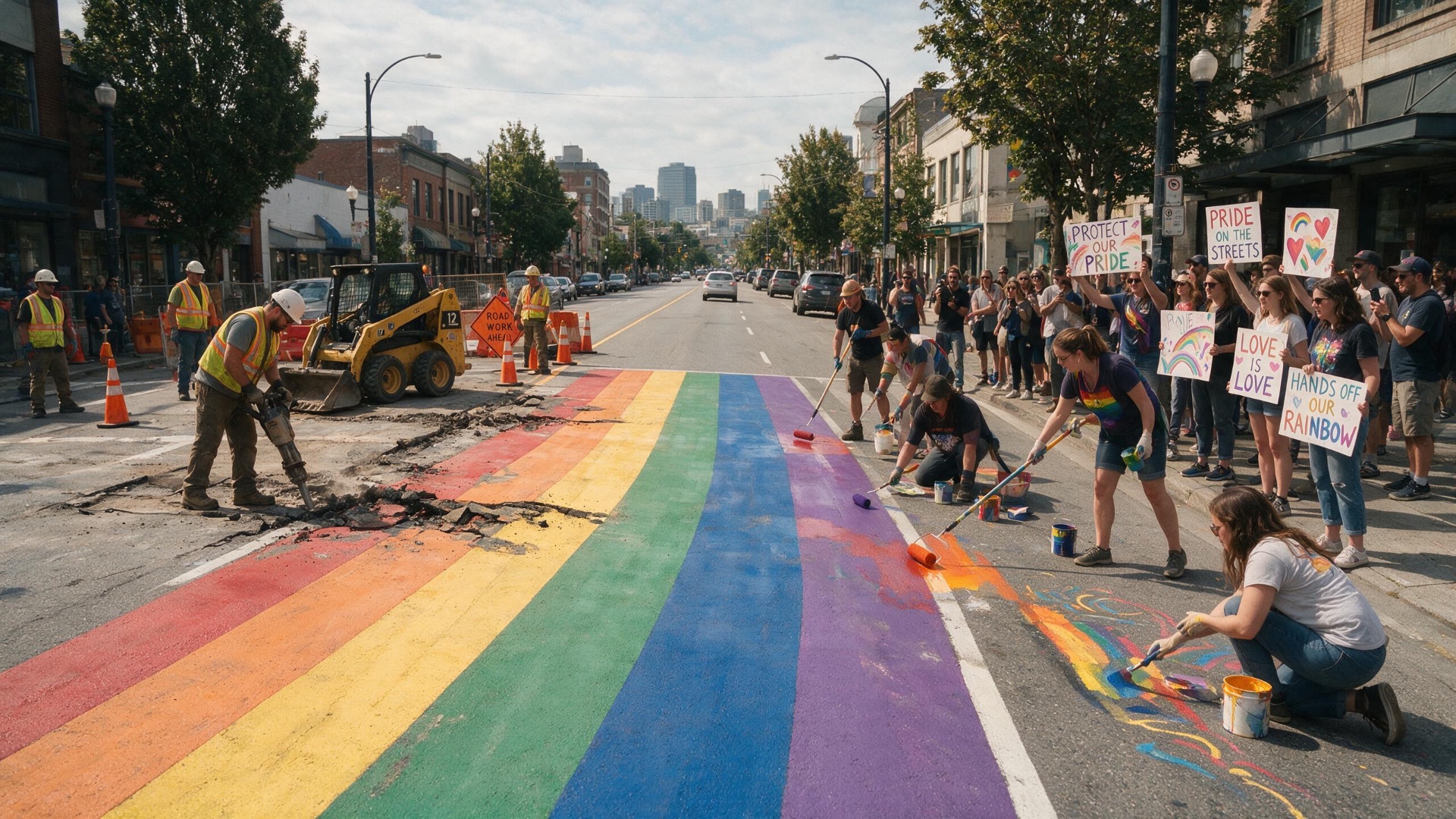
By the end of this month, Austin's famous rainbow crosswalk on West Fourth Street will be gone — scrubbed down to standard white lines. It's the latest casualty in a campaign that has, in less than a year, erased queer street art from LGBTQ+ districts across the country and echoed overseas.
The push began in July 2025, when U.S. Transportation Secretary Sean Duffy ordered states to eliminate rainbow crosswalks and other roadway "distractions," declaring that "roads are for safety, not political messages." Critics quickly noted the department offered no evidence linking decorative crosswalks to traffic deaths — and in at least one case, the data cut the other way. In Miami Beach, Commissioner Alex Fernandez pointed to crash reports showing fewer accidents at the Ocean Drive rainbow crosswalk than at neighboring intersections, calling the safety rationale a cover for intolerance.
Florida moved first, and most infamously. In August, state crews arrived in the middle of the night and painted over the rainbow crosswalk outside Pulse in Orlando — the memorial to the 49 people murdered there in 2016. Orlando's mayor called it a cruel political act. Residents responded with chalk, recoloring the crosswalk again and again; the state painted over their work each time, posted "Defacing Roadway Prohibited" signs, and stationed troopers at the intersection around the clock. Pulse survivor Brandon Wolf noted bitterly that more officers were guarding the pavement than had guarded Pulse's front door the night of the massacre. Protests spread to Wilton Manors, Key West and Miami Beach as cities across the state received removal orders.
Texas followed in October, when Governor Greg Abbott directed TxDOT to strip "non-standard" crosswalks statewide and threatened to withhold road funding from cities that refused. Houston's Montrose crosswalks were power-washed away before dawn as residents watched. San Antonio's came up in January. Dallas sought an exemption for its ten rainbow crosswalks in Oak Lawn; the state said no, and by spring, crews had removed roughly 30 decorative crossings citywide — the Cedar Springs rainbows and Black Lives Matter murals in South Dallas alike. Austin, the last holdout, is complying now.
But the story isn't only erasure — it's adaptation. El Paso wrapped its street lamps in Pride flags. Dallas unveiled rainbow-painted public library steps, and Oak Lawn United Methodist Church colored its own front stairs. Austin residents painted a mural of multicolored hearts a block from their doomed crosswalk.
San Antonio delivered the most elegant counterpunch of all. After the state scrubbed the rainbow crosswalk at Main and Evergreen in January, the city invested roughly $170,000 in brand-new rainbow sidewalks at the very same intersection — brighter, bigger, and completely permanent. The genius is jurisdictional: the governor's order reaches the roadway, but sidewalks belong to the city. San Antonio even preserved pieces of the original scrubbed crosswalk for future art installations. The state erased one rainbow and got a bigger one that it can't touch, anchoring the city's Pride Cultural Heritage District. Streets belong to the state; the community keeps finding everything that doesn't.
The pattern has gone international. In France this spring, a wave of newly elected right-wing mayors removed Pride flags from town halls, painted rainbow crosswalks white, and canceled scheduled Pride marches — moves that French advocates warned feed a rising climate of anti-LGBTQ+ violence on both sides of the Atlantic.
Which brings us home — to the corner of Paradise and Naples, where this story could end differently.
The Fruit Loop enters this fight from a position no other gayborhood in America can claim right now: momentum. Last year, the Nevada Legislature designated our block a historic LGBTQ+ landmark — official recognition of five decades of queer life, from the first AIDS fundraiser in the city to the bars still packed every weekend. The intersection finally got the crosswalk this community spent a generation asking for. And the neighborhood said out loud what it wanted next: make it rainbow. We deserve that.
We still do. And the lesson from Texas isn't caution — it's blueprint. San Antonio proved a community can lose a crosswalk and answer with something bigger, brighter, and beyond any governor's reach. Now imagine that here, done first, done proudly, done before anyone comes with paint: rainbow sidewalks ringing the entire Loop. Pride-wrapped lampposts from Gipsy to Piranha to QUADZ. Color on every surface the community owns — storefronts, patios, walls, steps — a district you can spot from a plane on approach to Harry Reid. Not a defensive workaround, but the boldest queer streetscape in the American West, built into the bones of a state-recognized historic landmark.
Las Vegas has never been shy about lighting things up. In a year when rainbows are being scrubbed off asphalt from Orlando to Lille, this city — our city — could be the one that paints more, not less. The Fruit Loop was named a landmark because this community refused, for fifty years, to be invisible. The next fifty start with a bucket of paint. Who's in?