There is a version of the nonprofit story that everyone in this community has heard before, and it usually ends badly. A beloved organization runs out of runway. A board goes quiet. Services wind down between one grant cycle and the next, and the people who depended on them find out on their own. We have watched even our proudest annual celebration teeter — nearly $50,000 in debt two decades ago amid allegations that its own leadership had mismanaged the money, its future hanging by a thread until the community clawed it back. In a town that has buried too many of its own, the fear that an institution might simply disappear is not abstract.
So when word came on July 22 that The LGBTQ+ Center of Las Vegas had acquired both Aid for AIDS of Nevada — AFAN, the oldest HIV/AIDS service organization in the state — and Golden Rainbow, the housing charity founded by members of the entertainment community nearly four decades ago, the first question in a lot of living rooms was the obvious one. *Are we losing them?*
The answer, according to Center CEO John Waldron, is no — and the structure of the deal is more deliberate than the word "acquisition" suggests.
Both organizations keep their names. Both keep their federal charters. And in Golden Rainbow's case, the plan is not merely to preserve the brand but to grow it.
"While Golden Rainbow and AFAN have been acquired by The Center officially, those two brands will remain really strong in the community," Waldron said in an interview with QVegas. "We didn't want to lose the brand, and we didn't want to lose the legacy of AFAN."
A year of due diligence, and a decade of conversation
The idea is not new. Waldron traces the first conversations with AFAN back to 2019 — his first year as CEO. What changed recently was the seriousness. Work with Golden Rainbow began in earnest more than a year ago; the AFAN discussions accelerated within the last year, and both consumed the better part of twelve months in due diligence.
"Them evaluating us, us evaluating their organizations, and really getting to know one another," he said. "It takes a lot more work to combine the nonprofits like this than people might realize." All three boards, he said, supported the outcome.
As for the trigger, Waldron points outward, to Washington and to the foundations that fund this sector.
"All of the things that happened at the federal level are driving a lot of these conversations across the nonprofit sector," he said — organizations asking where they can combine and strengthen rather than each chasing the same grants alone. Every one of the three, he acknowledged, has hit obstacles in grant funding. Large foundations in the field, he said, are actively calling on Southern Nevada nonprofits to look for exactly these kinds of consolidations and economies of scale.
But he rejects the framing that he was mounting a rescue. "None of the organizations involved were necessarily sinking, or any of those types of things," he said. "But we saw a clear path forward of strength by all of us working together."
What the filings show
The public record adds texture to that, and it is worth laying out plainly.
AFAN, founded in 1984, is the elder statesman of Nevada's HIV/AIDS response — the organization that showed up when the medical and legal establishment would not, whose AIDS Walk once drew six thousand people and raised more than $400,000 in a single spring. Its recent filings describe a leaner operation. In fiscal 2024 AFAN reported about $1.4 million in revenue against $1.6 million in expenses, a deficit of roughly $216,000, following a $419,000 shortfall the year before. Revenue that topped $2.7 million a little over a decade ago had been nearly halved. Its independent audits for fiscal 2023 and 2024 each carried a going-concern finding — the accounting term for substantial doubt about an organization's ability to keep meeting its obligations — and the 2024 audit also flagged material noncompliance and a material weakness in internal controls.
Golden Rainbow, founded in 1987, reported about $721,000 in revenue against $817,000 in expenses in fiscal 2024, a deficit near $96,000. Its value has always sat less in its bank balance than in its property: the apartments and homes it owns outright, where residents living with HIV/AIDS pay roughly 30 percent of their income and the organization covers the rest.
The Center, over the same stretch, went the other way. In fiscal 2018 it reported about $1.3 million in total revenue. By fiscal 2024 it booked roughly $21 million against $16.4 million in expenses, closing with a surplus near $4.6 million and net assets of $13.4 million. More than half of that revenue — about $11.4 million — was earned program-service income of the kind a licensed clinic and pharmacy generate.
Waldron's account and the filings are not in conflict so much as in tension: he describes three organizations each facing "our own unique challenges" and choosing partnership over attrition. What the numbers make clear is that only one of the three had built an engine capable of carrying the other two.
The rescuer was once the rescued
Which is the part of this story that gives Waldron standing to make the argument at all.
In June 2017, the organization then known as the Gay and Lesbian Community Center of Southern Nevada was in visible distress. It had failed to land a year-end grant and started the year in deficit. It cut hours and staff salaries, closed on weekends, and turned to the community with an emergency campaign that had raised only about $7,600 of a $50,000 goal by that Pride month. The Bronze Cafe left in the fall.
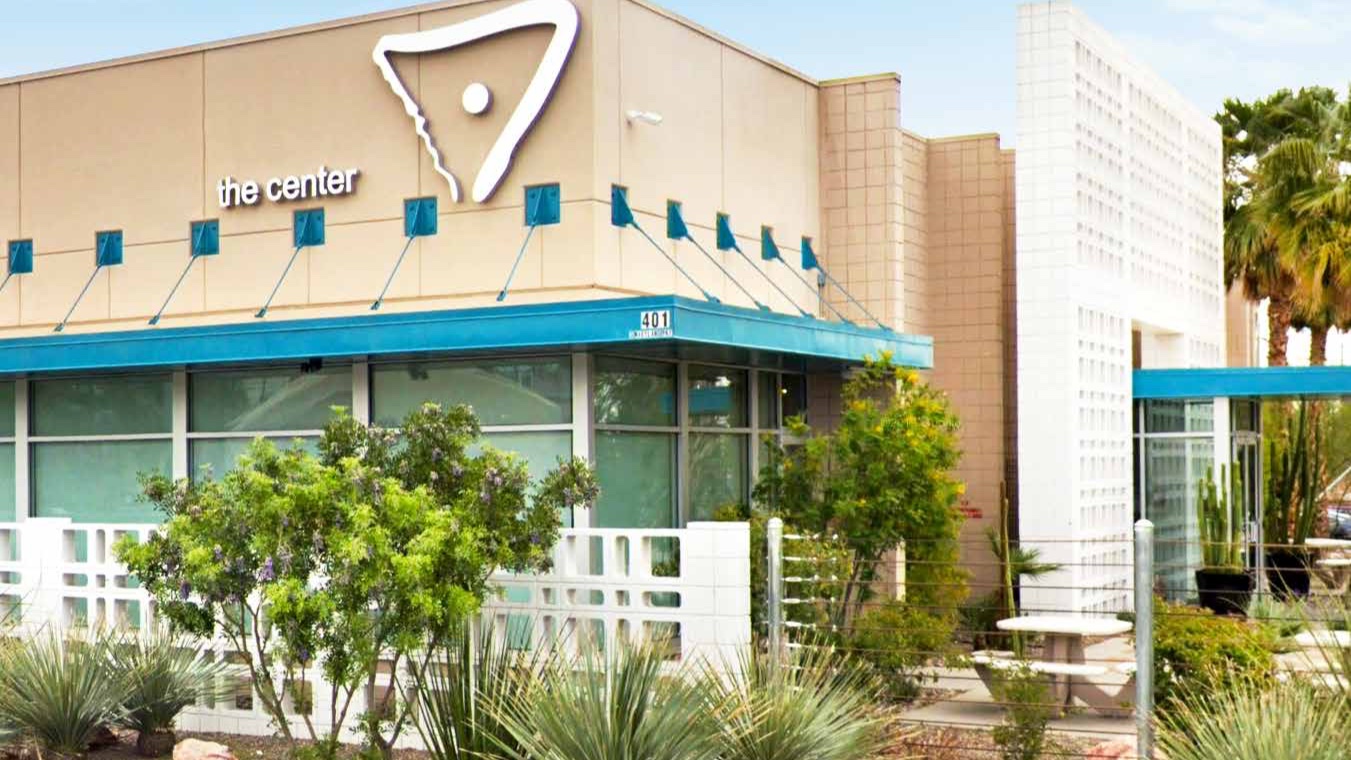
When Waldron arrived as CEO in January 2019, there were nine employees plus him. The donor base had waned. And a balloon payment was coming due on the Robert L. Forbuss Building, with — by his account at the time — no bank in town willing to refinance. That was certainly true, until the startup Lexicon Bank came through for The Center in December 2019. "They absolutely saved us when we had six months left to go on the Forbuss property and we honestly had no idea how we were going to recover. They refinanced us with a low fixed rate for 10 years to give us time to figure out a path forward for paying off the property, which we continue to work on today," recalls Waldron.
What changed it was a board and a plan: a strategic bet on a licensed health clinic that could generate recurring revenue and, in turn, sustain the free programming that had always been the organization's soul. Today The Center runs the Arlene Cooper Community Health Center and the Gavin J. Goorjian Community Health Center, a pharmacy operation, behavioral health, victim services, youth and senior programs — and, across all three organizations, more than 100 employees, not counting contracted medical staff.
"The day I started there were nine employees plus me," Waldron said. "And here we are, we're over 100 now."
Asked directly whether the acquisitions put that hard-won stability at risk, he was unequivocal. "We're not at risk with the acquisitions." He credits two things: the 340B pharmacy program, which generates what the law requires be called savings rather than revenue and which must be reinvested in mission, and the support of the organization's largest foundation funders. He also notes The Center now answers to two boards — a governing board and a foundation board — which he describes as very good at asking whether a thing has been thought through.
What survives, and what comes back
The most consequential detail of this deal is one the press release didn't spell out: The Center is keeping both 501(c)(3)s.
AFAN and Golden Rainbow remain separate federal charters, now governed by The Center's board, which assumes fiduciary responsibility and oversight for both. Part of the reason is practical — Waldron was candid that grants are attached to those entities and cannot survive their dissolution. "For full transparency, that was part of it," he said. But he framed the rest as commitment: multiple nonprofits in town operate subsidiary charters under a parent organization, and keeping these two allowed The Center to promise that the names would endure.
The division of labor is clean. All housing work — including future development — will carry the Golden Rainbow name. Everything in HIV prevention, treatment, education and outreach will carry AFAN's. The Center made a specific commitment to Golden Rainbow's board before closing that its existing properties will stay focused on HIV housing, even as The Center expands the brand into housing beyond an HIV focus.
The boards themselves have largely stepped back. AFAN's directors resigned except for board president Laura Foley, who joined The Center's board. Golden Rainbow's board resigned as a board and reconstituted as an official advisory council — with a specific charge.
"We want to bring back the Ribbon of Life," Waldron said.
That is news. Golden Rainbow's signature Strip-talent showcase, a fixture for more than thirty years, has been dormant; the advisory council exists in part to guide its return. Longtime executive director Gary Costa retired in the transition, but all three Golden Rainbow staff came over.
On AFAN's side, the fundraising traditions continue — and, importantly, the money stays where donors intend it. Proceeds are earmarked, not pooled into a general Center fund. Ribbon of Life will support Golden Rainbow and HIV housing. The AIDS Walk and the Black & White Party will fund the work under the AFAN brand, covering the needs that grants don't reach.
"We're not looking to merge those into fundraising for The Center itself," Waldron said, noting the commitment was made to both boards before the transactions closed.
Where everyone will work
The offices are consolidating. The Center recently purchased two buildings on Fourth Street downtown for $5.2 million, and is vacating its leased administrative space at 10th and Bonneville — seventeen offices — as of this week.
The larger building at 504 Fourth Street will house administration, finance and other Center functions. The smaller building at 516 Fourth Street, in the same lot, becomes the home of AFAN and Golden Rainbow, with the transition rolling out over the next couple of months.
There is a small poetry in the address. Fourth Street is the Pride parade route.
The funding question
The question a lot of people asked first was whether putting everything under one roof would dilute the federal money. Waldron says the opposite.
AFAN holds Ryan White Part B funding; The Center holds Part A. The two serve different purposes, which means combining them expands rather than duplicates — more case management, education and outreach, not less. Golden Rainbow no longer receives Ryan White at all; its primary support is HOPWA, the federal Housing Opportunities for Persons With AIDS program, which flows through the City of Las Vegas. AFAN also holds HOPWA funding for its own residential property, which Waldron notes actually houses more HIV residents than Golden Rainbow's.
Because those housing dollars pass through the city, City Hall effectively had veto power. Securing its blessing was, Waldron said, one of the most important things The Center did — and the support ran from the mayor through the council and into the departments.
He was careful to note the calculation ran both directions. "We were thinking about the risks on both sides," he said — that a city unwilling to work with The Center could have derailed the very programs the deal was meant to protect.
One limit worth naming: the 340B savings that underwrite so much of The Center's growth cannot simply be redirected to AFAN or Golden Rainbow. That falls outside the program's scope. Clients of either organization who use Center services benefit from it; the money itself stays put.
Antioco Carrillo's actual job
AFAN executive director Antioco Carrillo becomes The Center's Chief Housing and Integrated Health Officer — a title Waldron says he wrote himself, for a role he says the organization genuinely needed.
He was direct about what he wasn't interested in: a co-CEO arrangement, or the kind of shared-leadership model that often papers over a merger. "We were not interested in seeing Antioco go away. He wasn't ready to retire."
The role sits at the intersection Waldron keeps returning to — the social determinants of health. Carrillo will oversee all housing initiatives across the three organizations and work on the rapidly growing behavioral health side, including a federal grant for LGBTQ+ youth housing in which The Center facilitates placements rather than owning the units.
"We can get somebody healthier if we know that they're housed," Waldron said, invoking Maslow. The job, as he describes it, is to make housing, medical care and behavioral health function as one system aimed at a whole person.
For clients: one door, and one important caveat
The pitch to clients is efficiency — a Golden Rainbow resident who never used The Center's pharmacy or medical services now has an easier path to both. Waldron called creating those efficiencies the number one thing all three organizations wanted.
But he flagged something that took longer than anything else in due diligence, and that complicates the tidy one-stop-shop story in a way worth respecting: patient choice.
Living in a Golden Rainbow or AFAN apartment does not obligate anyone to use The Center for anything. Full choice of pharmacy. Full choice of provider. Federal law requires it, and The Center documented its operational approach with attorneys specifically to stay clean.
"That's why I laid that out," Waldron said. "We documented our operational approach to that with attorneys."
He was also honest that the seamless version doesn't exist yet. Asked what a client could do more easily today, he declined to oversell it — the work is underway with the medical and program leadership, but he wasn't going to claim a finished product.
What's still hard
Duplication. Three organizations meant three finance functions, three marketing shops, overlapping case management. Waldron says redundancies will be resolved "over time through attrition" rather than layoffs — the point was that this not be about eliminating jobs, in practice or in impression. Marketing is the clearest overlap; AFAN's operation was robust, and so is The Center's.
A crowded calendar. The Black & White Party and The Center's own Honorarium land less than two months apart, which taxes staff and donors alike. Planning for 2027 involves spacing things out. The Center brought in an outside agency for last year's Honorarium — a first — after finding that several staff were losing a large share of their year to it.
Appointment waits. The Goorjian health center's two-to-three-month wait for appointments is a consequence of demand outrunning capacity, and Waldron didn't defend it. "That's not reasonable. It's not what we envisioned." A chief healthcare officer physician is being replaced by year's end, with additional nurse practitioners and medical assistants in the works. PrEP intake at the Arlene Cooper center, he noted, does not carry that wait.
Concentration. The larger question survives all of the above: when one organization becomes the dominant provider of both LGBTQ+ and HIV/AIDS services in Southern Nevada, the community trades some pluralism for efficiency. Waldron's answer is structural — separate charters, preserved brands, earmarked fundraising, an advisory council, two boards and, in his telling, a board culture that pushes back. Whether that's sufficient is a fair thing for the community to keep watching.
Surviving to thriving
Waldron doesn't pretend the growth has been elegant. He repeated something his own staff tell him: they're flying the airplane while they're building it.
"And maybe we are," he said. "But we're still flying okay."
The organization now shuts down four times a year for all-day team development, a response to how fast it grew. There's a 2027–2030 strategic plan in final approval that includes expanded transportation access and a formal legal services division. Espresso Yourself, a workforce development program funded in part by NV Energy and Las Vegas Sands, now occupies the cafe spot.
Asked what single measurable thing would tell him, a year from now, that this worked, Waldron's answer was notably plural.
All three locations stable and growing. More people served, and served well. Increased financial stability in each organization — earned revenue and fundraising both. All three brands still strong and still respected in the community. And team members thriving, which he framed as the foundation everything else rests on.
"We're aggressive," he said. "But honestly, I hope the community sees we're not foolish, and we're not reckless with the responsibility that we've been given."
Seven years ago this organization was one balloon payment from losing its building. It repaid that stretch by building something sturdy enough to hold not only itself but two of its neighbors — and, in the version of the deal Waldron describes, without erasing either one's name from the door.
Whether this becomes the model for how a maturing community protects its own, or a cautionary tale about putting too much under one roof, will be written over the next few years in outcomes and audits rather than announcements. But it is worth saying plainly, in a season when so much of the conversation about our institutions is about what they've lost: nothing closed this week. Nobody lost their job. Two legacies got a balance sheet behind them, and a dormant thirty-year tradition got a second chance.
That's not surrender. That's how a community makes sure its promises outlive the people who first made them.