

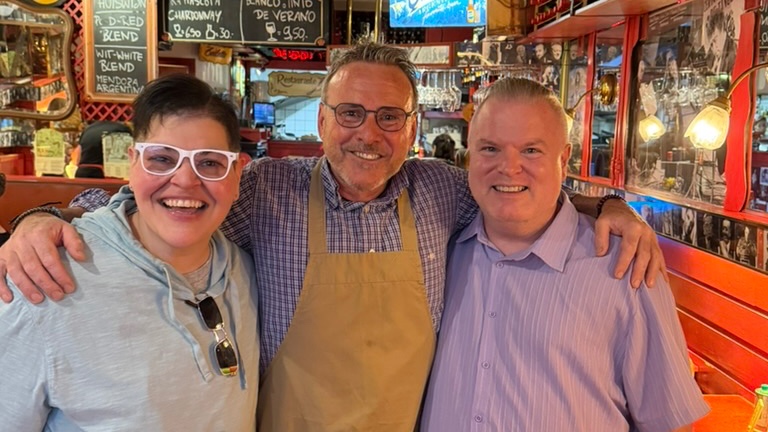
Those of you following along at home know I'm on a two month journey through Europe, one that began with the OUTbound WorldPride Cruise into Amsterdam. What I didn't know when I set out was where the trip would actually take me.
Here's one of the surprises. Just as we were pulling into Amsterdam for WorldPride, a post came across my feed from comedian Jen Kober, saying she and her wife Brooke were headed to Amsterdam for World Pride, too. Jen, as you may remember, was one of our cover models back when she was the resident comedian at Mad Apple. We've stayed friends online ever since. You don't pass up a coincidence like that. Dinner was happening.
Which raised the question of where. My first trip to Amsterdam was August of 2010, on an Atlantis cruise, and that's the trip where I met Michael Barbieri, who would go on to become QVegas's feature food writer. On our last night in the city, Michael and I ended up at an Argentinian restaurant. Sixteen years later, I couldn't resist finding out whether it was still there.
It is. Restaurant Luna has been serving Amsterdam since 1990, and not much has changed — which, as it turns out, is the entire point.
Owner Oberdan sat down with us after the dinner crowd subsided, hesitant his English wasn't good enough. This absolutely charming man went from shy to exuberant when he started talkabout about Luna. When I asked how many years the restaurant had been open, he started with "over 35," did the arithmetic, and landed on 36.
I wanted to know about fire. Argentinian grilling depends as much on the fire as on the cut, and I was curious what had to change to make that work in a Dutch kitchen. His answer reordered my assumptions. The fire matters, yes, and the grill has to be at a good heat — but quality comes first, above everything. Where the cow came from. How fresh it is. The breed: Aberdeen Angus.
And Dutch beef, he says, is good — just not the same, for a reason I hadn't considered. In Argentina the cattle are outside. Here they're inside nearly all year, eating potatoes and carrots rather than grass. "It's strange," he admitted, "but that is why the tasting is good." He's fond of American beef too, though his ideal animal lives almost its whole life outdoors and finishes on grain for three or four months at the end.
The cultural math is different as well. Argentina runs on meat. The Netherlands, he points out, is a fishing country.
Amsterdam is not short on Argentinian restaurants, so I asked what makes Luna stand out. The answer was history. The first wave of Argentinians arrived here in the '70s and '80s, and when they opened their grills, the Dutch — who had little exposure to serious imported beef — responded with what Oberdan called an explosion. Luna was among the first of them, in 1990. Over the decades, most of those restaurants were sold off to owners from Pakistan, Australia, Indonesia. The names stayed Argentinian. The ownership didn't. By his count, Luna is one of only about two left that are still the real thing.
Customers order the tenderloin for the tenderness. He prefers the rib eye, because flavor. And the empanadas are filled with tenderloin he trims and sets aside himself, cut by hand, never machine.
He's been cooking for about 35 years and also runs a second, more exclusive restaurant across town.
"I am not a chef. I am a grill man. And on the grill I make everything. Fish, vegetables, meat. Doesn't matter."