

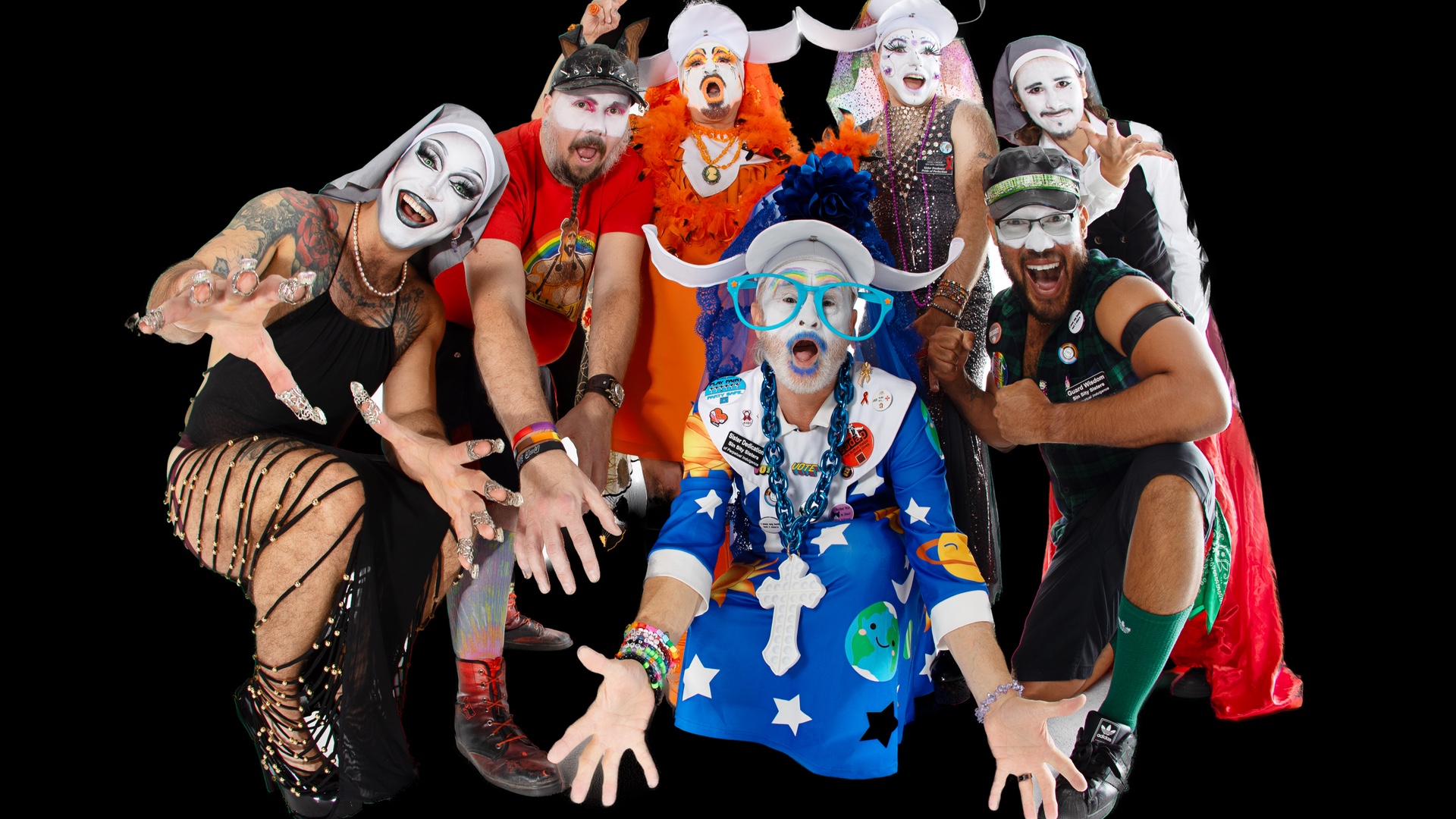
Twenty-one years in, Sister Prudence has learned that the most useful place to stand at a party is the corner.
"When I'm out as Prudence, people tell me things," Billy Pierro says. "I get coming-out stories. I get transitioning stories. Being diagnosed with HIV — all of those things get shared with me on a regular basis." While other sisters work the microphone, Prudence has spent two decades huddled off to the side of the room with somebody who needed a minute, explaining what the order can actually do for them.
That instinct — the quiet corner, the long conversation, the practical offer — is the engine underneath everything the Sin Sity Sisters of Perpetual Indulgence do, including the loudest thing they do all year. Project Nunway returns to Gipsy Nightclub on September 12 with a theme built for the moment: Night of One Thousand Curses — Monsters, Witchcraft & Pop Culture.
The three P's
The name came from television.
Pierro was working at Bellagio and had never done drag when he told his coworkers he was becoming a sister. As a founding member, he'd drawn a sin — one of the seven — and had to build a name around it. "I happened to be Pride, which is funny because I was the newest and the youngest one," he says. "And I feel like Pride is one of the best sins to have. Nobody wanted it."
He was deep into Charmed at the time. Prue Halliwell became Prudence, Perfection rounded it out, and the three P's nodded at the show's Power of Three.
There's a wrinkle he only caught later. The six founding members took the deadly sins — Wrath was retired, because the sister who would have carried it had agoraphobia and couldn't be out in the world with it. Everyone who came after the founders takes a virtue, and virtues are effectively unlimited. Except one.
"What I didn't realize is that Prudence is a virtue," he says. "So we had to retire Prudence as a virtue that somebody from our house can take. I unknowingly took a virtue and a sin in my name."
Two decades on, the name has become a second person. Billy is the organized one, the professional, the networker. Prudence turns the filter down — "more outgoing, more outrageous, more willing to approach somebody." He isn't the most shocking sister in the room and doesn't try to be. "You don't have to be the loudest or the most shocking sister to make an impact."
Why monsters, why now
The theme leans into witches, hexes and creatures — not a neutral choice in 2026.
"Monsters and witches have always represented the people in society that don't quite fit," he says. "They are feared, misunderstood, exaggerated, and sometimes blamed for everything that's wrong in the world. That actually feels really kind of appropriate right now."
But Nunway is not a lecture. "It isn't meant to be a depressing political lecture," he says — "although Prudence does that sometimes." The plan is to take the imagery and make it fabulous. Or, as he puts it: take the curse and rhinestone it.
Twelve designers, $75, and whatever's in the garage
The format has been the same since year one and it's still the best hook in local nightlife: designers build a runway look out of recycled and found materials on a shoestring budget — roughly $75 — and a sister walks it.
Twelve designers, twelve looks, twelve walks, with the recycled-materials mandate built into the judging criteria. Designer wrangling falls to Victor Rodriguez, which means the sisters walking are genuinely in the dark about what everyone else is wearing.
"I'm not privy to any of the other designs," Pierro says. "I can only talk about my designer." His this year is a retired sister, which has changed the conversation. "He really gets it. He's having conversations with me that some of my previous designers did not — about how I'm going to design my face, how I'm going to do the walk. He understands Prudence."
Pairing designers with sisters is part matchmaking service, part sisterly interference: personalities, aesthetics, body types, and the practical reality that nobody is being paid. "We're not Project Runway. We're not trying to throw a huge challenge at people," he says. "If we can pair somebody up within the scope of what they can do — I mean, none of these people are getting paid."
The one real format change this year is about credit. A traditional fashion show puts one designer behind every look; Nunway has twelve, and past attempts to spotlight them with pre-recorded video ran into the eternal problem of AV in a nightclub. So this year each designer submits a short blurb about the concept, read aloud by them or by the host, then joins their sister onstage for a photo after the walk.
"That's the moment," he says. "That's when people put it on social media, and that's when you get highlighted as designing that outfit."
Hosting duties this year go local. Nunway has brought in national names before — Chad Michaels performed, Alexis Mateo hosted for a couple of years — but the order is deliberately pulling the budget down so more of the night's revenue clears through to the beneficiary. Akasha Lstatt takes the mic, with performances from Sin Licencia and Poison Munro, both drawn from the local bar circuit rather than the touring roster.
"We're at Gipsy this year, where we have this huge platform," Pierro says. "We thought it would be a lot more special if we can showcase some of the local talent."
The reason any of it exists
Every dollar Nunway raises goes to SADAP — the Sisters' AIDS Drug Assistance Program — and Pierro is emphatic that it isn't an abstraction. "This assistance is for people in our community that need help accessing HIV-related care and medication," he says.
The gap it fills is narrow and specific. Public assistance cuts off at 400% of the federal poverty level — somewhere around a $65,000 salary. Make a dollar more and you're paying for your own medication, which can run thousands a month, more on injectables. "That's a rent payment," he says. "I mean, that's rent and car."
So SADAP catches the people sitting just above the line: between jobs, newly employed, earning too much on paper and not nearly enough in practice. "We can't help everybody. We help people that fall right above that."
About five years ago the program expanded into PrEP, working through the Center and other local agencies rather than routing patients to a volunteer organization. The per-patient cost is far lower, but Pierro argues cost sensitivity is higher. "If somebody is negative, they don't have the same urgency," he says. "And if there's any cost barrier, they're even less likely." Twenty dollars is enough to talk someone out of it.
His elevator pitch is a public-health one: a negative partner on PrEP and a positive partner undetectable on treatment means the virus isn't moving. "We're not going to be the ones funding a cure," he says. "There's money that goes to that. We need to help people in our community who are affected by this."
The rest of the calendar
Nunway is the marquee event, not the only one. Red Dress lands in March, and OINC has run monthly at Fun Hog Ranch for roughly eighteen years, including through the pandemic. Then there's the work that isn't fundraising at all. "We don't always have our hand out," he says. "The community doesn't always have money." A quarterly meal at the nunnery, run with the Las Vegas Court, rotates themes — a chili cook-off, a barbecue, a soup night.
His favorite is World AIDS Day, when the sisters run a bar ministry across town in a single night, lighting a candle at each stop and carrying a white veil anyone can write a name on. Back at the nunnery, they burn it.
"There are a lot of World AIDS Day vigils, and I love that they exist," he says. "But some people are going to be at the bar, and they're going to find their comfort a different way. And we're going to them."
Handing over the veil
The sisters were honored at this year's HRC gala, which still seems to startle him. "For an organization like HRC to recognize our little local organization is mind-blowing."
But the thing Pierro most wants on the record is about leaving. "I love that I'm the abbess," he says. "But I'm really trying to make sure it's set up for the future, because I can't do it forever. And anybody that thinks they can do it forever, I think, is going to be the demise of it."
He's building bench strength and as much system as a volunteer order can sustain, with an eye toward eventually handing Prudence's reins over — something he wouldn't have been comfortable with a few years ago. That means being willing to let traditions end. "As much as I love the history and the legacy the Sin Sity Sisters have built over 21 years, it doesn't do us any good if we're continuing to beat a dead horse," he says. If Nunway runs its course, or Red Dress does, he hopes somebody replaces it with something better. The Velvet Circus, newly launched at the nunnery, is on its second edition, and if it eventually eclipses what came before, fine.
"You better have something new, though," he adds. "Don't stop something that's successful if you don't have something new."
The corner of the room, it turns out, is also where you learn how to leave.