

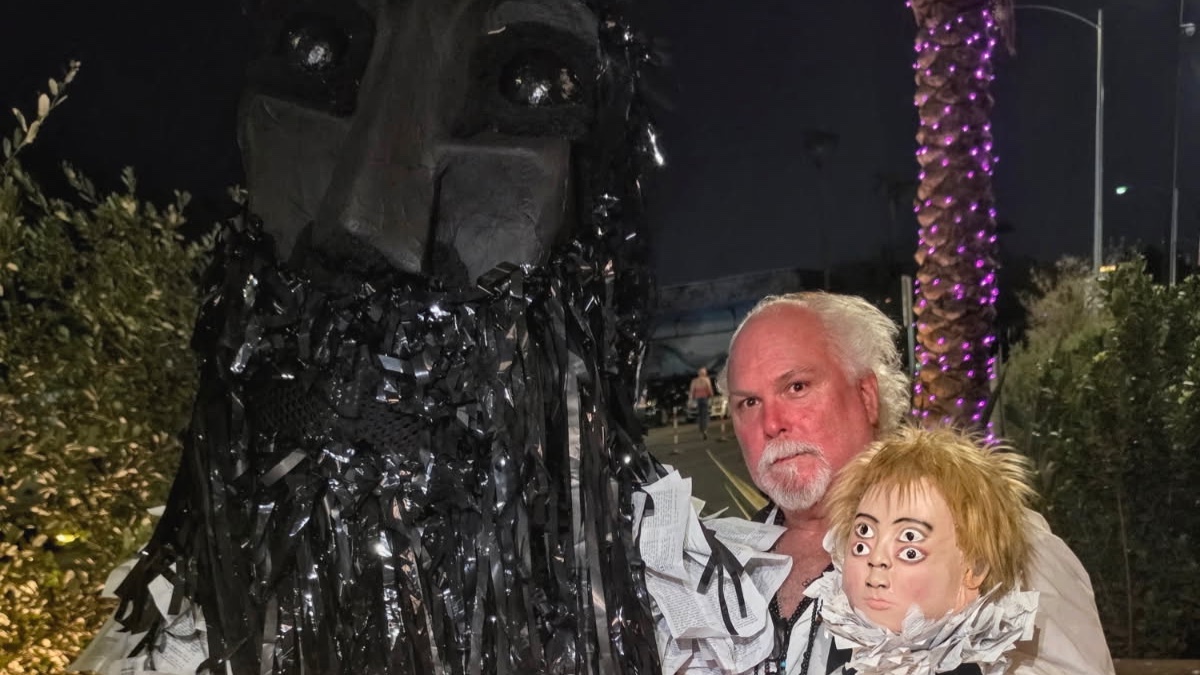
Jim McCoy doesn't do small. At this year's Project Nunway, the Las Vegas designer, known to many as Norma Llyaman, added another crown to a run that stretches back to the competition's very first night. He did it with a look that unsettled the room, and on a budget of about twenty dollars.
Project Nunway, the fashion fundraiser staged by the Sin Sity Sisters of Perpetual Indulgence, has never been a conventional runway show. McCoy describes it as fringe, eccentric and artistic, pulling in performers, costume makers and visual artists alongside people who actually design clothes. The rules are loose but pointed: designers get a theme, the look has to carry some of the Sisters' sacred-meets-profane essence, spending is capped at $200, and unconventional materials are strongly encouraged. Some entrants build a dress and accessories. McCoy goes the other way.
"I always choose to be as theatrical as possible," he says. "I miss that in our world."
A veteran since year one
McCoy was there before there was much of a there. In the event's first year he sat on the grassroots committee asking what Nunway should even be, then entered and won. The theme inverted the deadly sins, and McCoy drew chastity. His answer was a womb sculpted entirely out of barbed wire. The runner-up, Chris Cope, built a look out of balloons, and when the two embraced on stage the barbed wire popped every one of them.
"Nobody had seen anything like it," McCoy says. That first win still means the most to him, partly because of how raw and homemade the whole thing was, and partly because of his friendship with the Sister who founded the order locally and brought Nunway to it.
He hosted year two, returned to compete in year three with Scorpio, a towering scorpion, and won again. He spent the following two years as host and MC before this year's creative director, Victor Rodriguez, went looking for past participants. McCoy calls Rodriguez a Pied Piper for creative people. "He made it special this year," he says.
This year's theme: Curse
Organizers framed the theme around haunted houses and horror-movie hexes. McCoy went to the source material instead. Digging into the Old Testament, he found a list of curses, one of them aimed at sexual immorality, and his mind went straight to the abuse scandals that have shadowed the Catholic priesthood for decades.
The finished piece showed a man of the cloth clutching a small altar boy, walked down the runway to gothic music. It was built from construction plastic, cardboard, fabric and roughly an inch of Bible pages, all of it secondhand, borrowed, pulled from his garage or rescued from a dumpster. He spent about $20.
"I think way too much when I design stuff," he admits. The process included pages of sketches and an evening of documentaries on the history of the scandals. Afterward, people told him he'd taken it to a different level. "I like it when people say that," he says. "I did my due diligence."
Building it on a body
The look only works if someone can wear it, and McCoy treats his model as a collaborator. For the curse piece he wanted someone tall and game, and found that in Sister Fairness. The costume was hot and bulky, and the mask alone was a cardboard box nearly three feet across. They did test runs, and because Fairness could barely hear inside the box, they worked out a system of hand signals: a squeeze or a touch told the model what to do next.
"That chemistry was a lot of fun," McCoy says.
His Scorpio model got different direction entirely. "I said, I want you to prance like you're a showgirl, but you're a scorpion," he recalls. Once the music hit, the tail started whipping and the crowd lost it. For McCoy, that's the best part: watching Sisters step out of the habit and the whiteface and let their own characters loose.
The night, and the point
This year's show landed at Gipsy, with one complication: the heat. Designers had to sprint across the parking lot to reach the stage. McCoy didn't mind. The room was full of new faces, and the rivalry stayed friendly, even if he jokes that he's a terrible loser. What he wants more of is ambition. He thinks the queer community has grown complacent about what it can create and offer, and Nunway is his argument against that.
Complacency is also why he says the Sisters matter now more than ever. The money Nunway raises supports the order's HIV and AIDS assistance program, and McCoy worries that PrEP and modern treatment have made younger people too relaxed about a disease the community still lives with every day. He watched the program carry people through the pandemic, when many lost jobs and insurance. By his account, more than 90 percent of applicants receive help, usually within 24 to 48 hours, with no questions asked.
"That purpose is still there," he says of the work the Sisters began in the 1980s.
His hope for Nunway is simple: that it keeps growing, bigger and stranger every year. Given his track record, expect him to be part of it.