Nevada politics loves a theme night. Some election cycles it’s “family values,” some years it’s “law and order,” and every so often it’s “we swear this is about principle, not power,” delivered with the straight-faced confidence of someone trying to sell you a bottle-service package that includes exactly one (1) lukewarm mixer and a complimentary regret.
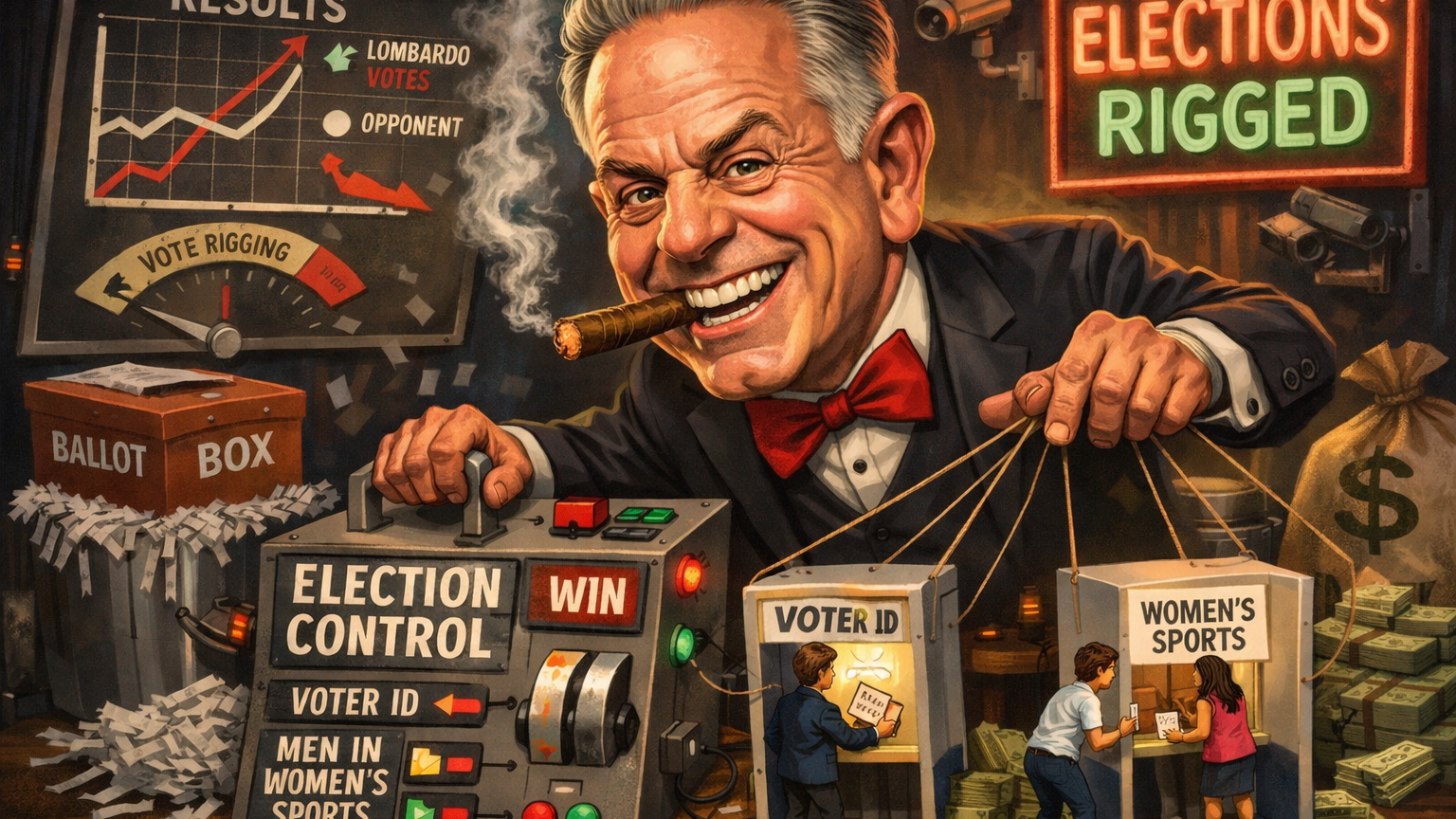
This time, the theme is Turnout: The Remix—and the soundtrack is a leaked recording from a closed-door supporter event, discovered because The Nevada Independent obtained the audio file and reported on what’s in it. The rest? That’s not rumor, not interpretation, not “people are saying.” It’s right there in the transcript you shared, in the governor’s own cadence: a re-election “game plan” built around using ballot measures as a cattle prod to get voters moving.
Not inspired. Not persuaded. Not engaged. Moved.
Because the bluntest thing about this whole episode is not the policy content—though we’ll get there. The bluntest thing is the strategy. The governor isn’t describing a thoughtful agenda for Nevada. He’s describing an electoral mechanism. A turnout machine. A way to “ensure” people get off the couch, not because they’re excited about governance, but because a couple of hot-button ballot questions will drag them out by the emotional lapels.
You know how some people can’t get friends to show up to brunch unless they promise bottomless mimosas? Same energy—except the “bottomless” part is moral panic, and the “mimosas” are constitutional amendments.
Let’s start with what the transcript actually says, because the transcript is the entire plot.
In the Sept. 16, 2025 recording, Lombardo tells supporters: “we’re also gonna put a couple of ballot initiatives forward to ensure that we get people out to vote.” That’s the frame. Not “here’s what Nevada needs.” Not “here’s how we protect people.” It’s turnout. It’s bodies. It’s votes.
Then he names the first ballot motivator: “first and foremost is voter ID.” He points to a prior vote, references Nevada’s two-election requirement for constitutional changes, and lays it out like a calendar invite: “what happens next cycle in 26 when I'm up for election? We have another vote, the 2nd vote of voter IDs. So that's gonna get people out to vote. It's gonna get people out to vote.”
If you’re keeping score at home, that’s not a policy pitch. That’s a turnout pitch with a policy costume.
He doesn’t stop there. He adds the part that campaigns usually save for the group chat: “They're not gonna come out to vote just because of me.” Then he does the little spiral where politicians pretend they’re being humble while also insisting they’re the main character: “Uh, he's gonna comment. I don't need to vote. He's gonna get elected. That's crap. That's absolute crap.” And then—chef’s kiss—he says the quiet part with the volume turned up: “So let's get them out. Let's create some other motivators to force them to get out the vote.”
Force. Motivators. Get out the vote.
That’s not “public service.” That’s “crowd control.” That’s “how do we herd the vibe.”
And this is where the voter-rights piece kicks the door in.
Because the voter ID debate isn’t just about whether you personally feel comfortable showing identification. It’s about whether voting is treated as a fundamental right that the state must protect and facilitate—or a conditional privilege that gets more hoops whenever it’s electorally convenient.
When a governor is presenting voter ID as a turnout lever—something that will “get people out to vote” because it will be on the ballot again—he’s not treating it like a sober, administrative safeguard. He’s treating it like a campaign instrument. Like a “motivator.”
That matters, because voter rights aren’t only threatened by the most obvious forms of suppression. They’re threatened when the rules of voting become a stage prop in an ongoing performance of grievance politics—when the act of voting is recast as a reaction to fear instead of an expression of civic agency.
And fear is always selective. It always finds the same targets.
Which brings us to the second “motivator.”
In the transcript, Lombardo pivots from voter ID to what he describes as: “this thing called men and women's sports.” He says he’s “in the process currently of raising the money for this ballot initiative to get the signatures to qualify it and put it on the ballot.” Then he delivers the line that turns policy into pure political calculus: “That's gonna get people out to vote.”
Again—no subtlety, no euphemism thick enough to hide it. The whole thing is framed as an engine for turnout.
And that’s why people are reacting the way you are. Because this isn’t just “he supports a policy you dislike.” It’s “he’s openly describing an entire community as a tool.”
Trans people aren’t being talked about as Nevadans with rights and lives and dignity. They’re being talked about as a motivational device—an emotional tripwire designed to trigger a certain response from a certain audience. A wedge you insert into the ballot so the electorate splits the way you need it to split, on the day you need it to split.
If you want to be extra honest, “men in women’s sports” isn’t even a policy description. It’s branding. It’s a phrase designed to do three things instantly:
It misgenders trans women by default. It frames the situation as infiltration. And it turns a human identity into a threat narrative that fits cleanly on a yard sign.
It’s the political equivalent of putting “DANGER” tape across a doorway to a room you want people to avoid thinking about rationally.
And here’s the bigger point: even if you’ve never met a trans athlete, even if you’ve never been inside a high school gym that wasn’t hosting a bake sale, even if you think this topic is complicated—you should still care about the method.
Because the method is: take a small, vulnerable group. Inflate their existence into a statewide crisis. Put it on the ballot. Use it to drive turnout for the guy on the top of the ticket.
That’s not “debate.” That’s extraction. It’s political strip-mining: find a community whose safety is negotiable to your base, and dig until you’ve got enough outrage to power the election.
And it’s not happening in a vacuum. Lombardo doesn’t present this as an isolated idea. He presents it as a pairing—voter ID plus “men in women’s sports”—like a combo meal for voters who prefer their democracy with a side of suspicion and a large cup of cultural panic.
That pairing is not accidental. Psychologically, it’s elegant in a deeply ugly way.
Voter ID activates the “the system is loose” instinct: the sense that something must be wrong because the world is scary and change is happening and we need a rule that feels simple.
The trans sports initiative activates the “something is being taken” instinct: a story about boundaries being crossed, categories being “invaded,” a nostalgic fantasy of how things “used to be.”
Put them together and you get a perfectly engineered emotional loop: the system is untrustworthy; the culture is under siege; therefore show up and vote.
And if you’re sitting there thinking, “But isn’t turnout good?” Sure. In the abstract. In the way “more water” is good until it’s a flood.
Turnout is great when it’s built on engagement with real problems. It’s great when it’s built on people caring about schools and housing and wages and healthcare and public safety and the actual, boring machinery of making a state work.
Turnout is not great when it’s built on a plan to “force” people into participation by weaponizing identity and baiting voters with a ballot full of trigger points.
That’s where it becomes an attack on voter rights—not because turnout itself is bad, but because voting is being manipulated into a reflex.
A reflex is not agency. A reflex is what you get when someone keeps flicking the same nerve.
And the nerve being flicked here is trans existence.
So yes: this is an attack on the trans community. It turns trans kids and trans adults into talking points, then into ballot language, then into a turnout strategy. It encourages the public to “police” who belongs in what category, to treat gender like a bouncer’s list, to reduce complex human lives to whatever makes the room groan in approval.
But it’s also an attack on voter rights in a more structural sense: it normalizes the idea that voting rules and ballot measures are tools to manipulate behavior rather than frameworks to protect participation.
The transcript says it plainly: “Let's create some other motivators to force them to get out the vote.”
Read that again, slower, because it’s doing a lot.
“Motivators” is marketing language. It’s what you call an upsell. It’s what you call a two-for-one special. It’s not what you call the foundation of democratic participation.
“Force” is even worse. Not in the literal sense—nobody’s dragging voters to polling places like it’s a field trip. But in the conceptual sense, “force” reveals the mindset: the electorate is a mass to be moved. A blob to be pushed. A couch to be emptied.
And the couch metaphor keeps showing up because the governor himself uses it in other reported remarks from these events (as you summarized): he’s worried he’s “not enough of a motivator” on his own. So he wants external stimuli. Something louder than his own campaign.
That’s not leadership. That’s a DJ who knows his set is mid, so he’s throwing glitter cannons into the crowd and hoping nobody notices the playlist.
Now, there’s a second layer here that’s worth naming: the way ballot initiatives can be used to launder political intent into “the will of the people.”
Because once something is a ballot question, everyone talks about it like it’s an organic expression of public opinion. “Voters will decide.” “Let the people speak.” “Direct democracy.” It sounds wholesome. It sounds neutral. It sounds like a civics textbook.
But ballot questions don’t fall from the sky. They’re curated. They’re funded. They’re signature-gathered. They’re messaged. They’re designed. And as Lombardo lays out in the transcript, they can be deployed specifically to shape turnout—who comes, who stays home, what emotions are dominant on election day.
That’s not democracy in its purest form. That’s democracy as an instrument.
And when the instrument is tuned to target trans people, you get the ugliest kind of politics: the kind where someone’s humanity is a campaign component. A “vote-getter.”
This is also why the “it’s just about sports” defense doesn’t land.
Even if you want to have a good-faith policy conversation about fairness, safety, competitive categories, and the rights of trans students, that’s not what’s happening here.
Because the governor framed it as turnout. He framed it as a “game plan.” He framed it as a reaction to the crowd: “just by the groans in the room, I think you're gonna support it, right?” That line is telling. It’s not “here’s the research.” It’s not “here’s a stakeholder process.” It’s “I can hear the vibe, and the vibe is votes.”
This is what it looks like when a politician treats a community like a button—press it, and voters light up.
And if you’re the kind of person who cares about elections being legitimate and fair, that should bother you even if you agree with him on one of these issues.
Because once this becomes normal—once it’s acceptable to openly say, “We’re going to put these measures on the ballot to get people out to vote for my re-election”—the incentive structure gets worse every cycle.
Why run on competence when you can run on a cultural panic? Why solve problems when you can manufacture enemies? Why expand participation when you can selectively activate it?
This is how you get politics that feels like an endless fight in the comments section—because it’s easier to mobilize anger than it is to mobilize nuance.
And the cost of that is paid by real people:
Trans kids who are told their existence is controversial.
Trans adults who have to navigate yet another public referendum on their right to belong.
Voters who are told, implicitly, that voting is something you do to punish a perceived “other,” not something you do to build a society.
And everyone who actually needs policy solutions while the ballot gets loaded up with bait.
So what now? Now Nevada gets to watch a governor and his allies attempt to build an election season around two themes: “trust us, the system needs more gates” and “trust us, the culture needs more policing.”
That’s not governance. That’s a security theater double-feature—one part paperwork, one part panic.
And if you’re tired, you’re not alone. The point of this strategy is to exhaust you. To make politics feel like a permanent emergency where the only choice is to pick a side and scream.
But the transcript gives away the secret: it’s not about emergency. It’s about turnout.
It’s about re-election.
It’s about a “game plan.”
And if Nevada voters are going to be treated like a couch that needs emptying, maybe the response should be the one thing this strategy can’t control: showing up not because you were baited, but because you refuse to let your neighbors’ rights be used as campaign confetti.