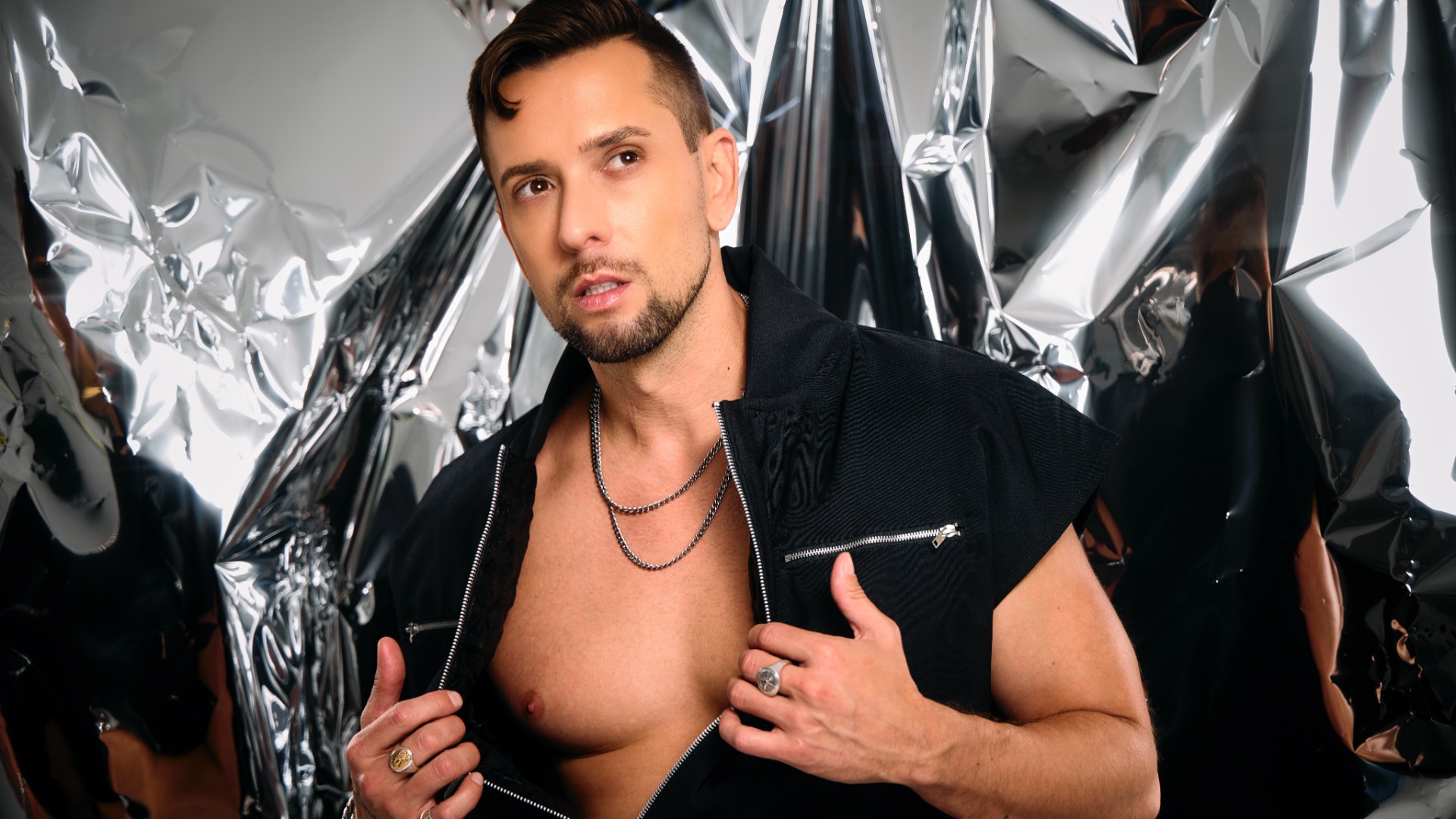
David Hernandez is not hiding behind a hook anymore. With his new single “feel it all” (out September 12, 2025 on all platforms) and an intimate, movement-driven video co-directed with longtime collaborator Johny De, the pop-soul vocalist steps squarely into the light—sober, vulnerable, and ready to tell the truth about what it takes to come back to yourself. The timing is no accident: the single arrives the very weekend Hernandez debuts a two-night lounge run at the newly reimagined Fontainebleau Las Vegas (September 12–13), where he’ll flip beloved hits into jazzy, throwback arrangements with his quartet, Midnight Bleau, and—if the moment calls—thread in the song that started as a secret and became a lifeline.
“You don’t go around hard things—you go through them,” Hernandez tells QVegas. “That’s where this song came from.”
From Notes App to Anthem
“feel it all” wasn’t meant for release. Hernandez, known nationally from American Idol Season 7 and a resume that includes The Ellen Show, The Today Show, TRL, and President Obama’s Inaugural Kick-Off Celebration with John Legend and Maroon 5, began writing the song as he began living differently. Sobriety forced the singer to stop sprinting past discomfort and start listening to what it had to say.
“I don’t keep a formal journal,” he says, “but my Notes app? That’s where all the little truths go—ideas, quotes, scraps of feeling. One day it clicked: I’ve spent decades distracting myself. What happens if I just sit with it? That was the spark.”
The song took four months—the longest he’s ever spent writing a single track—accumulating piece by piece as if the story would only let itself be told when he was ready. Verse one, a chorus, a second verse that arrived in the steam of a shower. Even a rhythmic spoken section he jokingly calls his “first-ever flirtation with rap.” The push-pull wasn’t creative block; it was fear.
“I felt exposed,” he admits. “I worried about oversharing being weaponized. Addiction and trauma aren’t pretty dinner-table topics. I kept asking, ‘Is this just for me?’”
The answer arrived when Hernandez finally played an early mix for two close friends. “They cried,” he says simply. “Their stories weren’t the same as mine, but the message landed. I thought: maybe this doesn’t belong on my hard drive. Maybe it belongs to whoever needs it.”
Saying the Quiet Part Out Loud
If the message is universal, the language is deliberately specific. The song opens with a lyric Hernandez nearly cut: “Who am I without the substances? Who am I without the sex?” It’s not coy, and that’s the point.
“Addiction is isolating; it tells you you’re the only one,” he says. “I tried to soften those lines, to find gentler words that still rhymed. There weren’t any that were honest. Keeping them was me refusing the lie. Sobriety stripped away my escape routes. It forced me to feel everything. That’s how this song was born.”
Turning Vulnerability Into A Visual
The video for “feel it all” began as a simple concept in a rented space. After conversations with trusted friend John Duran, Hernandez’s publicist Len Evans, and people in his recovery community, the idea deepened into something far more intimate: a recovery circle. Real people from different backgrounds—some queer, some not, many in recovery, all of them carrying something heavy—gathered in a warehouse to hold space for each other while the camera listened.
“I didn’t want actors-for-hire who could ‘play’ pain,” Hernandez says. “Everyone in the video connected personally to the song. They heard it first. They chose to be there.”
Co-director Johny De, who previously partnered with Hernandez on “Vices” and “I AM,” layered the circle with choreography and camera language that honors the body as an instrument of truth. “Johny brings movement and breath where words might fail,” Hernandez says. “His trust in the process made it feel special.”
The set was deliberately trauma-informed. Hernandez opened the day with a thank-you and clear consent: participate where you’re comfortable, opt out where you’re not. “There’s a party scene that implies substances,” he notes. “Some people sat that out. That was more than fine.”
By day’s end, the “shoot” had quietly become something else. Messages poured in afterward from cast members who’d made new friends or felt heard for the first time in a long time. Hernandez’s mother—whom he flew in for the video—connected with his recovery community, a full-circle moment given their shared history and the work they’ve done to understand each other. “The whole thing felt like group therapy in the best way,” he says.
To ground the art in action, the team partnered with the West Hollywood Recovery Center, whose logo appears in the video and whose network of resources will be linked to the release. Hernandez is also coordinating with national organizations so fans who watch, feel seen, and need help have a clear next step. “If someone DMs, ‘I think I need help,’” he says, “the first response is: ‘I’m glad you reached out. You’re not alone.’ Then we help them find a meeting, a hotline, a person. Connection is the antidote.”
The Queer Context
Hernandez is frank about the ways addiction intersects with LGBTQ+ life. “People still think it’s a choice—just stop, go home,” he says. “But our community carries layers of trauma: family rejection, church wounds, being ‘othered,’ the validation economy we build around sex and roles. If addiction runs in your family, the party can turn into a coping mechanism. Naming that isn’t about shame; it’s about love.”
Part of the work, he believes, is refusing to pathologize the feeling itself. “Life is awkward, uncomfortable, cringy. No one wants to sit in that 24/7,” he laughs, “but growth demands it. That’s why the song is called ‘feel it all’—not ‘feel the good parts.’”
Redefining Success, On His Terms
If “feel it all” is Hernandez’s most personal work, it also reframes what success looks like seventeen years after Idol. “As a kid, success meant fame: platinum records by 30, Grammys, the whole fantasy,” he says. “I’ve done national tours, opened for John Legend at the inauguration, released music on my own terms. That’s success too.”
Sobriety helped him “right-size” his perspective. “I love creating. I get to support myself with art. The story isn’t linear, and I’m staying out of results I can’t control. That’s new for me,” he says, smiling. “I’m type A—I want to drive the bus. But art is subjective. The job is to tell the truth and let it go.”
Bringing Honesty To The Bleau
That ethos travels with him to Fontainebleau Las Vegas, where Hernandez will perform September 12 and 13 in one of the property’s jewel-box lounges—either Nowhere Lounge or Azul Lounge (final placement TBD at press time). September 11 is a private event; the public can join him Friday and Saturday.
The show aesthetic? “Sexy and sleek,” he says. Think Postmodern Jukebox–style reinventions: sturdy pop and soul standards bent into midnight jazz, pliable grooves, and spotlighted vocals that breathe differently in a lounge than on an arena stage. His band, Midnight Blue, is a polished quartet with the elasticity to go from high-octane to hush without losing the thread. “We want people to hear something they love in a way they’ve never heard it,” Hernandez says. “And yes, I might slip in an original. When the room’s ready, intimacy belongs.”
The Work Behind The Work
Hernandez credits a blend of spirituality, a 12-step program, morning hikes, and a support network with getting him here. “Healing isn’t linear,” he says. “But music has been a bridge back to myself—and now, hopefully, to others.” That practicality extends to the creative team. With Johny De shaping the visual language, and trusted voices like John Duran and Len Evans pushing the concept deeper, the campaign around “feel it all” feels less like a splashy single roll-out and more like a community-minded offering.
It’s also a reminder of where Hernandez comes from as an artist. He’s a self-producing singer with a catalog that’s earned club love (“Beautiful” hit the Billboard Dance Top 100) and a steady stream of recent singles (“Sorry,” “Kingdom,” “I AM”) that spotlight range without sacrificing heart. The new song, and the way he’s releasing it, suggests the next chapter will be less about reinvention for its own sake and more about integration—gathering everything he’s learned and letting it sing.
Video Premiere
The video premiere of “feel it all” will debut at Rocco’s in West Hollywood on Septemberwith a DJ and live performances. He’s thoughtful about the ecosystem around the event. Meet-and-greets will be present but healthy, with boundaries that honor both fans’ feelings and his own recovery. He’s exploring ways to make the venue experience more inclusive—alcohol-free options, resource cards at the merch table, even potential lobby partnerships with local orgs on select nights. “The music is the headline,” he says, “but connection is the throughline.”
What He Hopes You Hear
Asked what he wants someone in active struggle to hear between the lines, Hernandez doesn’t hesitate. “That you’re not broken, you’re human,” he says. “That connection is possible. That help exists. And that feeling everything—yes, even the terrible parts—isn’t punishment. It’s the way through.”
He pauses, then adds the simplest thing a pop chorus can sometimes forget: “You’re not alone.”
Hernandez has always been a singer. With “feel it all,” he becomes something more dangerous and more necessary: an artist who trusts his whole story. Vegas gets the first look—and, if he has his way, the courage to feel it, too.
David Hernandez at Fontainebleau Las Vegas
Dates: September 12–13, 2025
Single & Video: “feel it all” available September 12 on Spotify, Apple Music, and all major streamers; official video premieres on YouTube