

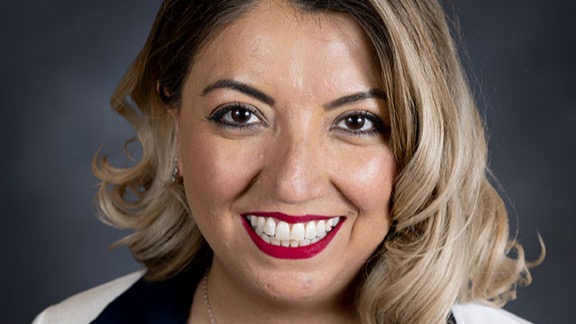
The first thing you notice when you step into the new Gavin J. Goorjian Community Health Center isn’t a stethoscope or a clipboard. It’s warmth. The lobby feels like a neighborhood café—sunlit, welcoming, a place where people linger, charge their phones, and exhale. That’s not an accident; it’s a clinical strategy. “Dignity is clinical care,” says Dr. Leana Ramirez, the Center’s Chief Clinical Officer. “We want a beautiful space for our community. Not cracked chairs and clutter. When you feel seen the moment you arrive, the healing starts earlier.”
Ramirez is a pharmacist by training and a 14-year veteran of HIV care who rose to leadership the way so many great stories start in Las Vegas—by showing up when the lights were dimming. During COVID, when much of the world went remote, she went the other direction. “I’m not a work-from-home kind of girl,” she says with a laugh. “The Center was one of the only clinics still open offering HIV testing. I started volunteering, helped stand up the PrEP protocols, and it just snowballed. I fell in love with the culture and the mission.” Today, alongside CEO John Waldron and a team she calls “fearless, fun, and absolutely obsessed with meeting people where they’re at,” Ramirez is reshaping what accessible, stigma-free healthcare looks like in Southern Nevada.
> “We don’t provide barriers—we provide access,” she says. “That’s the whole point.”
From Volunteer to Vision
The engine of her work is not a policy so much as a posture. It’s the inclination to slide a box of tissues across the desk at exactly the right time. That tiny act, she confesses, came from her own painful afternoon. “Not long ago I was at a doctor’s office, sobbing while trying to schedule a follow-up, and the person on the other side of the counter was just… clinical. If they had handed me a tissue, it would’ve changed everything. So we made that part of our standard here. The small things matter.”
Her path from volunteer to chief clinical officer reads like improvisational jazz performed during a power outage. The problems were immediate—pandemic protocols, testing infrastructure, medication access—and the solutions required speed and creativity. “We built as we went and focused on what the community needed that day,” she says. “And then the next day. And the next.” What kept her going was the joy of the work. “I love people. I love community. We get the chance every single day to change someone’s life.” She pauses, then adds, “And yes, we have a lot of fun doing it. It’s a loving place to work.”
A Las Vegas Lens
Las Vegas sharpens every clinical edge. The city’s brutal heat, housing instability, transportation hurdles, and historically poor health outcomes make access fragile. Ramirez doesn’t waste time sugarcoating it. “Our healthcare numbers are terrible,” she says bluntly. “So my job—and John’s job—is to make sure patients don’t have to think about money or red tape. Insured or not, you get care. We go find the funds. We solve for access.”
That clarity shows up in the design of services and the choreography of the patient journey, where compassion is engineered at every step. Front-desk staff greet patients by name. Providers pull their chairs closer. Clinicians translate options into plain language. “We want people to feel like they’re visiting a relative,” Ramirez says. “Stop by the café bar, look out the window, plug in your phone. We’re building an extension of home.”
Lessons from the Early HIV Era
Ramirez came of age professionally when HIV treatment often meant hard bargains. “We had to choose which side effects we could live with because we didn’t have options,” she recalls. “Those regimens kept us alive but didn’t let us live.” That memory is a compass. “Now I love being able to tell a patient, ‘You don’t even have to take a pill every day if that’s not right for you.’ We’re not making people settle anymore.”
She never forgets the debt owed to those who went first. “We were our own guinea pigs. We learned together. So when I talk with patients, I focus on education and agency. The goal is to help you become your own healthcare advocate. We don’t want you to just stay alive—we want you to thrive.”
Credentials with a Purpose
Ramirez wears an alphabet of credentials—AAHIVP through the American Academy of HIV Medicine and CSP as a Certified Specialty Pharmacist—but she treats them as tools, not trophies. “It’s not about letters; it’s about leverage,” she says. “It means I understand the meds that aren’t at every corner pharmacy. It means I know how to navigate assistance programs, adherence challenges, and side effects. Those are daily wins for our patients.”
Her pharmacist’s mindset also drives a signature policy: pharmacist-led PrEP. “I’m proud we’ve trained pharmacists statewide to prescribe and manage PrEP,” she says. “More qualified touhpoints means more protected people. It’s simple math that saves lives.”
Building the Goorjian Center
The Goorjian Center didn’t spring from nowhere; it grew out of the Arlene Cooper Wellness Center, a proof-of-concept that quickly became a lifeline. “From January to December, we logged over 2,700 encounters in just six months,” Ramirez recalls. “That number is humbling. It told us exactly how much need was out there.”
What the Goorjian Center adds is scale and depth. The model is straightforward: one door, whole-person care. Primary care sits alongside gender-affirming services and an on-site pharmacy. Showers and laundry are available. Behavioral health is integrated. Diagnostic capacity expands with mammography and DEXA scanning. “I’m particularly excited about DEXA,” Ramirez says. “In HIV care, everyone talks about bone density. Now we’ll baseline it, track it, and publish what we learn. In five years, I want to share real data on what improves outcomes.”
Transformational philanthropy made the dream concrete. A $3.5 million bequest from Gavin J. Goorjian enabled the purchase of the building; a $2.2 million grant from the Helmsley Charitable Trust equipped it. Ramirez puts it plainly: “Goorjian let us buy it; Helmsley let us outfit it. Now we’re back even—and ready to scale care.”
Quality, Safety, and the Discipline of 100 Percent
If the Goorjian Center’s heart is empathy, its spine is rigor. “We might be building the airplane in the air,” Ramirez says with a grin, “but safety and customer service are non-negotiable.” The Center runs continuous internal audits, invests in staff training, and treats every error as a systems-level opportunity to improve. The discipline shows up in the receipts: three straight years of external audits with 100 percent compliance and zero findings.
“That’s how you earn the right to innovate—by proving the basics,” she explains. “Small, measurable changes that stick. That’s how excellence is built.”
Training is exhaustive by design. Staff don’t touch a chart—or a patient—without what Ramirez jokingly calls “five million trainings,” from HIPAA and blood-borne pathogens to deep cultural competence. “Pronouns, preferred names, LGBTQ+ clinical nuances—it’s not a checkbox,” she says. “It has to live in the body. If you’re 99 percent right in that room, you failed one person, and that’s one too many.”
Why an LGBTQ+-Focused Clinic—Here and Now
The case for an LGBTQ+-focused clinic in 2025 isn’t rhetorical; it’s epidemiological. “The data are clear: our community faces unique barriers in healthcare,” Ramirez says. “We are The Center. We are the community. If we can’t deliver excellence in LGBTQ+ care, who will?” Representation in the exam room matters, and so does relevance. “I don’t need a pregnancy test if I don’t have sex with men,” she offers, matter-of-factly. “Care has to fit lives as they are.”
The built environment carries the same intentionality. “I wanted the lobby to feel like a coffee shop where you could sit next to a neighbor, or stare out the window and catch your breath,” she says. “These are not decorative choices. They are clinical interventions against stigma and anxiety.”
Prepared for the Next Emergency
The pandemic left scars—and a blueprint. The Center now maintains on-site pharmacy capacity, stocks basics like masks and gloves, and operates telehealth crisis booths to stabilize patients who arrive in acute distress. “If someone is in crisis and we can’t manage it entirely on site, we can put them in a safe space immediately and connect them to the care they need,” Ramirez explains. “Speed, safety, dignity. That’s the order.”
Security is handled with the same seriousness. “We’re a health center. No one is getting into medical records, period,” she says. On-site safety protocols cover both Goorjian and Cooper locations. “People need to feel safe when they arrive, and they need to be safe while they’re here.”
Culture, in One Word: Loving
Asked to distill the clinic’s culture into a single word, Ramirez doesn’t reach for jargon. “Loving,” she says simply. “Empathy lives here.” You can hear it in the way she describes the front desk remembering your name, or a provider moving a chair closer so you don’t feel alone, or a pharmacist lingering to answer one last question. “These are little things that add up to big things. We want people to feel like this is home.”
Mentors, in her telling, include everyone from the CEO to the patient receiving a routine injection. “I’m influenced by leaders and by the person sitting across from me who’s doing something brave for the first time,” she says. “It’s a shared and caring environment. That’s the goal.”
Metrics That Matter
If there is a dashboard light Ramirez wants glowing green, it’s customer service. “If 100 percent is possible, I want 200 percent,” she says without irony. Access to care is its twin obsession. “We will refer you elsewhere if that’s what you need. We will help you navigate the system. As long as you know we’re here, you’ll never go without options.”
That extends to the most vulnerable moments. “Sometimes the most clinical thing you can do is pull up a chair and listen,” she says. “Sometimes it’s handing over a tissue. We build those moments into our training because they are healthcare.”
What She Wants the Nervous First-Timer to Hear
Ramirez aims her final message directly to the person who is hesitating. “Just come in,” she says, warm and direct. “I promise you won’t regret it.”
She knows that walking through the door is often the hardest step. That’s why the door is so deliberately easy to find—and so intentionally kind to cross. “We don’t want you to feel like a problem to be solved,” she says. “We want you to feel like a person who belongs.”
The Work Ahead
The Goorjian Center opens with a clear mandate: turn access into outcomes. Over the next five years, Ramirez plans to publish data on bone health, adherence, and preventive care across populations that have been sidelined by the traditional system. “We’re going to put numbers behind the things we know in our bones,” she says—no pun intended. “Then we’ll teach others how to replicate it.”
There’s an audacity in that ambition, the kind of audacity Las Vegas understands. Build the airplane in the air, but keep the rivets tight. Scale love without diluting it. Measure what matters, then measure it again. “We’re not trying to reinvent healthcare just to be clever,” Ramirez says. “We’re doing it because people deserve better.”
What began with a volunteer shift in a dark season has become a blueprint for brighter days. The lights at the Goorjian Center are fully on now, and the room is filling. Ramirez looks around and sees more than a clinic. She sees a promise being kept.
As the ribbon is cut on October 3, the message is simple and profound: empathy lives here. And for a city that knows a thing or two about making people feel welcome, that may be the most Vegas medicine of all.