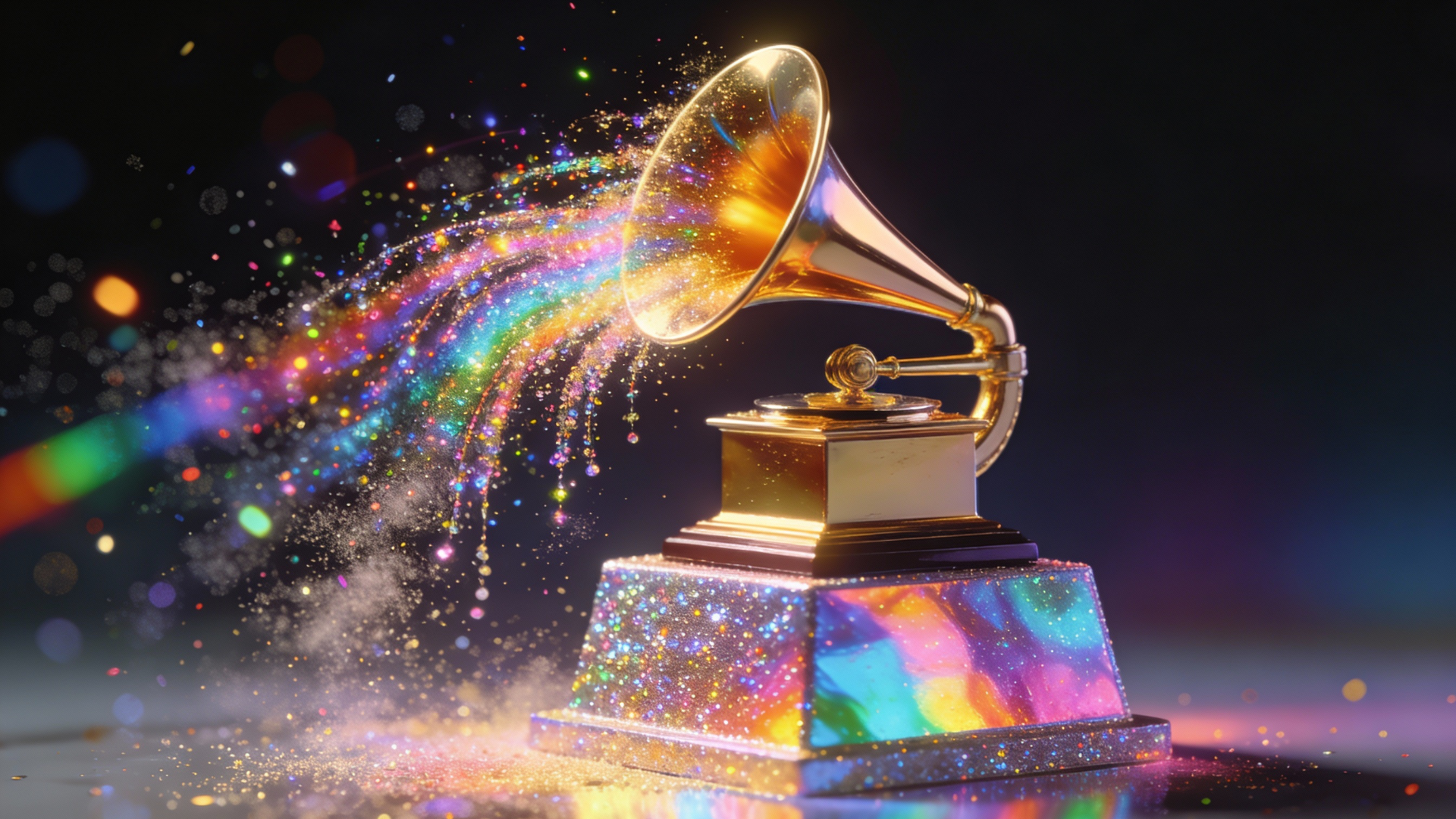
Under the lights at the 68th annual Grammys in Los Angeles, the biggest story for LGBTQ+ fans wasn’t just who won — it was *what kind of night it was*: pop maximalism, dance-floor art kids getting their flowers, and a few very pointed moments of cultural resistance woven into the celebration.
Bad Bunny’s Album of the Year win felt like a cultural (and linguistic) victory lap
The night’s top prize, Album of the Year, went to Bad Bunny for DeBÍ TiRAR MáS FOToS — a win that landed with particular force for queer Latinx listeners who’ve long treated his catalog as both party fuel and permission slip to be complicated in public. It’s a recognition that Spanish-language pop isn’t a “specialty lane” — it’s the main freeway.
The ceremony carried visible political undercurrents, with moments framed as anti-ICE sentiment and winners using the stage to make points beyond music. In LGBTQ+ spaces — where chosen family, migration, and safety are not abstract topics — that context matters. The Grammys weren’t just congratulating excellence; they were (at least occasionally) acknowledging the world outside the arena.
Kendrick and SZA turning “Record of the Year” into a moment
For Record of the Year, Kendrick Lamar and SZA won for luther — and the presentation itself was pure queer-icon theater: Cher, fresh off a Lifetime Achievement moment, handing the night’s most mainstream trophy to two artists whose work has consistently pushed boundaries.
Billie Eilish wins Song of the Year — and the sad-girl cathedral gets its hymn
Song of the Year went to Billie Eilish and FINNEAS for WILDFLOWER, which continued the night’s theme: intimacy can be arena-sized if the writing is sharp enough.
Billie’s work has long lived in the Venn diagram of queer-adjacent fandoms — the kids who grew up online, the kids who built identity from playlists, the kids who learned feelings are allowed. A major “songwriting” win isn’t just industry validation; it’s a nod to the kind of emotional world-building that LGBTQ+ listeners often treat as survival skill.
Best New Artist goes to Olivia Dean — a classic “watch this space” moment
The Grammys’ Best New Artist went to Olivia Dean, with the moment made even more pop-cultural by the handoff: she accepted the award from Chappell Roan.
Even if you’re still catching up, this is exactly the kind of Grammys move that queer audiences clock early: a rising artist with real vocal chops, real taste, and a trajectory that feels more “career” than “viral moment.” It’s not a coronation — it’s a spotlight being aimed before the rest of the world fully notices.
Gaga’s pop-field domination: camp wins, dance wins, the fans win
If you want a clean “LGBTQ+ joy” headline, here it is: Lady Gaga won Best Pop Vocal Album for MAYHEM.
And she doubled down in the dance-pop lane, taking Best Dance Pop Recording for Abracadabra — a title that sounds like it was designed specifically to be screamed in a club bathroom mirror at 1:47 a.m. Gaga’s wins read less like a comeback and more like a reminder: queer pop isn’t a “genre,” it’s an infrastructure. It’s the system that teaches a community how to celebrate itself loudly.
Dance/electronic stayed weird (compliment)
In the categories that tend to mirror nightlife culture most directly, the Grammys made some choices that will play well in queer spaces.
FKA twigs won Best Dance/Electronic Album for Eusexua — a win that feels like a love letter to the art kids, the fashion kids, the after-hours kids. Meanwhile Tame Impala took Best Dance/Electronic Recording for End Of Summer.
R&B with heart — Kehlani’s win lands where it should
One of the most warmly received wins for queer fans came in R&B: Kehlani won Best R&B Performance for Folded.
For LGBTQ+ listeners, Kehlani’s catalog has always been more than “good songs” — it’s emotional representation that doesn’t flatten desire into clichés. Seeing that recognized on a major stage felt less like a surprise and more like something finally catching up to reality.
Broadway got its moment, too
The night also delivered for theater gays: Best Musical Theater Album went to Buena Vista Social Club (Original Broadway Cast). It’s a category where “winning” often means “getting discovered by people who don’t already live in Playbill-land,” and that’s always a fun ripple effect.
A final note: Trevor Noah’s goodbye lap
Host Trevor Noah closed out what the show framed as his final turn at the Grammys — and for once, an awards-show “era ending” actually felt real. The vibe of the night (glamour + edge, joy + reality) is exactly the balance queer audiences tend to demand: celebrate us, but don’t pretend the world is fine.
Let’s just say the QVegas crystal ball was serving looks, not serving accuracy. We went 7-for-16 — which is a perfectly respectable batting average if you’re swinging a feather boa instead of a spreadsheet — and honestly, we nailed the categories that matter most to the gays with functioning playlists: Gaga in Pop Vocal Album, “Abracadabra” in Dance Pop, FKA twigs in Dance/Electronic Album, Kehlani in R&B, and even the full-on Broadway diva moment with “Defying Gravity.” The top three, though? Honey. Record, Album, and Song said “thank you for your imagination” and promptly walked right past our table like we were trying to hand them a flyer on the Strip. Still: we didn’t lose — we simply curated a more fabulous alternate reality.