Sunday’s Super Bowl LX at Levi’s Stadium in Santa Clara wasn’t just a football game—it was a three-act mini-festival about identity, spectacle, and who gets to be “America” on the biggest stage in the country. From the opening guitars to the halftime theater, the night’s performances carried a through-line that felt especially loud to LGBTQ+ viewers: visibility doesn’t always arrive wearing a rainbow cape. Sometimes it shows up in a navy suit, an ASL interpreter, a Spanish-language chorus shouted into the sky, and a pop star cameo that turns the whole field into a dance floor.
The pregame musical slate set the tone: polished, high-wattage, and culturally intentional. Charlie Puth handled “The Star-Spangled Banner,” Coco Jones delivered “Lift Every Voice and Sing,” and Brandi Carlile took “America the Beautiful” and made it feel personal—like a letter you keep rewriting because you’re still trying to believe in it. Carlile’s performance landed with extra weight because it didn’t pretend the country is already finished becoming itself. She leaned into tenderness rather than bombast, and the inclusion of American Sign Language interpretation by Julian Ortíz made the moment feel more expansive—patriotism as something you can share, not something you gatekeep. For queer audiences who’ve spent lifetimes being told to “love it or leave it,” Carlile’s presence read as a third option: love it *enough* to demand better.
Then came Green Day, dropping into a medley rooted in *American Idiot*—an era-defining album for anyone who grew up learning politics through protest songs and late-night MTV. Even if the band kept the sharpest edges slightly sanded for broadcast, there was still something deliciously subversive about hearing that familiar bite in the minutes before the NFL’s most corporate spectacle. For LGBTQ+ viewers, Green Day has always been a reminder that mainstream doesn’t have to mean sanitized. The band’s energy functioned like a palate cleanser before the pageantry—proof that a little mess, a little critique, and a little sweat still belong on the field.
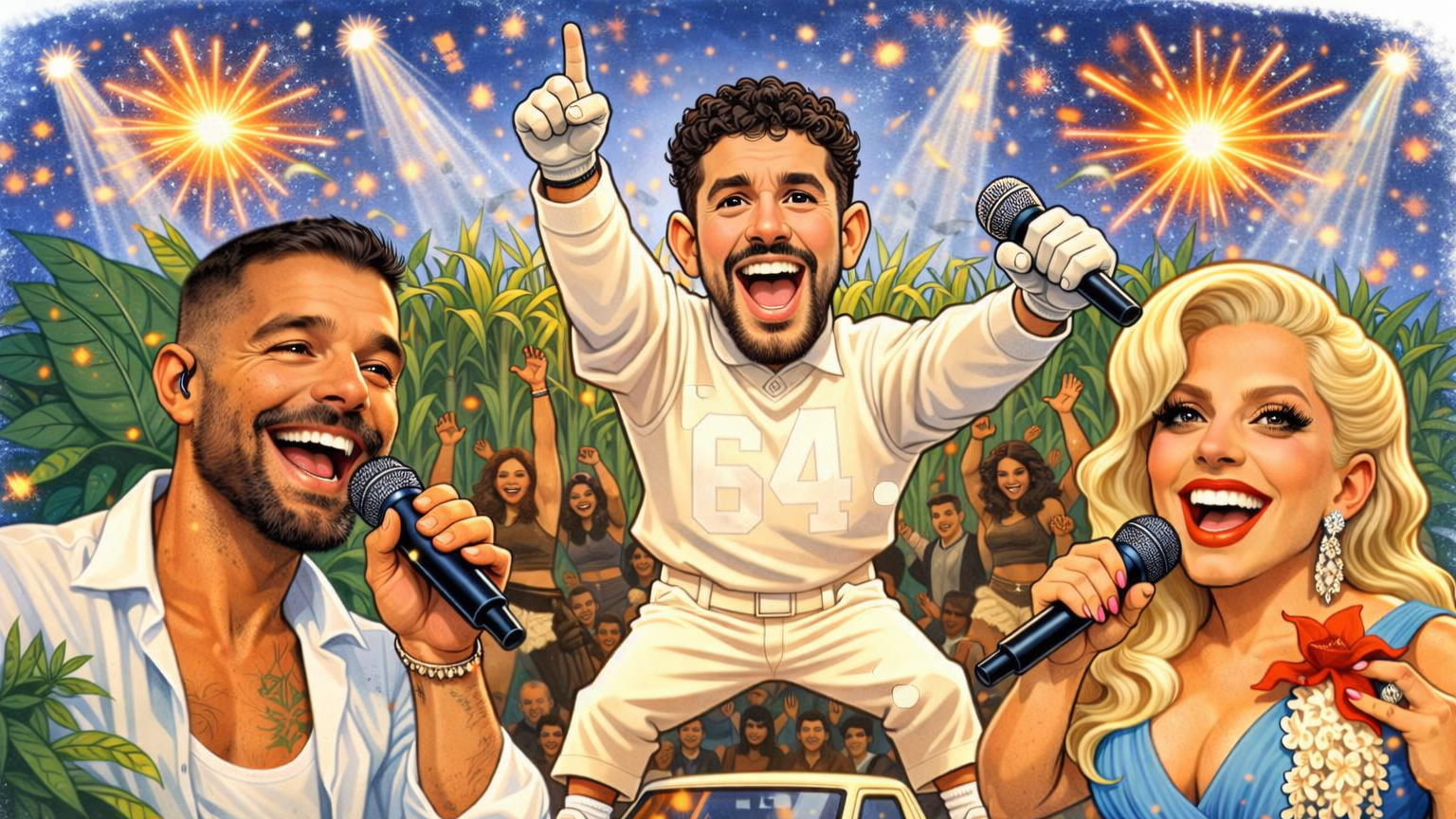
But halftime is where the night turned from “big show” to “big statement.” Bad Bunny’s Apple Music halftime performance played like a love story to Puerto Rico and to the broader Latinx diaspora—part block party, part stage musical, part cultural thesis. Visually, it was maximalist and cinematic—sets shifting like scenes, choreography that moved in waves, and symbolism that didn’t ask permission to take up space. And that’s exactly why it clicked for queer audiences: it wasn’t just entertainment; it was self-definition at scale.
Bad Bunny didn’t merely headline—he curated a community. The guest appearances (including Lady Gaga and Ricky Martin) amplified the sense that this halftime show wasn’t built around a single star so much as a shared stage. Gaga’s presence in particular landed like a wink to the millions of LGBTQ+ fans who treat her as both pop icon and emotional support glitter. When she shows up, it’s never just a cameo—it’s a signal flare: the weird kids are invited, too. And Ricky Martin’s inclusion carried its own generational weight, bridging eras of Latin pop stardom with a reminder that queer Latin excellence isn’t a niche; it’s foundational.
One of the most queer-coded joys of the night was how the halftime show refused to translate itself down for anyone. Multiple outlets noted the Spanish-forward set as historic in its own right, and the overall message—ending on unity across the Americas—felt like a direct rebuttal to the idea that “American” has only one language, one look, one story. That’s the thing LGBTQ+ viewers clock instantly: the politics aren’t always in the lyrics. Sometimes they’re in the simple audacity of taking the center and not shrinking.
And yes, it was also just *fun*. There were spectacle beats designed to become instant group-chat gifs—big choreography, big reveals, and the kind of theatrical pacing that understands the halftime show is basically drag adjacent: costume, concept, emotional arc, then a mic-drop exit. Even the night’s broader presentation—ASL on the broadcast moment, the crossover of genres, the embrace of cultural specificity—felt like the NFL inching, however imperfectly, toward a bigger tent.
Super Bowl LX’s performances didn’t hand LGBTQ+ viewers a single “pride moment” to clip and move on. Instead, it offered something more lasting: a night where queerness could be present without being the only headline. Brandi Carlile turned patriotism into a question you’re allowed to ask out loud. Green Day reminded us that disruption still belongs in the mainstream. Bad Bunny made halftime feel like a cultural homecoming—one with room for everyone who’s ever been told they’re “too much.”
And that, honestly, is the dream: not just representation, but ownership. Not just being included, but being undeniable.