

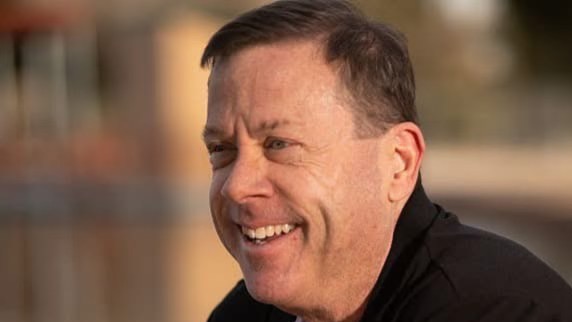
Ron Quinn
October 14, 1958–September 7, 2025
How a gentle force of nature taught Las Vegas to love louder, show up harder, and build chosen family that lasts
There are people who seem to carry a room with them—who arrive and suddenly everything gets warmer, easier, more possible. In Las Vegas, one of those people was Ron Quinn. He was a board president, a volunteer whisperer, a connector of organizations that didn’t know how much they needed one another—and, to hundreds of us, he was family. Mentor. Gay dad. Best friend. The person you texted first when you didn’t know what to do, and the one who made you laugh so hard the hard parts of life briefly forgot your name.
Ron passed peacefully in his sleep earlier this month after a difficult battle with tongue cancer, compounded by years of living openly and bravely with HIV and the unrelenting pain of trigeminal neuralgia. The relief is that his suffering is over. The reality is that his absence is immeasurable. To honor his leadership and love, Aid for AIDS of Nevada (AFAN) will dedicate this year’s Black & White Party to his memory on Saturday, Sept. 20 at KAOS Nightclub—a tribute planned to include remarks, a video montage, and a moment of remembrance before the night lifts off in the Wild West theme he would have adored organizing, then out-organizing.
But Ron’s story is bigger than titles and tributes. It’s made of moments—birthday chocolate-raspberry cakes baked from scratch nine years in a row; summers poolside where advice felt like sunshine; volunteer meetings that became family dinners; and a laugh that was, as one friend said, “louder than life.”
One of those stories belongs to Sean VanGorder, who was asked by Ron’s son Ronnie to speak on behalf of the family’s web of love—legal, chosen, adopted, matrimonial. In telling us what Ron meant to him, Sean helps explain what Ron meant to Las Vegas.
“Every male father figure in my life failed me,” Sean says quietly. “Ron was the only one who showed me what it meant to have an older, more mature male figure really believe in you. He supported me in ways I had never experienced. He taught me to believe in myself because he believed in me so much.”
Then Sean smiles, because grief is a mirror that remembers joy. “And then, at a certain point, we moved from father figure to best friends. That shift was special. We’d go get our nails done and just be girlfriends. Some of my favorite, most ridiculous, most honest memories are right there—no pedestal, no pretense. Just us.”
He had the most remarkable talent for finding you—what you cared about, what you needed to grow—and then making you feel seen while nudging you toward your bigger self. It’s how he built volunteer culture that actually worked.
The volunteer whisperer
Many first met Ron through the Human Rights Campaign. He served as volunteer coordinator, but the title doesn’t come close to capturing the alchemy. Ron didn’t recruit volunteers; he made family. He opened his home to meetings and made newcomers feel like honored guests before they’d stapled a packet or set a table. He asked about your life, remembered the exact thing you said mattered, and gave you a job that fit your purpose. And then he did it again next week.
“Ron created a format I don’t think other cities were doing,” Sean explains. “It was deeply connected. He hosted meetings at home. If you were a stranger, he found a way to make you feel special and acknowledged. I learned how to be a volunteer—and a volunteer leader—from him. Other cities tried to imitate it, but it was never quite the same.”
Long before “collaboration” became a grant-writing buzzword, Ron was dismantling silos by hand, making HRC work alongside queer organizations, homeless-youth shelters, and service providers who rarely sat at the same table. When other leaders got promoted away from the grind, Ron kept a foot in it—loading cars, chopping vegetables, cooking holiday meals for youth at The Center, showing up for the quiet jobs no one photographs. Even after he stepped away from official leadership, you’d find him elbow-deep in the work, glancing up with that grin that dared you not to pitch in.
“Ron Is Love”
Latoya Holman said it simply: “Ron Quinn is love.” From the first meeting—those steady blue eyes, sincere and warm—to the last days of text messages and hospital visits, everything he touched was shaped by love. He built a volunteer program out of backyard gatherings and made it national by making it intimate. He inspired a decade of leaders who are now inspiring another. He offered his professional skills freely because he could and because it mattered. He believed we are united in the pursuit of a self-actualized life—and he believed volunteers could help people find it.
Family, by every name that matters
If volunteerism was the way Ron moved through the world, chosen family was the home where he set his bags down. Ask anyone in his orbit and you’ll hear the same story with different proper nouns: Ron saw me. He stood next to me. He made space for me at the table and then handed me the carving knife.
For Sean, that story includes the day he met Ron’s son Ronnie opening his first account—two parallel lives that intertwined when Ron later adopted Ronnie. It includes Patrick, Sean’s partner of 12 years—and soon, finally, his husband. And it includes their friend Cristina DeGioia, who became Ron’s fierce hospital advocate when health systems needed a translator who wouldn’t blink.
“The four of us were all in, all the way through the end,” Sean says. “We stayed at Ron’s house together. We told stories. We made a shared Apple photo album so we could laugh and remember. We decided that the connection Ron provided for us is our responsibility to keep. We have to stay close. We have to talk. We have to show up.”
There’s a road-trip story they tell a lot now—a van barreling to San Diego for the HRC Gala, packed with friends, and Ron insisting on driving even though everyone knew he was a terrible driver. “We were terrified,” Sean laughs. “We’d give anything to be in that van again.” The punch line is less about brakes than about time: what it feels like to recognize you were in the good old days while you were living them.
Ron built his life around those days. When realtor John Hildebrant found Ron the home where so many weekends unfolded, Ron’s only non-negotiable was space to entertain “my kids.” Pool days and movie nights turned into birthdays and holidays. Advice turned into consent—“Do what makes you happy,” he’d say, and you’d feel your shoulders drop. For Sean and Patrick, who are marrying in three weeks, the joy feels braided with absence. Ron was supposed to give them away. When they postponed their wedding too many times, he teased them for “kicking the can down the road.” They hear him now: Get married. Keep living.
“He was the one we’d call to ask how to get through this exact moment,” Sean says. “So we’re trying to be each other’s Ron.”
Courage that made room for other people’s courage
Ron led with compassion, but it wasn’t soft. It was courageous. It wasn’t easy to be open about HIV when stigma remained stubborn. He carried that truth carefully for years and then began to share it, especially through his work with AFAN, because he knew that his honesty could be a bridge for someone else. He knew what the 1980s did to our community. He knew how trauma isolates and how connection saves.
Last year, when he shared news of his cancer diagnosis, he did it in the same steady voice: Here is what’s happening. Here’s how I’m facing it. Here’s why my fitness and diet matter. Here’s the plan for reconstructive surgery. Here’s where humor still fits—I might even get a “no extra charge” neck lift. He wrote like the resilient Libra he joked about being, the one with a phoenix tattoo for a reason. He told us not to wait to get checked out if something felt off. He told us, with a wink, that he seemed to have nine lives.
The hard part of that story is that the disease didn’t play fair. The brave part is that Ron never stopped meeting the days with the same values he lived in health: show up, love harder, feed people, believe in something bigger than yourself.
A city says thank you
In the swirl of grief, rituals help. AFAN’s decision to dedicate the Black & White Party to Ron feels exactly right—an event he helped elevate into a signature celebration returning on Sept. 20, now wearing its Wild West theme as a reminder that community rides out together. There will be a special on-stage moment for Ron, and it will be loud, because this city understands who built so much of its quiet strength.
Then, on November 1, friends, colleagues, and family will gather at The LGBTQ+ Center of Southern Nevada for a community celebration Sean is lovingly calling “The Ron Reunion.” The name matters. Ron would not have wanted a somber affair that looked at the floor. He would have wanted music, clinking glasses, people who haven’t hugged in years, and the guiding philosophy is simple: community, connection, reflection—and joy.
There will be private rituals, too. Honoring Ron’s wishes, his family chose cremation, with plans to scatter his ashes on the California coast he loved. Those closest to him selected keepsake urns, including a blue-and-yellow heart that mirrors the HRC colors—a small, perfect emblem for a man who made equality not just a cause, but a dinner-table value.
The lesson of sharing what you love
Sean has been thinking about something that may resonate for anyone who loved Ron. When someone makes you feel singular—understood in a way you’ve never been understood before—it can be disorienting to remember you aren’t the only one. “So many of us felt like we were his person,” Sean says. “It can be confusing to share that. But that’s the greatness. He made hundreds of people feel like the only one. The kind thing—the Ron thing—is to celebrate that, not compete with it.”
If you’ve ever felt that twinge, know this: it’s proof of the magic he practiced. It means you were loved well. It means you’re part of the family he built on purpose, across bloodlines and beyond categories.
What he left us to do
Ron’s legacy isn’t theoretical. It’s a to-do list disguised as a hug.
Keep showing up. When a friend is in the hospital, be their advocate. If you don’t know how to navigate, find the person who does—someone like Cristina did for Ron—and be there, fully. When an organization needs volunteers, don’t just sign up; bring two people with you and feed them afterward. Host the meeting. Make it personal.
Keep the rituals. Bake the cake. Start the group text. Make the shared album. Tell the story of the San Diego van and the terrible driving and how, God, you’d risk it all to be car-sick again with those exact people. Go for pedicures. Be “catty bitches” with your best friend who used to be your dad and is still both, because life is richer when we blur the lines that don’t need policing.
Keep your promises. If you’ve been “kicking the can down the road,” tie the knot. Launch the project. Book the flight. Schedule the check-up. Take the photo. Write the note. Love is a verb, and regret is an editor you should never hire.
And keep faith—in each other, in the future, in the stubborn goodness that built this city’s glittering, generous queer community long before a press release noticed. That faith is how Ron lived. It’s how he asked us to carry him forward.
A final thank-you
There is one more story that says everything. Years ago, volunteering side-by-side, Sean thanked Ron with a pop-culture shorthand: “Thank you for being the Mr. Miyagi to my Daniel-san.” Later, they joked that he was Mr. Miyagi to an entire HRC meeting—a teacher not of karate, but of kindness, constancy, and craft.
Las Vegas was Ron’s dojo and his dinner table. He taught us how to care for people in the language they hear best. He taught composure in crisis and how to laugh in the waiting room without apology. He taught that giving back is less a duty than a pleasure. And he taught that if you build a family out of volunteers, they will show up for the work—and for each other—long after the sign-in sheets are recycled.
Safe passage, friend. Thank you for changing our lives for the better. We will never forget you.
And to everyone who felt like Ron’s “only one”: you were. We all were. That’s the miracle he left us—and the standard he asked us to meet for one another.