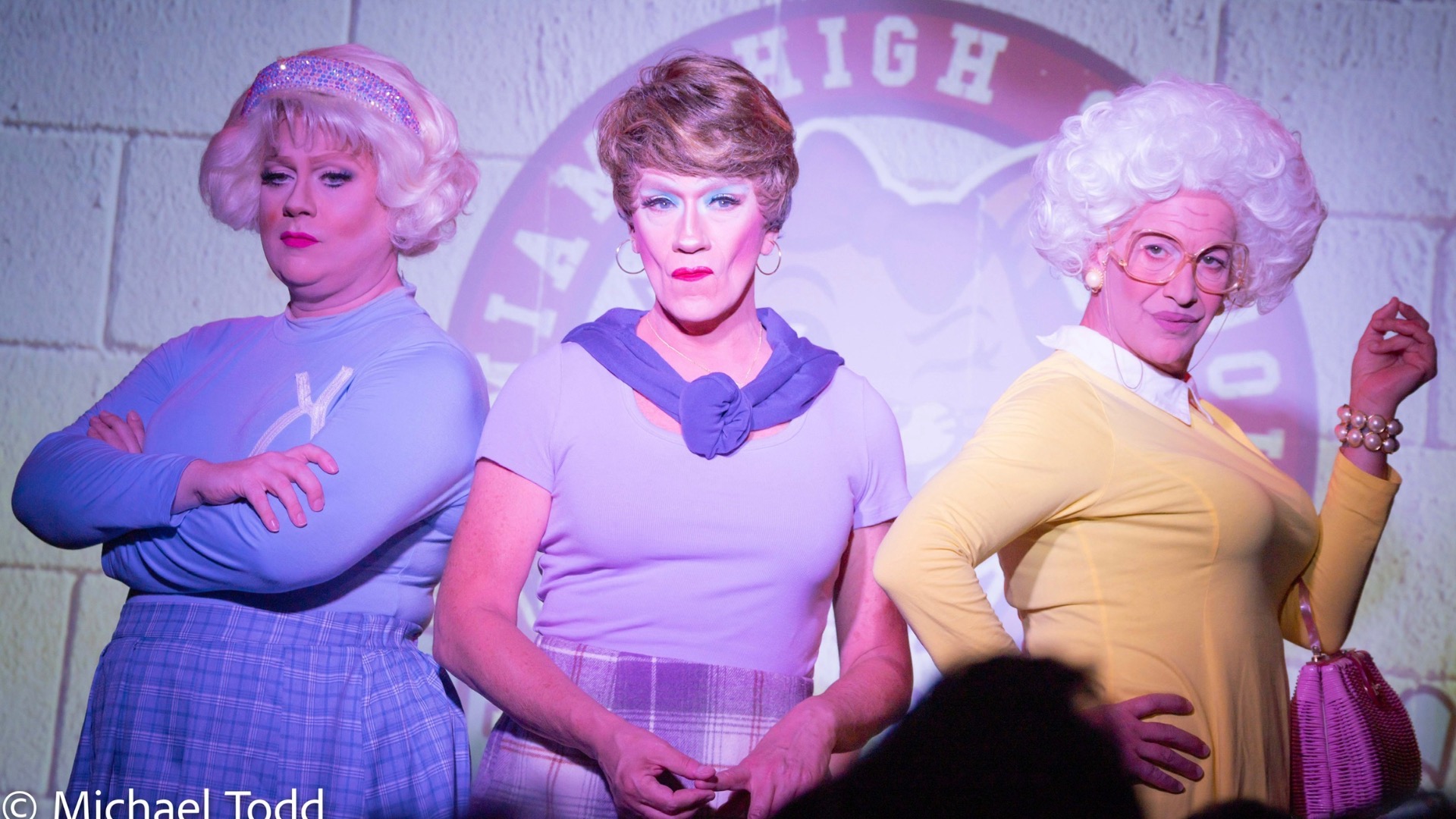
Jamie Morris has been delighting audiences with cleverly crafted parodies for many years, transporting beloved characters from film and television into utterly unexpected scenarios. His newest creation, The Golden Mean Girls, is a collision of two pop culture powerhouses: the classic sitcom The Golden Girls and Tina Fey’s comedic masterpiece, Mean Girls. In a conversation with QVegas Magazine’s Garrett Pattiani and Russ White, Morris shared how this unlikely fusion came to life, why he’s found a home for his plays in Provincetown’s lively theater scene, and how his love of drag-driven comedy has evolved over the course of his career.
A TITLE WORTHY OF A MARQUEE
Every show Morris creates begins with the same spark: a catchy title. He freely admits that “when I’m premiering a show in Provincetown, you have to hook them with the title—that’s half the battle.” Morris was hesitant for years to craft a Golden Girls parody, in part because it’s such revered material and also because “back in the day, you would get a cease and desist.” As time passed and the licensing world relaxed a bit, Morris still asked himself, “What new angle can I add to something that is so perfect and still popular 40 years later?”
The lightbulb moment came one random day, courtesy of Morris’s partner, Christopher. “He just said three words: Golden Mean Girls,” Morris recalls. “It was immediately a great title, and I started processing it, thinking, ‘Oh my God, I think this might be it.’”
BRINGING MEAN GIRLS TO MIAMI
Next came the real puzzle for Morris: blending the dynamic, senior-living world of The Golden Girls with the teenage drama of Mean Girls. As Morris struggled with the question of how to merge these two iconic sets of characters, he toyed with the idea of Blanche going back to high school and competing with Cady for Aaron Samuels. But then the creative solution hit him, quite literally, on a treadmill.
“Cady comes to Miami to live with the Golden Girls because Dorothy used to be friends with her parents back in Africa,” he says. “They have that whole moment where they think she’ll be Black, echoing the famous joke from Mean Girls, and then they put her to bed by singing ‘Mr. Sandman’—that’s all straight from the original show. Then I thought, what if it’s all a dream? In a dream, you can do anything you want!”
That simple tweak opened all kinds of possibilities. Once Morris allowed the premise to unfold in Cady’s sleeping imagination, the script fell into place. The result is equal parts Golden Girls banter and deliciously catty Mean Girls references.
FROM REDESIGNING WOMEN TO DEVIL WEARS PAYLESS
The Golden Mean Girls is far from Morris’s first foray into parody. Going back to 2003, he has created a string of crowd-pleasing shows, including Silence of the Clams (a spin on The Silence of the Lambs), The Devil Wears Payless (a fresh look at The Devil Wears Prada), and Redesigning Women (paying homage to the sitcom Designing Women). “I always say you can’t parody something you don’t love. You have to feel passion for the source material,” Morris explains.
He typically “cuts his teeth” in Provincetown, affectionately known as P Town, because it’s the perfect environment for testing new shows. Each summer, P Town explodes with a vibrant cabaret and theater scene, and the process of “barking” (hawking your show to passersby) means audiences discover you in a way that’s direct, spontaneous, and electric. “It’s both incredibly humbling and thrilling,” Morris says. “If I can get an audience there, I can take the show anywhere.”
Yet, for Morris, there’s also great joy in bringing his work home to Las Vegas. “All my friends are here. When Troy [Heard] at Majestic Repertory Theater offers me a week, it’s fantastic to show off what I’ve been working on,” he says. “Las Vegas’s indie theater scene is thriving, but we’re still overshadowed by the Strip. It’s great to bring a fun show for the locals.”
CASTING THE DREAM TEAM
For The Golden Mean Girls, Morris is reprising his role as Blanche Devereaux, a character whose enduring appeal he relishes. “I’ll just say I play Blanche, and leave it at that,” he teases. The rest of the lineup features a mixture of new and returning performers from his Provincetown run. Jonathan Joseph Peters, known from Project Runway, plays Rose Nylund; Michael McAdam (Payton Saint James) takes on Sophia Petrillo; and Jason B. Schmidt—a Bea Arthur impersonator with the Golden Gays troupe—brings Dorothy Zbornak to life. The role of Cady is played by Katy Heard, and local actor Ray Winters will be playing Aaron/Damian.
Their comedic challenge is twofold: they must stay faithful to the iconic personalities of The Golden Girls, while also dropping references and lines from Mean Girls that audiences will eagerly await. Morris knows that in parody, there are lines you simply can’t leave out. “If I didn’t include ‘Shady Pines, Ma,’ or some version of a Rose Saint Olaf story, fans would be furious,” he says with a laugh. The same goes for Mean Girls quotes such as “That’s so fetch,” “On Wednesdays we wear pink,” and the beloved “She doesn’t even go here!”
EMBRACING SMALL SPACES, BIG WIT
Part of Morris’s success in P Town is tied to the famously small scale of venues like the Post Office Cabaret, which he affectionately calls a “postage stamp theater.” Rather than use huge set pieces, Morris relies on creative props and video projections to represent everything from a Florida lanai to a high school cafeteria. “When you tour,” he explains, “you can’t lug giant set pieces around. An easy solution is a single wicker chair with that classic Golden Girls palm-print cushion, and maybe a kitchen table. Then let the projection and the actors do the work.”
This minimalistic approach works well at Majestic Repertory Theater, which also has an intimate stage. “It forces you to focus on the performances and the script. Small spaces can create real magic if you’re willing to lean into the limitations,” Morris says.
ART IN A DIVISIVE CLIMATE
Amid the fun of man-in-a-dress comedy, Morris and his fellow performers are acutely aware of the heightened political tension around drag performances. Some U.S. states are passing laws that limit or explicitly ban drag artists from performing in certain venues, or conflate drag with acts meant to harm children. Morris is adamant that this pressure doesn’t dissuade him.
“I don’t worry about it, because if anything, now is the time to fight harder,” he says. “Part of that fight is just putting on a great show, an hour of silly drag, so people can enjoy something joyous and leave the world behind for a moment. That’s our superpower as artists. We may not change legislation overnight, but we can offer laughter and escapism. That’s a powerful response.”
FUTURE PROJECTS AND GOLDEN DREAMS
Like many creative minds, Morris’s brain is bursting with new title ideas—many of which keep “Golden” as a pivotal theme. “I’m thinking about Golden Spice Girls, or maybe Golden Mean Girls 2, just to see what happens next,” he muses. He also toys with the idea of a second installment of The Devil Wears Payless, should the real-world The Devil Wears Prada sequel film make a splash.
However, he admits that time often needs to pass before a piece of pop culture transforms into prime parody material. “It has to live in the bones of the people who love it,” Morris remarks. “Mean Girls, Devil Wears Prada, and The Golden Girls are all so quotable. You need that kind of instant recognition to really hit people’s nostalgia and comedic sweet spots.”
DRAG AS COMEDIC HIGHLIGHT
Although Morris’s parodies usually feature drag, he’s open to all kinds of casting. Earlier in his career, he often used all-male ensembles, but these days, he wants to widen his casting pool. “I like having a cis female actress walk onto the stage surrounded by larger-than-life drag characters,” he explains, referring to the new Cady Heron in The Golden Mean Girls and the Andy Sachs in The Devil Wears Payless. “It really heightens the comedy, makes her the fish out of water in a drag-driven universe.”
He cites Charles Busch and Charles Ludlam as key inspirations—the godfathers of so-called “ridiculous theater,” along with comedic icons like Carol Burnett. That sense of comedic tradition, forging onstage illusions and celebrating camp, energizes everything Morris does.
HOMEGROWN PRIDE
Though Morris’s usual rearing ground is Provincetown, he’s thrilled to bring this latest parody to Las Vegas. The chance to perform in front of friends and local theater fans is a big deal. “Everything can be so Strip-centric,” Morris says. “I love that we have places like Majestic Repertory Theater, where we can produce something edgy, silly, and homegrown for the community, separate from the massive Vegas productions.”
Morris openly credits Troy Heard, founder of Majestic Repertory, for supporting local indie theater artists. Working with Heard also means Morris can cast local talent alongside his seasoned P Town crew.
LAUGHTER AS THE BEST MEDICINE
As The Golden Mean Girls prepares to make its mark with just four special performances at Majestic Repertory Theater, Morris reassures fans that they’ll get everything they ever loved from both The Golden Girls and Mean Girls: the gentle barbs, the iconic lines, the comedic heartbreak, and of course, some sensational one-liners delivered in wigs and heels.
“We want people to have fun,” he says. “It’s drag, it’s parody, it’s silly, and I hope it’s an hour of laughter and a break from everything else going on in the world. That’s what I strive to create every single time.”
And with that, Morris smiles, reflecting the spirit that defines his work. Political intensity may rise and fall, but as he points out, sometimes the best antidote is simply to put on a fantastic show and, in Blanche Devereaux’s confident drawl, invite the audience to sit back and enjoy. After all, even in the face of the harshest realities, there’s always comfort—and comedy—to be found among the Golden Girls.