
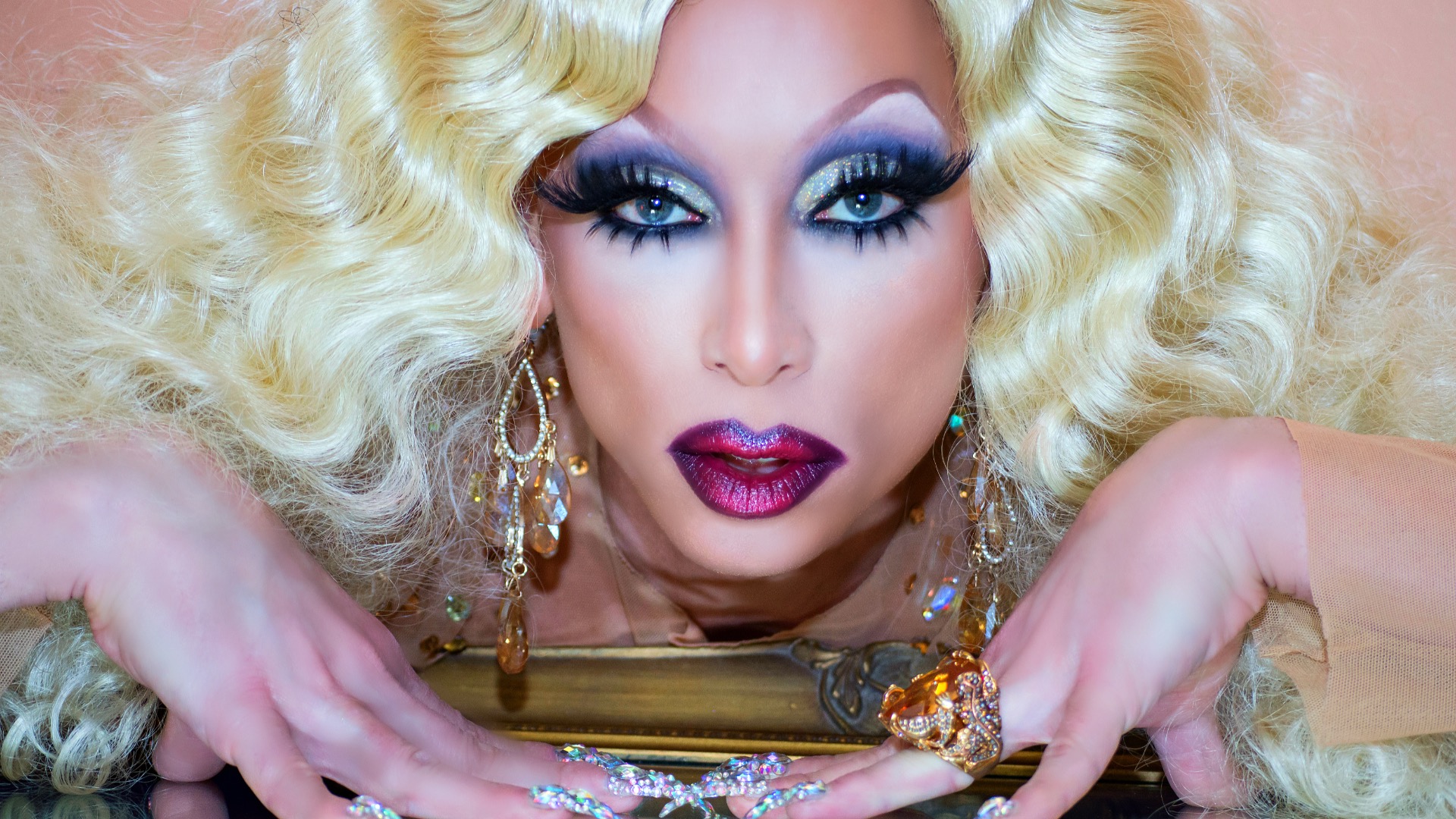
Las Vegas has never been short on spectacle, but on March 14, Gipsy Nightclub will host a performer who’s been turning nightlife into a full-contact comedy sport long before drag became a mainstream industry. Sherry Vine—self-described “drag legend,” and, in her words, “a nice way of saying old”—is bringing her newest show, *Dirty Blonde*, to the city for an evening built on parody, storytelling, and the kind of fearless humor that has kept her a fixture in drag for more than three decades.
“I’ve been performing in drag for 36 years now,” Vine says. “This is year 36.” In an era where a drag career can be launched in a single viral clip, her longevity reads like something rarer: proof of craft. Over the years, Vine has become synonymous with a particular style—highly produced comedy parodies that twist familiar songs into sharp, silly, unapologetically adult punchlines. Her shorthand description is disarming and perfectly on brand: she takes songs “that everybody knows and loves and ruins them.”
Ruins them, yes—but with precision.
Vine’s approach is “dirty, not vulgar dirty,” she explains—more playful than mean, more wink than shock. It’s the difference between crude and comedic, and it’s a line she’s made a career walking with confidence. “For some people who are a little apprehensive,” she says, “I always say it’s very silly and dumb and funny.”
From grad school project to calling
Like many artists, Vine didn’t arrive at drag through a straight line. She discovered it through an assignment. While in grad school, she was tasked with creating three characters based on real people she’d spent time with. She chose a “super straight kind of Wall Street businessman,” a “nerdy artistic director from the Pee-wee Herman show,” and—almost as a wild card—a drag queen in West Hollywood.
The first time she transformed into that third character, something clicked. “Literally bells and whistles went off,” she recalls. “And I felt, ‘Oh, this might be something I should explore.’”
What began as a one-off—she intended to perform a single song, “Black Coffee”—quickly “spiraled,” she says. “I felt, ‘Oh, I think this is my calling.’” She had moved to Los Angeles with movie-star dreams. Instead, she found her real lane under stage lights, in wigs, surrounded by laughter.
Finding her people, finding her style
When Vine began performing as Sherry Vine around 1990, drag inspiration wasn’t something you scrolled into; it was something you hunted down. “This was before the internet and phones and stuff,” she says. “You actually had to really search out and research other performers.”
One early touchstone came via the film *Mondo New York*, which introduced her to artists like Joey Arias, John Sex, and Phoebe Legere. Arias, in particular, left a mark. “That’s the first time… I was like, ‘Oh. That seems like something I would like to do.’” Arias remains, she says, both mentor and close friend to this day.
Other influences cemented her path away from the traditional “beaded gown lip-syncing to Whitney Houston” model—drag she respects and enjoys, but didn’t see as her own. Seeing performers like Lady Bunny and Vaginal Davis helped clarify what she wanted: comedy, absurdity, personality-first drag. “They were doing a different kind of drag,” she says. “Just being stupid and funny.”
And at the heart of Vine’s comedic DNA is an icon outside drag altogether: Carol Burnett. “I grew up watching Carol Burnett,” she says. “It’s been my biggest influence.” Vine describes her own drag as existing “under the umbrella of Carol Burnett,” albeit with a bawdier edge. When developing new material, she returns to a guiding question: “What would Carol do?”
Staying relevant by staying specific
After decades of performing, Vine credits her endurance to focus more than reinvention. “I’ve stuck to a very laser-focused character,” she says. That character—“this kind of Las Vegas sex girl, sex kitten, but comedy”—was present from the start. Parodies were, too. She admits there were moments where she considered a dramatic pivot, “something completely different,” but it never felt authentic. “It just didn’t work,” she says. “It didn’t have the same authenticity.”
In other words: the brand isn’t a marketing strategy. It’s the most honest version of what she does best. “I’m not a dancer. I’m not going to sing a Celine Dion song. I can’t sing pretty,” she says, bluntly. “Let me stick to what I know.”
What to expect from *Dirty Blonde*
If you’re arriving at Sherry Vine for the first time, *Dirty Blonde* is designed as a clean entry point into her world—clean in structure, not in subject matter. Vine promises what her fans already count on: nonstop laughter, a tight set list, and the familiar themes she jokingly calls her signature. “Yes, it’s sometimes the same themes,” she says. “I’m singing about poop and penis. But I try to find new and creative ways to work within those themes.”
Musically, *Dirty Blonde* spans genres: “Broadway… disco… some ’80s pop music.” There’s also new material tied to modern chart culture, including “a new Taylor Swift parody.” She namechecks additional influences in the mix—Tina Turner and U2 among them—suggesting a show built like a playlist for people who love pop history as much as they love punchlines.
The production begins before she even hits the stage. Vine is especially proud of the opening video, created with collaborator Kain O’Keeffe, whom she calls “a genius.” It sets the tone for what she aims to deliver: an hour that moves fast, hits hard, and doesn’t let the crowd catch its breath.
Script-light, room-heavy
One of Vine’s strengths is that her shows feel alive, not locked. “I 100% read the room,” she says. While the set list stays largely consistent, the connective tissue—stories, asides, audience energy—is flexible.
Last year, a major life event changed her process: a full knee replacement that forced her to take two months off. During recovery, she focused intensely on writing and discovered a new structure. Instead of writing a parody first and inventing a fictional setup, she reversed it—starting from real stories and finding songs that fit.
“It just worked,” she says. Friends who’d seen her countless times told her it felt like her “most real show,” while still being funny. She’s continued that approach for *Dirty Blonde*: “I took real stories that people are going to be like, ‘There’s no way that’s real.’ And I promise you, they’re all real.”
One of the stories she’s most excited to share—without spoiling the whole bit—involves an unexpected sexual encounter she never imagined would happen: a three-way with a straight man and his girlfriend. It took years to find the right song to match it, and now, she says, it consistently lands with “jaws on the floor laughing.”
A Vegas night with Ms. Edie—and a cabaret future
For the Gipsy Nightclub date, Vine will be hosted by Ms. Edie, a longtime friend and fellow performer she’s known for over 30 years. Their history runs through New York, Provincetown, Puerto Vallarta, and cruise circuits—shared stages and overlapping eras. “I adore Edie,” Vine says. “I love her and I’m very flattered that she’s going to host the show.”
The evening also reflects a shift Vine is leaning into at this stage of her career: cabaret-style performances rather than late-night club sets. “I’m at a certain age now where I don’t want to perform at one o’clock in the morning in a club anymore,” she says. “I really want to focus on the cabaret show.”
Gipsy is leaning into that format, too—reworking the room for seated, intimate viewing. The goal is an environment that welcomes audiences who want drag as a show, not a background element. It’s a setup that also feels right for Vine’s style: comedy that plays best when people are close enough to catch every beat.
YouTube pioneer, global first drag memory
Long before TikTok drag snippets and streaming-era fame, Vine was building a digital audience on YouTube—at exactly the right cultural moment. “It was just such an exciting chapter,” she says, recalling the early days of the platform, when a performer could suddenly “reach this massive audience… overnight.”
Her Lady Gaga parody of “Bad Romance” hit big in 2009—“one year before Drag Race,” she notes—during a time when influencers like Perez Hilton boosted the visibility of internet-forward drag. That era’s impact still follows her. These days, she says, young fans approach her constantly with the same line: “You were the first drag queen I ever saw when I was 15 on YouTube.”
Even internationally. At Zurich Pride last year, she recalls younger fans becoming emotional as they told her she was their introduction to drag. It’s a strange, powerful legacy: not only being an entertainer, but being someone’s first sense of what drag could be.
Fans can find her work on YouTube by searching “Sherry Vine,” though she cautions much of it is “not safe for work.” More information and media live at her website, sherryvine.com.Drag, politics, and the job of making people laugh
Vine doesn’t mince words about the current political climate around drag. She views “drag queens are grooming your children” rhetoric as calculated distraction—“100% spin,” she says—echoing older political tactics once used against LGBTQ+ communities under the banner of “special rights.”
Her punchline cuts through the panic with a blunt reminder: “As far as I know, there’s no drag queen in the Epstein files, right? We’re not after your children. We might be after your husband, we ain’t after your children.”
She has felt the ripple effects in booking realities. A Key West Pride appearance raised last-minute concerns about keeping material “not dirty” due to fears of fines. Ultimately, she performed her act anyway. But the anxiety, she says, is real—and it affects venues and organizers even when audiences are ready to laugh.
Which is precisely why she believes in what she does. “We watch the news all day, and it’s this, and it’s that,” she says. “For one hour, you have the right to come and be silly.” Her show is live-sung, tightly paced, and built around a simple promise: “You will walk away laughing.”
And as she puts it—with the candid humor that’s carried her for 36 years—“I’m old, so come and see me while you can.”