

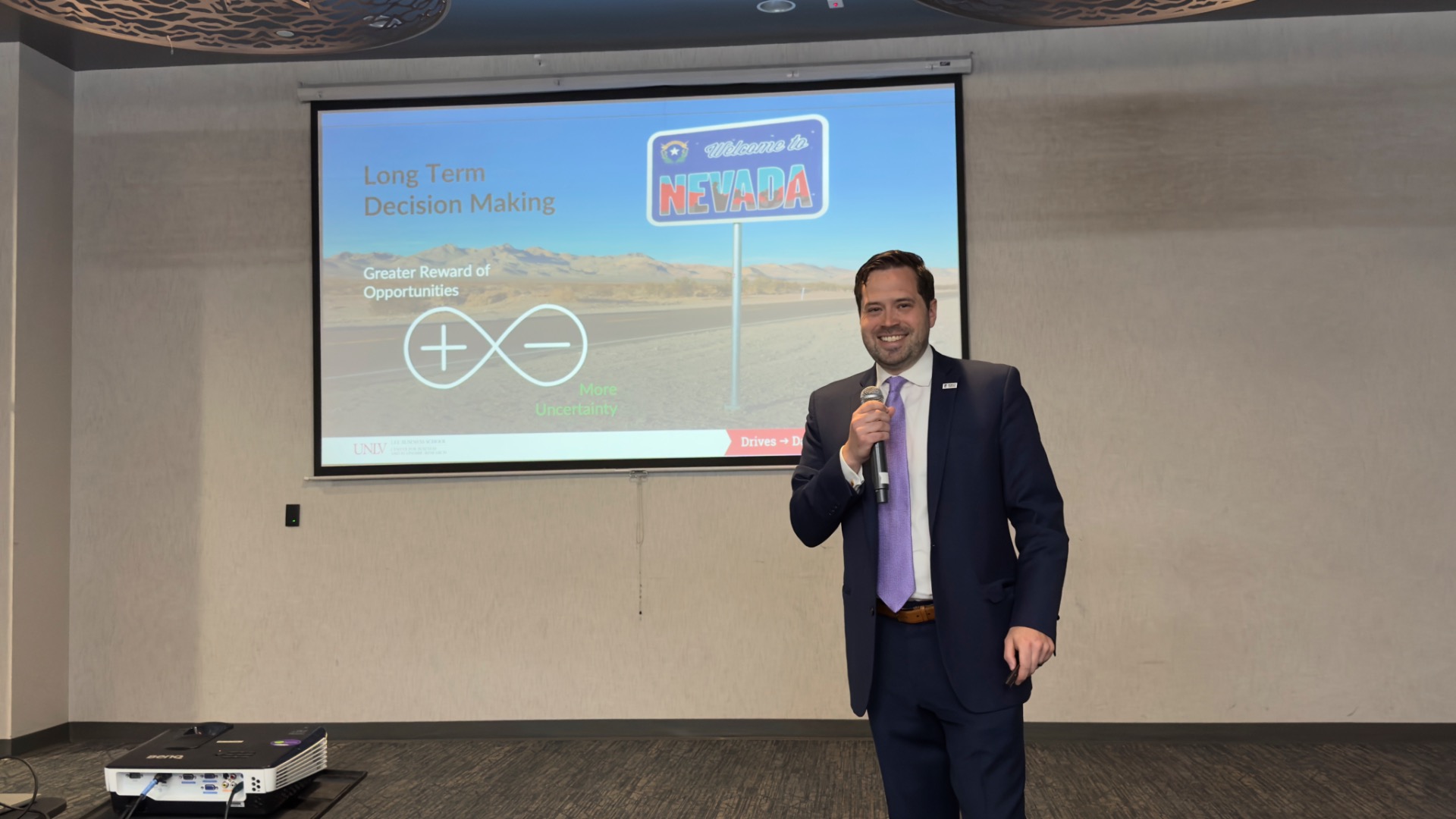
The mood in the room was upbeat, curious, and cautiously optimistic as attendees gathered at the Lambda Business Association Luncheon at The Center for an engaging and candid conversation about Nevada’s evolving economy. Andrew Woods, the Director from the Center for Business and Economic Research (CBER) at the University of Nevada, Las Vegas (UNLV), didn’t waste time getting to the heart of the matter: “We’re not here just to look at short-term numbers—we’re here to think long-term, too.”
That forward-thinking mindset is at the heart of CBER’s mission. Founded in 1975—the same year Microsoft was established—CBER is celebrating 50 years of research, economic forecasting, and community connection. Based at UNLV, the Center provides data-driven analysis for local and state agencies, private industry, and the public through newsletters, forecasting events, and quarterly publications. They’ve forecasted population trends in Southern Nevada since 1997 and remain a vital part of decision-making for infrastructure, education, housing, and health care.
The speaker, a seasoned economist who has been with CBER for over four years and in Nevada for twelve, delivered a comprehensive look at where our region stands economically—and where it’s headed. They didn’t shy away from tough realities or complex issues, but their tone was hopeful and grounded in data.
Forecasting the Future
CBER’s population forecasts are uncannily accurate. Over 20 years ago, they projected that Southern Nevada’s population would hit around 2.4 million by 2024—and that’s exactly where we are today. This sort of foresight is more than academic; it drives everything from school funding and housing development to water conservation and public transportation planning.
By 2042, they anticipate the region’s population to exceed 3 million. That means more residents, more jobs, and greater demands on infrastructure and services. “Planning is everything,” the economist explained. “We can’t control every variable, but if we can see the curve in the road ahead, we can prepare for it.”
A Story of Change
Nevada’s story has always been one of transformation. From mining and railroads to casinos, mega-resorts, and now professional sports, the state’s economy evolves alongside cultural and demographic shifts. This rapid adaptability is a double-edged sword. On the one hand, it’s enabled Las Vegas to become a global destination. On the other, it’s made the region vulnerable to economic shocks—like the Great Recession and the COVID-19 pandemic—more than most U.S. cities.
The economist emphasized the importance of balancing growth in established sectors like hospitality with diversification into areas like healthcare, logistics, and technology. “We know how to grow quickly,” they said. “What we’re working on now is growing sustainably and resiliently.”
What’s Driving Growth
Southern Nevada was one of the five fastest-growing regions in the country last year and the only western metro area on the list. With 387,000 more people expected to move here in the next decade, growth is inevitable. Much of that migration is domestic, with many new residents coming from California—especially older adults and those with higher education levels.
In terms of employment, the sectors forecasted to see the most growth include:
-
Accommodation & Food Services (especially tied to the tourism industry)
-
Healthcare & Social Assistance
-
Transportation, Warehousing & Wholesale Trade
Healthcare is especially critical. With a younger-than-average population now and an aging one in the future, the need for healthcare professionals and facilities is only going to grow. That presents a chance for thoughtful investment—if policymakers and private partners seize the opportunity.
Small Business & Entrepreneurship
One of the most fascinating insights shared was about the rise of small business ownership post-pandemic. Nearly 20% of small businesses operating in Nevada today were started after 2020. Many of these new ventures are led by women and people of color, reflecting a shift in who’s driving innovation and job creation.
CBER is currently working on a white paper analyzing whether these businesses have survived, grown, and hired employees—or remained as solo ventures. This research will help policymakers understand how best to support emerging entrepreneurs in Nevada.
The Sports Economy
Las Vegas has become a bona fide sports city, and CBER is measuring that impact, too. From hosting the Super Bowl to attracting professional teams and growing youth sports participation, sports now play a larger role in the local economy than ever before.
The fastest-growing youth sport in Southern Nevada? Girls’ hockey. Participation among girls under eight years old has jumped dramatically—up from a handful to hundreds. And businesses around youth sports, such as coaching services, have grown by 80% over the past eight years.
Challenges Ahead
Despite the positive outlook, uncertainty remains a key concern. Recent developments around international tariffs—especially on electronics and manufacturing materials—pose risks to the local economy, particularly for sectors dependent on imports.
Higher interest rates and inflation also create obstacles for housing affordability and business investment. “Even if you throw money at a problem,” the economist warned, “uncertainty makes it harder to plan and deliver real solutions.”
On housing, land—not water—is the biggest constraint. Federal land policy affects how and where Southern Nevada can grow, and that’s something local leaders continue to navigate. Add in rising construction costs and supply chain issues, and it's clear that housing affordability will remain a major policy challenge.
Real Wages & the Consumer Economy
Though wages have begun to outpace inflation at the national level, Nevada is catching up more slowly. In Clark County, only three out of the last eight quarters have shown positive real wage growth. Service industry workers—especially in leisure and hospitality—continue to feel the pinch.
Still, consumers are spending, businesses are investing, and jobs are being created. “The American people have shown incredible resilience,” the economist noted. “Despite the shocks we’ve experienced, we continue to march forward.”
Looking Ahead
CBER’s current forecast, made in January before the latest tariff developments, predicts around 1–2% economic growth in 2025. That’s not recession-level slow, but it does suggest a need for caution and long-term thinking.
There’s still strength in Southern Nevada’s economy—especially if the region can balance short-term opportunities (like hosting major events) with long-term investments in education, infrastructure, and diversification.
“We’ve seen what happens when we grow too fast without a safety net,” the economist reminded the crowd. “Let’s make sure the next chapter of Nevada’s story is about resilience.”
For more information on the Center for Business and Economic Research and their latest data, visit cber.unlv.edu.