Las Vegas has never been subtle about its desires. It’s a city built on reinvention, neon, and the kind of ambition that can sparkle—or scorch—depending on who’s holding the spotlight. So it feels almost inevitable that Showgirls: An Unauthorized Musical Parody is planting its stilettos right where the original film lives in the cultural bloodstream: on a Vegas stage, for a Vegas audience, with the volume turned all the way up.
Opening January 15, 2026 at Majestic Repertory Theater, the production promises an evening that doesn’t simply wink at camp—it embraces it, body-checks it down a staircase, then sings about it with full-throated glee. And if the cast’s impromptu, chaotic little sit-down is any indication, this show isn’t here to politely “pay tribute.” It’s here to detonate—lovingly—every outrageous beat of the Showgirls mythology, while still finding the bruised humanity underneath the glitter.
QVegas caught up with the cast in the kind of unplanned, caffeinated burst of conversation that feels very Majestic and very Vegas: half rehearsal room pulse-check, half group therapy, half comedy roast. Somewhere between giggles and existential truth bombs, the performers laid out exactly what audiences can expect: big laughs, bigger choices, and a surprisingly sincere heart beating beneath the rhinestones.
Fear, thrill, and “what have I done?”
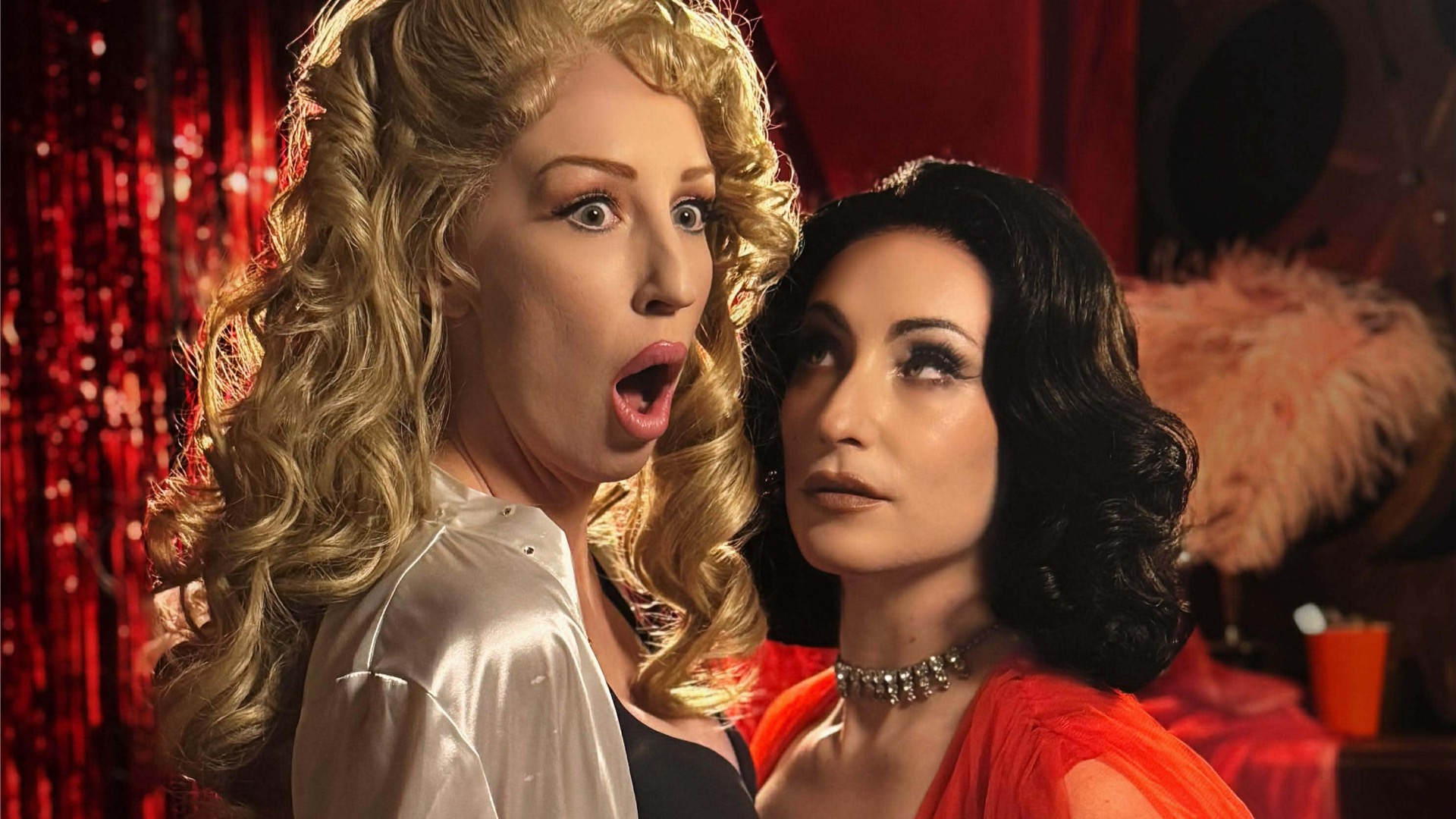
If you’re taking on Showgirls material, you don’t get to be casual about it. Everyone in that world is iconic—sometimes for the reasons the filmmakers intended, sometimes for reasons the internet lovingly refuses to let die. And for Kady Heard, who plays Cristal Connors, the casting moment came with a very specific cocktail of emotion.
“Fear,” she admitted, because Cristal is “so beloved” by anyone who knows the film even a little. But the fear is threaded with lived-in confidence. Heard has been a Vegas showgirl for 17 years, and she spoke with the kind of honest weariness that only people who’ve danced under lights night after night can translate. That experience, she said, makes the role feel not just fun—but right. “I think it’s gonna work out,” she shrugged, as if daring the universe to disagree.
Across from her, Elaine Hayhurst, stepping into the role of Nomi Malone, radiated the opposite energy: pure, gleeful combustion. “Incredible excitement,” she said. “Where else do you get to be so ruthless and play all the different emotions out of ten—crying, yelling for no reason?” She called Nomi “one of the most fun and juicy characters a lady could play,” and honestly, you could hear the cackling fanbase across town nodding in agreement.
This is the first big takeaway: the cast isn’t approaching parody as something smaller than “real acting.” They’re treating it like a license to go bigger—and then go bigger again—while still keeping the characters emotionally legible. Camp, yes. But not hollow.
The cult classic that never left Vegas
For some performers, Showgirls is a rite of passage. For others, it’s a Vegas homework assignment you cannot fail without consequences.
Jeffrey Dubey, who plays Zack Carey, admitted he hadn’t actually seen the movie until about a week before his audition. “When I told people that I hadn’t seen it, I was almost crucified,” he laughed, adding that he’d only moved to Las Vegas a little over a year ago. But once he fixed that “problem,” he understood why locals clutch the film so fiercely. Being part of a stage parody, he said, feels like stepping into a piece of Vegas lore.
Meanwhile, Erik Amblad, who plays Mama Bazoom / Tony Moss, came with deep hometown reverence. A native Las Vegan, he described taking friends to opening night of Showgirls back in college, already sensing what the world would eventually learn: it was destined to become a cult classic. “Halfway through, I thought this will be our generation’s cult classic,” he said. The way he talked about it wasn’t ironic. It was affectionate, almost devotional—like he’s been waiting decades for Vegas to fully claim what Showgirls became.
And that’s the second takeaway: this production isn’t pretending it’s outside the legacy. It’s part of it. Vegas doesn’t just host the story—it is the story.
The surprising hard part: speed, switches, and staying sharp
Parody looks effortless when it’s done well—because the joke lands, the timing snaps, and the audience is too busy laughing to clock how much precision it takes.
Steffan Scrogan, who plays Al Torres / Andrew Carver, highlighted what audiences rarely understand: in shows like this, performers often play multiple roles, switching personalities and intentions at breakneck speed. The challenge isn’t just memorizing lines or hitting marks; it’s keeping each character distinct and funny while the show barrels forward like a sequined runaway train.
That pace, the cast repeatedly stressed, is part of the thrill. It’s not a slow burn. It’s Vegas: once the first beat drops, the night doesn’t stop until the lights go out.
Camp with a pulse: finding the human underneath
The smartest thing about Showgirls—and the reason it’s survived for decades—is that beneath the notorious lines and the internet-famous moments, it’s still a story about hunger. Hunger for success. Hunger for validation. Hunger for escape. That kind of desire is always relatable, even when the characters are behaving like cartoon villains.
Hayhurst spoke about bringing humanity to Nomi without shrinking the character down. She described herself as naturally over-the-top, someone who’s always had “huge emotions,” and said the trick is remembering that those big reactions come from real places: bruises, history, trauma, insecurity. “We’re all reacting out of our own past experiences,” she said. Parody doesn’t erase that—it can actually underline it, because it allows the performers to externalize what most people try to hide.
Amblad echoed that emotional undercurrent in a different way: he wasn’t surprised the characters are vulnerable, but he was surprised by how vulnerable the performers become in the process—especially with a brand-new, evolving script. “Trying to find sanity in the chaos and fun in the chaos,” he said, has been both exciting and a little gobsmacking.
A brand-new score in a blender of genres
One of the most exciting reveals from the conversation: this isn’t jukebox nostalgia. The show features an original score, and composer James E. Edwards described the musical approach with the kind of specificity that makes theater nerds lean in.
The songs, he said, genre-hop like a mixtape from the late ’80s through the early 2000s—then get tossed into a blender with musical theater. Each number stands on its own stylistically, but recurring themes and motifs stitch the experience together so it still feels like one cohesive ride. In other words: you’re not just getting jokes; you’re getting craft.
That matters, because the material demands a soundtrack that can match its chaos without collapsing into it. If the music can carry both satire and sincerity, the show can do more than spoof—it can sing its way into something memorable.
“Go bigger” — and then bigger than that
Because this is a premiere script in performance, the cast described the process as a rare kind of luxury: they’re effectively workshopping it in real time. Heard said lines and scenes have shifted constantly—rewritten, sharpened, escalated—to make moments funnier or clearer. “You never get to do that,” she said. And you could feel the cast’s excitement: this isn’t a museum piece. It’s alive. It’s being built for this audience, this city, this moment.
Perhaps the most telling comment came when Heard said the company realized they had to go “so much bigger than we thought we were going to” to match the outrageous energy of the source material. That’s not just about volume. It’s about committing. In parody, halfway choices die onstage. This cast is choosing all the way.
Vegas, distilled
Because the story is set in Las Vegas—and the show is being performed in Las Vegas—I asked what feels most “iconically Vegas” about this version.
Hayhurst answered instantly: strip club energy. Dubey shouted out a local rite of passage: getting harassed by the card-slinging clickers on the Strip. But the deeper answer, the one that landed as the room settled for a second, was the idea of Vegas as reinvention central. Nomi comes here to become someone new, and whether you arrived yesterday or you’ve been here your whole life, that storyline hits. Vegas is full of people who have rewritten themselves—sometimes bravely, sometimes desperately, often with lashes on.
And then there’s the warning.
Is there any reason not to sit in the front row? The cast grinned like people who know exactly what they’re doing. If you don’t want to be covered in “mysterious liquids,” maybe don’t. If you don’t want to be touched physically or spiritually, definitely don’t. And if you’re easily offended? This may not be your show.
But if you’re the kind of person who believes laughter is a survival skill—and that Vegas is at its best when it’s gloriously unhinged—then Showgirls: An Unauthorized Musical Parody sounds like a perfect night out. It’s loud. It’s relentless. It’s ridiculous. And, somehow, it’s honest.
Majestic Repertory Theater has never been afraid of bold choices. This one looks like it’s about to strut into town, flip the bird to subtlety, and remind us all why Showgirls refuses to die: because desire—messy, hungry, hilarious desire—never goes out of style.
Showgirls: An Unauthorized Musical Parody opens January 15, 2026 at Majestic Repertory Theater in Las Vegas. Tickets are available through Majestic’s online ticketing page.