

In the heart of Southern Nevada's LGBTQ+ community, Aid for AIDS of Nevada (AFAN) stands as a testament to decades of resilience, service, and advocacy. At the helm for over a decade is Executive Director Antioco Carrillo, a passionate and dedicated leader whose personal journey has been deeply intertwined with the evolution of HIV treatment and awareness in Clark County and beyond.
Carrillo, who took over AFAN in January 2012, has seen the HIV/AIDS epidemic from multiple angles over the last 30 years. His career began in 1994, a time when the virus still carried the weight of a death sentence, and the LGBTQ+ community was grappling with overwhelming loss.
"In 1994, 1995, there were not enough medications, and people were still dying regularly. Much of my work then was about helping people get their affairs in order, preparing for the worst," Carrillo recalls. "We would open the door to support groups, and you never knew who would come back the following week. Sometimes they didn’t."
But 1996 marked a turning point with the advent of protease inhibitors and other life-saving medications. Suddenly, people were living longer and healthier lives, and with that came new challenges—and new hope.
AFAN quickly adapted, shifting from palliative care and crisis counseling to helping clients navigate the complexities of returning to work and rebuilding their lives. "People on disability wanted to reenter the workforce. So we offered workshops on resume building and skill development. It wasn’t just about surviving anymore—it was about living."
Along with vocational support came financial education. Many clients, thinking they were going to die, had maxed out credit cards and depleted savings. Carrillo notes that part of AFAN’s role was helping people face the consequences of their financial choices and find a sustainable way forward.
By the early 2000s, the narrative around HIV had changed significantly. No longer viewed exclusively as a death sentence, it was becoming something people could live with—though not without stigma. Prevention remained critical, and new waves of infections highlighted the need for continued outreach.
Then came PrEP, a revolutionary tool in prevention that drastically changed the HIV landscape. "It boomed," Carrillo says. "But the misconception that HIV was 'over' became widespread. People relaxed. They let their guard down. And infection rates persisted."
Clark County today reports an average of 490 to 500 new HIV diagnoses annually. While medications have advanced and the message of "undetectable equals untransmittable" (U=U) has gained traction, Carrillo warns that the fight is far from over. "We're running out of combinations of therapies. Without new pharmaceutical innovation, we could face another crisis."
Compounding the issue is the intersection of HIV and poverty. "The biggest risk of getting HIV now is that you may become poor. Medical costs, employment discrimination, housing insecurity—these are real challenges for people living with HIV."
Federal policies have also put many support systems in jeopardy. Under the Trump administration, funding for HIV prevention and treatment continues to face threats as the current administration—despite unveiling a plan during Trump’s previous term to end the HIV epidemic by 2030—has wavered on its commitments.
Carrillo emphasizes that AFAN’s services are vital, and many are tied to federal grants. These include:
• Medical case management
• Housing and rental assistance
• Transportation to medical appointments
• Access to first-month rent and deposits
• A 20-unit housing project for low-income individuals with HIV
AFAN's holistic approach ensures clients stay in care, access necessary treatments, and maintain viral suppression. “The social service network is what keeps people alive,” Carrillo stresses. “It’s not just about medicine—it’s about community.”
That sense of community extends to AFAN’s broader impact on public health in Nevada. The organization has played an active role in legislation, education, and legal advocacy. Carrillo was vocal in efforts to modernize HIV criminalization laws and worked on policies that challenged discriminatory adoption and housing regulations.
He recounts one such instance: a gay couple seeking to adopt was denied because one partner was HIV positive—based on regulations from the 1980s. AFAN stepped in. “Nobody had updated the rules. People just assumed they weren’t needed anymore. But they are still being used to discriminate.”
AFAN also supports legislative efforts to decriminalize HIV exposure and engaged with statewide committees focused on LGBTQ+ rights and public health. “We write letters to Congress. We lobby local officials. When policies threaten our clients, we act.”
These actions are grounded in a deep understanding of confidentiality and the realities people with HIV still face. “We don’t pay rent assistance under the AFAN name. That’s how deep the stigma still goes,” Carrillo explains.
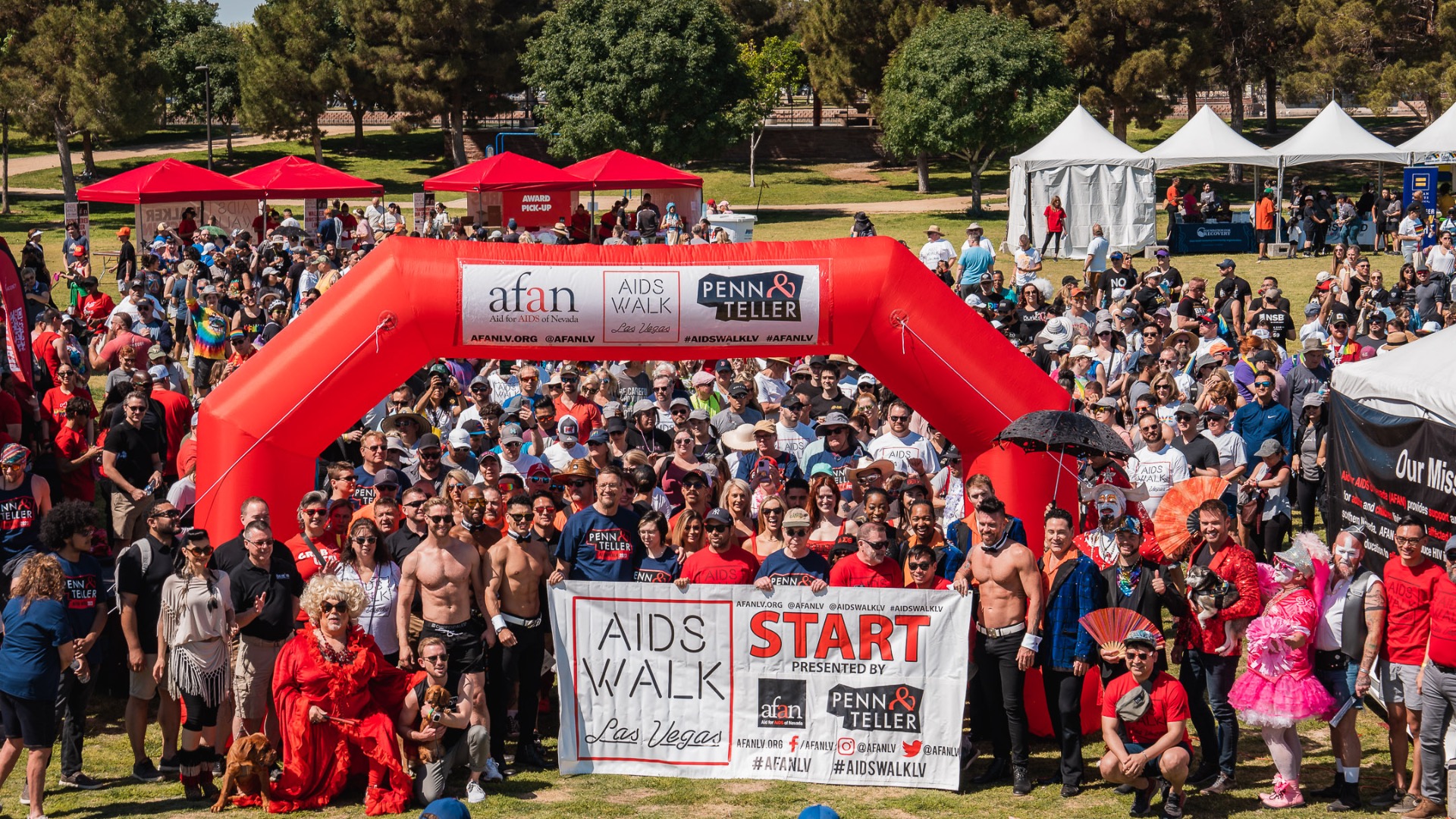
With all of this in mind, one of AFAN’s largest public-facing events—the annual AIDS Walk—remains a vital rallying point for the community.
Set for April 27, 2025, this year’s AIDS Walk will be held at the Las Vegas Ballpark, marking a shift toward a safer, more inclusive environment. Participants will walk four laps around the venue in a space secured by on-site security, ensuring a judgment-free, family-friendly, and pet-welcoming experience.
“This year, I feel a lot better,” Carrillo admits. “At previous parks and venues, I always worried about safety. Now, I feel we can finally give our community a great experience.”
The event is also significant because every dollar raised stays local. “We don’t send money to a national headquarter. Everything supports services here in our community,” he emphasizes.
Hundreds of participants and dozens of sponsors have already signed on. AFAN’s fundraising goal is $150,000—but Carrillo hopes to exceed it.
“We have a very loyal base, and every person who attends is making an investment in their community,” he says. “You’re investing in local health, dignity, and survival.”
Participants can register as individuals or as teams at afanlv.org. A $30 registration fee includes a T-shirt, and those who raise $100 or more will receive additional swag—including neon tank tops, water bottles, and even Penn & Teller show tickets.
Yes, the legendary duo Penn & Teller will return for their 24th year as Grand Marshals. “They’ve taken us under their wing,” Carrillo says. “They believe in us, and they’ve been incredible allies.”
Beyond the fundraising, Carrillo sees the AIDS Walk as a day of connection and visibility. “The pandemic made it hard to know who’s still here. This is a chance for the community to reconnect, to see what resources still exist, and to remind ourselves that the work isn’t done.”
And that, perhaps, is the core message Carrillo hopes to leave with readers:
“This organization was created by the previous generation who fought tooth and nail to survive. It’s our job to honor that legacy, to keep fighting, and to make sure no one is forgotten. HIV is not over. But neither is our determination to end it.”