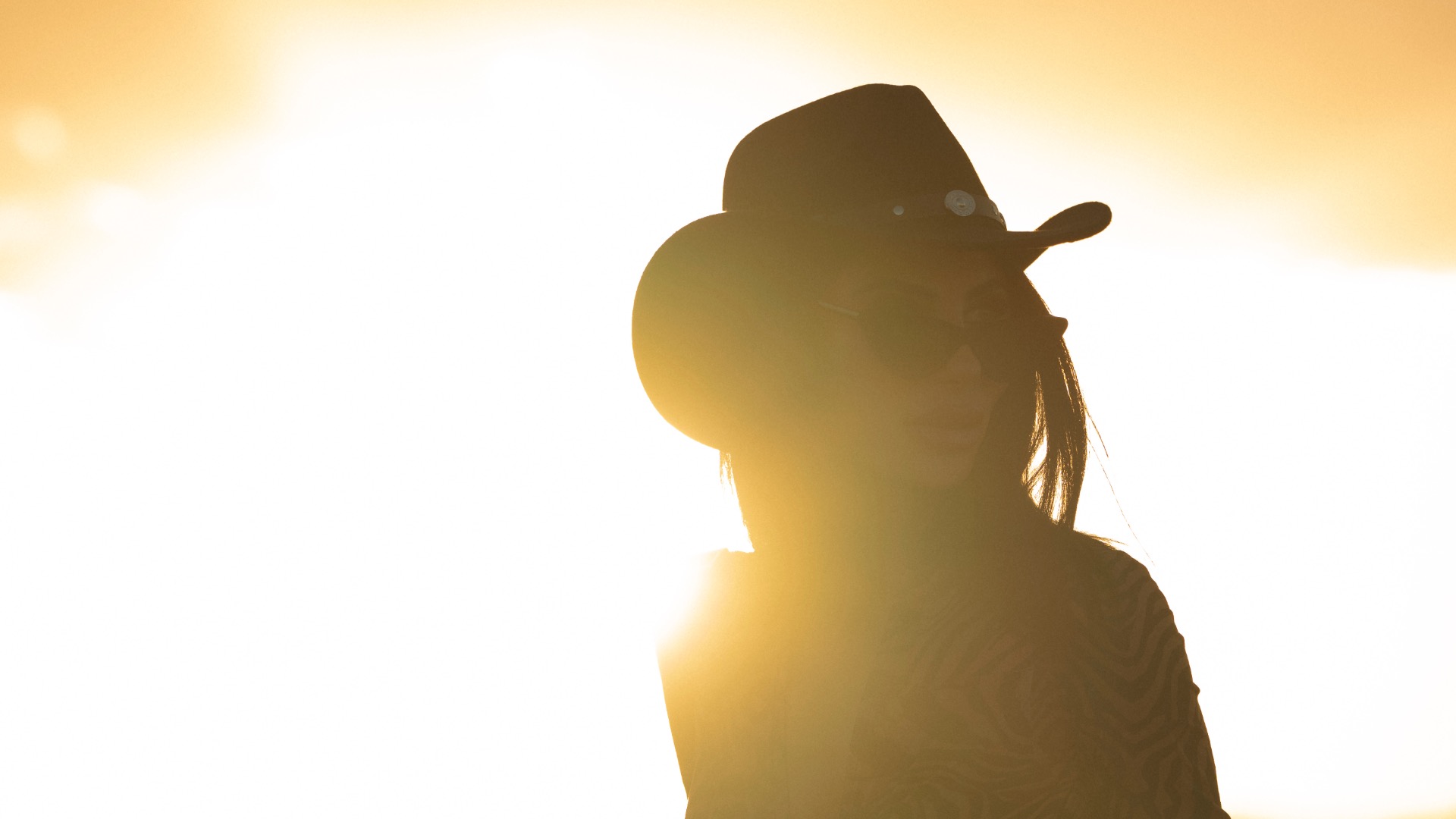
Las Vegas has a way of boomeranging its brightest back to the neon. For Mikalah Gordon, the return feels less like a comeback and more like a coronation. The singer, comedian, and broadcaster—who first burst into America’s living rooms as a teenager on American Idol—now splits her time between two quintessentially Vegas microphones: mornings as a co-host on 98.5 KLUC, and nights fronting a band residency at Fontainebleau. Somewhere between dawn drive-time and midnight encores, she wrote “Good Girl,” a pop-soul anthem with a swaggering hook, a generous heart, and a message meant for the 16-year-old who did everything right—and got judged anyway.
Gordon’s origin story is Vegas through and through: scrappy, glamorous, and impossible to ignore. At 16, she made Idol’s Top 12 (and roomed with future superstar Carrie Underwood). That lightning-strike moment hurled open a string of doors: red-carpet correspondent gigs, and a sitcom arc opposite Fran Drescher on Living with Fran. But the same spotlight that accelerates opportunity also amplifies opinion. For a teenager, the echo can be deafening.
Two decades on, Gordon has something the younger version didn’t: perspective—and a pen. “Good Girl” is a letter across time to the person who needed protection when the crowd got loud. The song tells her: we made it, we did what we set out to do, and the voice inside you—equal parts bravado and vulnerability—was always the compass.
The Sound: Pop Soul with Bite
Slide “Good Girl” between Amy Winehouse’s melodic immediacy and Jazmine Sullivan’s steel and you’ll land in the right register. Gordon wrote the track with fellow Idol alum Brandon Rogers, prioritizing a melody you can learn in one chorus and belt by the second. This is deliberate: the song invites the room to finish lines with her, to take ownership of the refrain, to transform from listenership into fellowship.
The lyric that hits like a confetti cannon: “You said I’m a clown—well, bitch, I’m funny. I make my money living out loud.” It’s a wink and a boundary at once. People once mistook her sparkle for superficiality; the joke’s on them. Close behind, another line plants a flag on the Strip: “Win or lose, love me or hate me, I’m a Vegas baby.” In a town that rewards reinvention, it reads like an oath.
The Frame She Chooses
If Gordon’s music is a love letter to her younger self, her visuals are a mirror held steady. She’s been candid about body image—the internet’s whiplash from “too much” to “too little,” the way grief can redraw a silhouette, the pressure to satisfy an audience that always wants something else. Her measure now is plain: happy and healthy are the only metrics that matter.
In the “Good Girl” video, she leans into that clarity. She plays a showgirl who falls for another femme showgirl, a romance she couldn’t safely put on-screen at 16. Sequins are not a disguise; they’re a declaration. “This is my body. This is my sexuality. Love it, hate it—it’s mine,” she says. The creative team is intentionally and proudly queer, because representation behind the camera shapes what the camera dares to show.
Not a Drag—A Diagnosis
There’s a version of this story that spirals into grievance. Gordon declines the bait. “Good Girl” is not a takedown of Idol or reality TV; it’s a clear-eyed reminder that an algorithm doesn’t absorb cruelty—people do. The target isn’t a franchise; it’s the comfort of anonymous criticism. The temperature stays warm: firm lines delivered with empathy for the kid who absorbed the first wave and for the grown woman still tender enough to admit, “If you say something rude, it hurts.” Strength isn’t the absence of feeling; it’s the decision to tell the truth anyway.
Comedy Timing, Diva Timing
Before the Fontainebleau spotlights and the KLUC morning bell, Gordon earned her pace the old-school way—on comedy stages at The Comedy Store and Laugh Factory. That timing stitches through everything she does: the way a verse swells into a chorus, the breath before a punchline, the look that lands the joke a half-beat after the lyric.
Her podcast, So Funny It Hurts, follows the same current. Many of the funniest people, she says, are simply the bravest at naming what hurt and turning it into air you can breathe. Music does that, too; it metabolizes pain into rhythm, into something hundreds of strangers can shout back until it belongs to all of you.
Powered by Joy, Anchored by Sobriety
The schedule would flatten a mortal—radio at dawn, interviews by day, stage at night—but Gordon describes the engine as gratitude on repeat. She knows the empty calendar and the overfull one; both taught her to treasure the work. Nearly three years sober, she speaks about clarity like it’s a gift she unwraps daily. “I don’t take anything for granted,” she says. “I just want to have fun with our community.” That sense of play—wry, welcoming, a little mischievous—bleeds into the banter at shows and the candor on air.
A Vegas Original, Reintroduced
Ask who shaped this era and she points to the city itself. Vegas is a finishing school for audacity: you learn to make your own seat at the table—and then you pull up chairs for others. There were marquee moments along the way (a key to the city, the giant building wraps, the billboards that wink back), but the deeper truth is steadier: Las Vegas doesn’t forget its own. When Gordon came home, the community caught her mid-stride and set her down right where she belonged—under the lights.
For visitors dropping into town—and for locals who haven’t yet built a ritual around her sets—Gordon’s shows have a gratifying Vegas balance: old-school showgirl polish, new-school pop bite, and a comedic throughline that makes the night feel like a party you wandered into and now never want to leave. Expect a band that can turn on a dime, a voice that can slide from velvet to gravel, and patter sharp enough to double as a roast if you tempt her.
If You’re New Here: How to Do Mikalah Right
Start with the song. “Good Girl” is the thesis in three minutes—learn the hook before the show (you’ll thank yourself when everyone else shouts it). Catch her in the morning on 98.5 KLUC to hear the quick wit in a different gear; it’s a primer on why her timing knocks in a live room. Then make an evening of it at Fontainebleau. Dress for the mood you want—leather or rhinestone, she won’t judge—and plan for a night that moves. Gordon’s set is built for motion: big choruses, sly asides, a surprise ballad that hushes the room, and at least one moment you’ll text about later.
If you wander afterward, keep the vibe alive with a late-night bite at a classic Vegas spot (she swears by The Peppermill). It’s the full-circle itinerary: breakfast radio, a nap, a glam, a show, a 1 a.m. plate the size of a cymbal.
The Last Word
There’s a single syllable that’s followed Mikalah Gordon from punchline to mantra, from teenage TV to Vegas headliner: “Bitch.” As in: yesbitch—one word, no spaces, all velocity. It’s not a sneer; it’s a grin you earn after you’ve survived a chorus of opinions and decided to sing your own anyway.
That’s the core of the “Good Girl” era: not rebellion for its own sake, but reclamation for the sake of every younger self who stood in the dark wings and hoped. The lights came up. The mic is on. The crowd is ready. And Las Vegas—the city that never lets its own go dim—has her right where she belongs.
Where to find her: On your morning drive with 98.5 KLUC and onstage at Fontainebleau with a show that pairs showgirl polish with pop-soul fire. Bring your outside voice—and someone who loves a big chorus.