

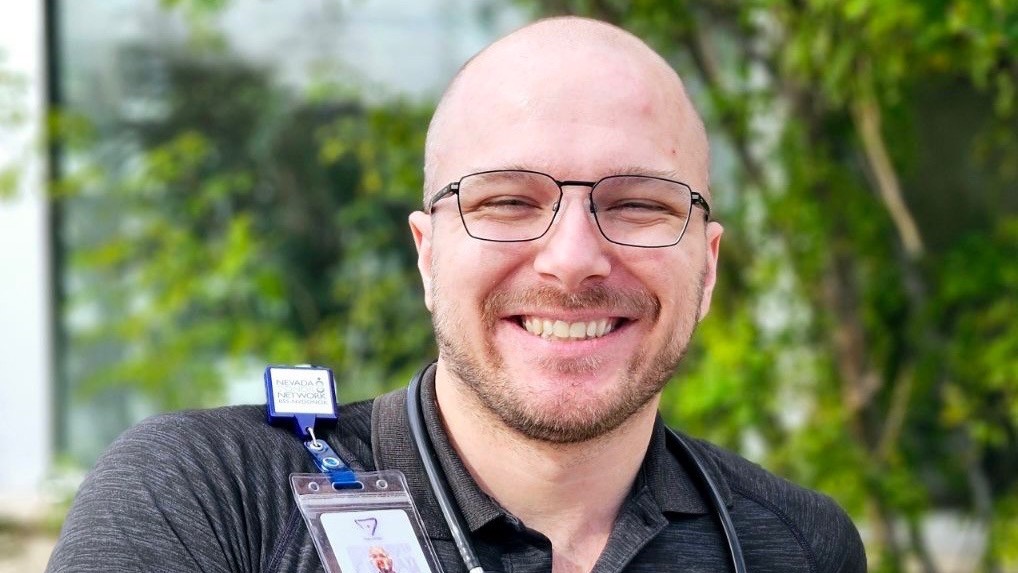
When nurse practitioner Thomas McNeil talks about his work at the LGBTQ Center of Southern Nevada, the first thing you hear is gratitude. “I joined the Center in October 2023, and it’s honestly been a dream ever since,” he says. After nearly a decade in healthcare—much of it in the intensity of the ICU—McNeil stepped into primary care with a purpose: to offer affirming, comprehensive medicine to adults, with a special commitment to older LGBTQ+ patients. “I knew I wanted to work with adults, and I really wanted to focus on the aging population,” he explains. “All too often, they’re overlooked.”
That focus isn’t just an abstract mission statement. It’s a daily practice of listening, careful screening, and building trust. “Every patient is safe with me,” McNeil says. “Nothing leaves the four walls. I want people to feel empowered, in control of their health and their destiny.”
Why Gerontology Matters—Especially Here
For many LGBTQ+ people, aging carries a unique set of challenges. “One of the experiences too many older LGBTQ adults face is loneliness,” McNeil notes. “We ask, what happens when we get older if we don’t have kids? Who is our support?” He’s candid about the consequences of that isolation—delayed care, missed screenings, and the quiet normalization of pain or fear. His response is to widen the circle, clinically and culturally. “We need to meet the needs of the community at all ages—not just pediatrics or young adults, but truly across the lifespan.”
McNeil chose adult–gerontology because he understands how identity, history, and health intersect. “Our dynamics and lifestyles are a little different as we get older,” he says. “Comprehensive care means acknowledging that difference and planning for it.”
Sexual Health Over 50: Still Here, Still Vital
If there’s a topic McNeil wants to put squarely on the table, it’s sexual health for older adults. “People still have sex. People still want to enjoy themselves,” he says with a warm smile. “It’s a conversation that too many providers overlook.” He emphasizes HIV awareness, safer sex practices, and newer tools like PrEP and doxycycline post-exposure prophylaxis. “A lot of these resources weren’t discussed or accessible for prior generations,” he explains. “There’s still stigma—and there’s tremendous opportunity for education.”
That education is practical. “I talk to everyone about sexual health,” he says. “How to have fun and also be safe. It’s not judgment; it’s empowerment.”
The Screenings That Save Lives
At the Center’s new clinic, sexual health services are robust and integrated. “We can address sexual health in both clinics, but the newer location gives us more resources for comprehensive testing and, in some cases, treatment,” McNeil says. For patients with prostates, he highlights evolving guidelines. “It’s less about the digital rectal exam now and more about PSA as an important marker,” he explains.
He’s equally direct about colorectal and anal health. “HPV is a big topic for us,” he says. “Historically, screening wasn’t comprehensive across all populations, and guidelines have changed many times.” Today, the clinic routinely screens for anal HPV, especially for those at higher risk. “If you’re positive, annual screening is key. For the general public, I tell folks—get screened at least once so you know your status and risk factors.” He underscores the rising rates of colorectal and anal cancers in midlife and beyond, noting that high-risk HPV variants can increase those risks.
Beyond sexual health, McNeil advocates a full panel approach to primary care: cholesterol, thyroid, A1C, and hormone checks when indicated. He orders PSA tests, facilitates gastroenterology referrals or Cologuard based on patient preference, and screens for lung cancer where appropriate. “If you’ve smoked a pack a day for 15 years and you’re 50 or older, you should be getting an annual chest CT,” he says. All of this sits within a broader risk assessment. “I’m calculating cardiovascular risk scores and thinking across systems,” he adds. “Health is dynamic, and we treat the whole person.”
A First Visit Without Fear
Asked what he’d say to a 68-year-old who hasn’t seen a clinician in years, McNeil doesn’t hesitate. “Hello—and there’s no better time than the present,” he says. “Thank you for coming in. Thank you for trusting me with your health.” He understands why people delay care—stigma, fear of judgment, discomfort discussing private matters with someone outside the community. “My appointments should never be scary,” he says. “You are cared for. You are safe. I’ve seen it all, and I’m here to help.”
Dispelling the Biggest Myth
For McNeil, one persistent myth keeps people away: the idea that providers won’t understand LGBTQ+ experiences. “There’s fear—of not being understood, of asking the wrong question, of being judged,” he says. “Let’s eliminate that fear. I want people to feel empowered to take charge of their health. Let me help facilitate what your success looks like.”
An Open Invitation
McNeil beams when he talks about his colleagues. “Come down and meet us,” he says. “We have amazing providers—Sarah, Chastity, Emily—and of course the legendary Dr. K.” The invitation is simple and sincere: “If you need care, direction, or just have questions about sex, HIV, or what it means to be healthy, let us help you unpack that. The Center is a safe place to go and feel supported—in your personal life and in your health.”
As the Gavin J. Goorjian Community Health Center opens its doors, McNeil’s message lands with clarity and heart: aging with pride requires care that listens, screens, educates, and welcomes—without judgment, and with unwavering respect. “You’re in control of your health and your destiny,” he says. “I’m here to make sure you have everything you need to thrive.”