
When Piranha Nightclub opened its doors in 2006, the corner of Paradise Road and Naples Drive was already legendary — but it was a legend mostly whispered among locals. The Fruit Loop, as the cluster of LGBTQ+ businesses had been informally called for decades, had been a refuge since the 1950s, when Club Black Magic first opened its doors and quietly became a gathering place for a community that had nowhere else to go. By the time Piranha cut the ribbon twenty years ago this month, generations of queer Las Vegans had already laid the foundation with legends like Kenny Kerr. What Piranha brought to the block was scale, swagger, and a sound system that could be felt three rooms away — and a promise to honor what came before by going harder, louder, and prouder.
This Memorial Day weekend, on Friday, May 29 and Saturday, May 30, Piranha and its sister club Gipsy mark the occasion with Anniversary WKND 2026: 20 Years in Our Platinum Era. Friday night belongs to international DJ Ben Bakson, whose signature uplifting house remixes have become a staple of Pride circuits worldwide. Saturday brings Nymphia Wind, the Taiwanese-American powerhouse who in 2024 became the first East Asian queen ever crowned on RuPaul's Drag Race, the reigning Banana Buddha herself. Nymphia performs the Gipsy stage at 11:30 PM with a meet-and-greet at 12:30 AM, then takes Piranha's back room at 1:30 AM. And of course, the legendary Piranha dancers and resident queens will be out in force—or fierce.
But before the bottles pop and the lights drop, it's worth pausing to consider how a 10,000-square-foot club on Paradise Road became a Las Vegas institution.
The Build
In the mid-2000s, Vegas nightlife was at an inflection point. The megaclubs were beginning their reign on the Strip, and the city was rapidly becoming a global destination for nightlife tourism. What it conspicuously lacked was a queer venue built to the same scale. The Fruit Loop's existing bars and lounges were beloved, but none of them were engineered to host the kind of high-production drag spectaculars, internationally booked DJs, and weekend crowds that Vegas was suddenly capable of attracting.
The Paradise Road address that would become Piranha had been queer-adjacent property for years — its front room having lived an earlier life as an ultra-lounge called 8 1/2 (a name that probably needs no explanation), with the larger space cycling through identities including Angles & Lace, and Icon. When Icon's owner passed away and the lease became available, Paul San Filipo and the team at Gipsy saw an opportunity to expand on Gipsy's success with something at an entirely different scale. They took the lease.
What they took possession of was a fifty-year-old building — original construction dating to the 1960s — and inside it, essentially, a black box: a basic front room with a bar, and a dark back room with another bar. Before breaking ground on the buildout, the team scouted clubs around the country. A multi-room venue in Miami — cozy front room with a fireplace and bar, dance club in the back, more rooms upstairs — confirmed the multi-room concept they had already been imagining. Combined with an aesthetic inspiration lifted straight from the Haunted Mansion at Disneyland — dark, dramatic, gothic, theatrical — the design started taking shape: a queer Vegas nightclub refracted through Imagineering.
The renovation was a full rebuild. New roof. New HVAC. New plumbing. Walls and ceilings opened up and reskinned. And then, two weeks before the planned grand opening — invitations already in the mail — the county arrived for its final inspection and discovered that the licensed electrician on the project had not filed his permits. Every wall and ceiling that had just been finished had to be opened back up so the electrical work could be properly inspected. Grand opening was pushed back roughly six months.
The delay turned out to be a gift. The back room of the venue had a second floor above it — an apartment, of all things, that had at various previous lives been a bookstore and a clothing store. With the construction timeline already blown, the team made an audacious call: open up the second floor too. They cut into the floor, added a railing, and created the balcony that now overlooks the back-room dance floor, with three private rooms, a bar, and table seating up top. The name came easily enough — people, after all, can be piranhas. The original build even included a live tank stocked with the real fish, eventually retired at the request of Nevada wildlife regulators.
Opening night in 2006 looked nothing like the Piranha of 2026. The front room was carpeted. There were chaise lounges. A softer aesthetic that has since evolved into the harder, brighter, more cinematic club the room is today. Among the queens who set the tone early on was Hot Chocolate, the club's longtime Mood Director, who has been part of the family for 19 of the 20 years. She remembers the early headliner nights: Janet Jackson, Carrot Top, and a steady parade of celebrities who used Piranha as the after-hours spot to actually let loose. "There's so many fabulous memories," she says of the run, the kind of casual understatement that only somebody who has truly seen it all can pull off.
The Empire Grew
Piranha did not open at over 10,000 square feet. It grew there.
Adjacent to the original venue, in the same strip of buildings, were a video store and an Ethiopian restaurant. As those leases turned over, the club absorbed them, room by room. The footprint expanded outward until it encompassed four distinct rooms inside and two interconnected outdoor patio spaces. By the time the dust settled, Piranha had become one of the largest dedicated LGBTQ+ nightclubs in the western United States — a venue that could legitimately function as four clubs in a single shell, each with its own DJ, its own crowd, its own personality.
The Celebrities and the Spectacle
The list of stars who've been spotted on Piranha's dance floor over twenty years reads like a Billboard chart and a tabloid index combined: Britney Spears, Paula Abdul, Lance Bass, Sam Smith, Andy Cohen and Anderson Cooper together, Kathy Griffin, Carson Kressley and most of the original and new Queer Eye for the Straight Guy casts. Dance and pop royalty has come through the room as both performers and patrons — Tiffany, CeCe Peniston, Erika Jayne. The Real Housewives franchise has filmed there, and a long list of Housewives across multiple cities have walked the door. Janet Jackson still drops in when she's in town — because at Piranha she can disappear into the crowd. The club's reputation as a place where A-listers could blend in unbothered became part of its mythology — the staff, then as now, treats privacy as a sacred trust. Nobody gets photographed without consent. Everybody gets to dance.
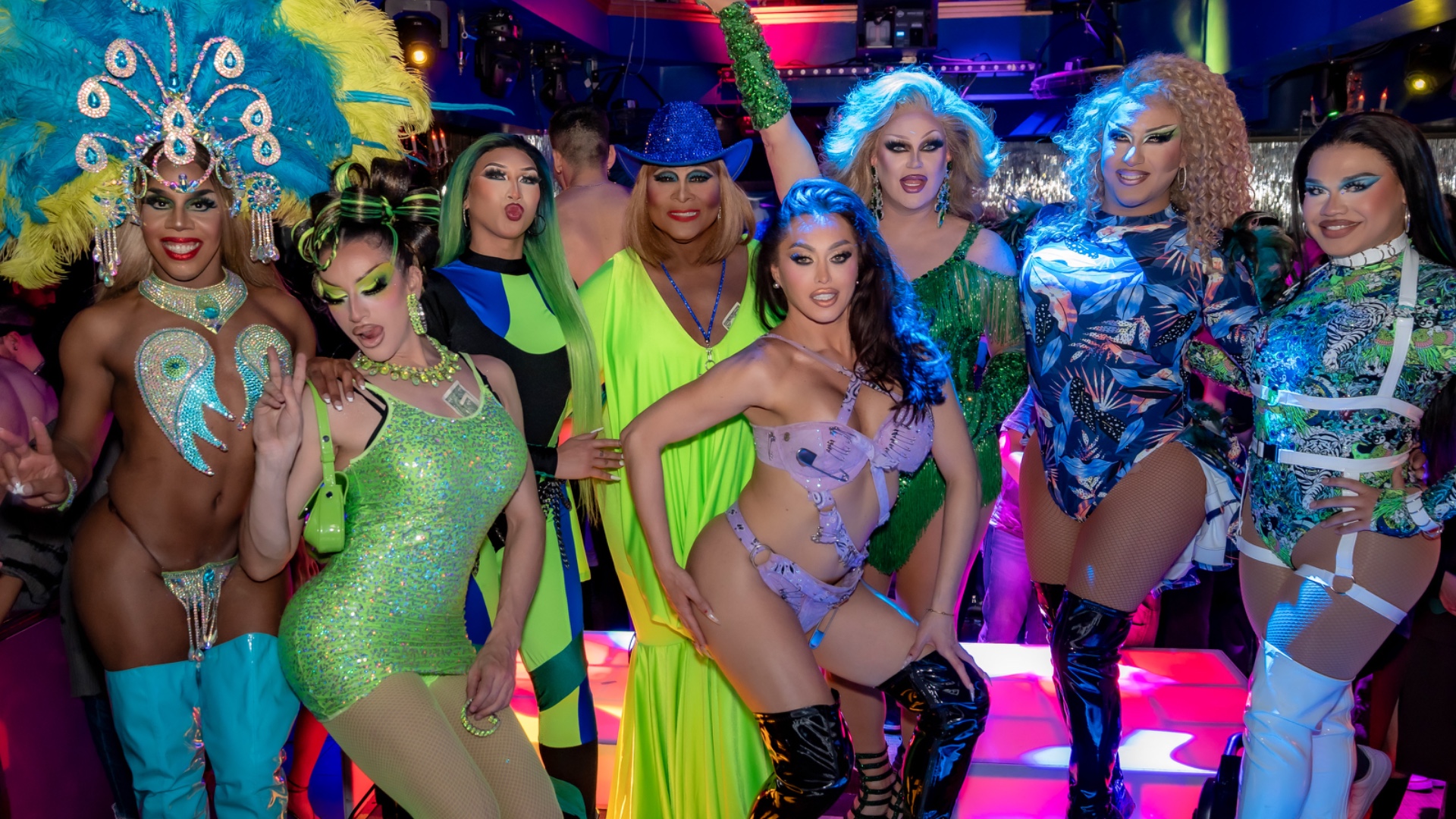
Beyond the celebrity sightings, the drag programming has been the connective tissue. The cast has become a launching pad and a homecoming, hosting Drag Race alumni and local legends in equal rotation. "My first memory of Piranha is a night with Willam, Detox, and Vicki Vox," says Russ White, co-publisher of QVegas. "That's the night Piranha locked itself into me — and twenty years later, the cast still hits that hard." Most regulars have a version of that night — the headliner, the dance floor, the after-after, the friend they made in line.
Surviving the Hits
Twenty consecutive years in business — in Las Vegas, in nightlife — is not a survival statistic anyone should take for granted. The Piranha story has terrain in it that nearly took the club out.
The first hit was the 2008 financial crisis. Las Vegas was ground zero for foreclosures, household budgets vaporized overnight, and the discretionary spending that nightlife depends on cratered city-wide. The clubs survived by adapting fast — lowering drink prices, watching the market move, responding before the bottom dropped further. Competition arrived around the same time. Krave, a large new venue that opened in the late 2000s, drew real attention and forced Piranha to sharpen everything from talent to programming to bar economics.
The second hit was COVID. The county shut Piranha and Gipsy down with the same order that closed major Strip resorts. The only path back to operating was to install a working commercial kitchen and space every table six feet apart — even across the dance floor. The team installed the kitchen. They set up the tables. They opened with a chair sitting on the dance floor where a body usually goes. And they made it through.
Each crisis produced a stronger club on the other side. The version of Piranha that exists today is the result of twenty years of pressure-tested decisions and a leadership team that has been around long enough to know which storms to ride out and which ones to remodel for. And not every loss across twenty years has been an economic one. The Piranha family has also buried coworkers and friends along the way — absences that leave permanent marks on a place this tightly woven, and that the staff carry with them every shift.
The Family Business
Ask anyone on the current Piranha and Gipsy team what makes the room different and you'll get some version of the same answer: it's the leadership. The clubs have long been guided by owner Jerry Masini, whose hand-picked team has stayed remarkably consistent through nightlife's most volatile decades. Hot Chocolate is hardly the only long-haul name on the call sheet — Vegas drag legend and longtime cast fixture Shannel crossed over from Gipsy and never really left, and bar manager Ramiro Lopez has anchored the operation behind the bar for years. Tenure at Piranha has effectively become its own credential. Sunshine, who hosts shows at Gipsy and discovered Piranha after moving to Vegas in 2011, credits Jerry directly. The longevity, she notes, comes from the team: management, entertainers, bartenders, security, custodians — every role treated as essential, every person treated like family.
Among the longest tenures of all belongs to Chris Adams, whose work across the Gipsy and Piranha world stretches back twenty-five years — covering the entire Piranha run from the chaotic construction-delay months in early 2006 onward, with a Gipsy chapter before that. Adams offers a portrait of the owner that captures the operation in a single image: even after twenty years, Jerry still personally fluffs the pillows before opening each night, and personally guides his management team through every hard call the room has had to make. That level of attention to detail, Adams notes, sets the tone for everything else.
"At the heart of Piranha is our team. They are the soul of this club. Without the bartenders, DJs, AV, VIP, security, performers, barbacks, managers, servers, daytime ops, and every person working behind the scenes, Piranha would simply not be what it is today," said Adams.
Nico Martinez plays a critical role in the daily upkeep and overall functionality of the venue, ensuring the space is clean, organized, and fully prepared for nightly operations. During the day, he is responsible for maintaining the venue and keeping the bar properly stocked, allowing the evening staff to operate efficiently without interruption. Nico’s dedication of 17 years behind the scenes is essential to the venue’s success and smooth day-to-day operation.
That family extends well beyond payroll. Amadeus Luevanos, a Piranha go-go dancer for three years now, points to Curtis Goodman — known in the house simply as MUVA — as the icon and father figure who shaped his Vegas. Amadeus's first time in the club wasn't as a guest at all. He stepped foot in Piranha for the first time at his go-go audition, climbed onto the box, and never really climbed back down. For him and for many of the entertainers who came up through Piranha's stages, the club has been less a workplace than a chosen home.
Anthony Vacanti, who danced as a guest at Piranha for a decade before joining the staff a year ago, puts it more bluntly: he had his first kiss here. He's hardly the only one. Two decades into the run, Piranha has become a place that holds a staggering number of firsts — first nights out, first kisses, first drag shows, first times feeling, as Tony Astor describes it, completely safe to be yourself in Las Vegas. Astor, who has been coming to Piranha since the day he turned 21 and is now part of the AtmosFIERCE family at sister-program Derek Daniels Productions, calls the club the absolute highlight of his thirty years in Las Vegas.
For the international dancers who call Piranha their artistic home, the sentiment is the same. Jorge Luis Rodríguez, who joined the cast in December 2024, puts it this way:
"Desde que llegué a Las Vegas, fue el primer club que creyó en mí, en mi talento y me brindó un lugar en esta increíble familia Piraña y Gipsy. Son un ícono entre la comunidad LGBT en Las Vegas y en el mundo, ya que recibimos visitantes de muchos países. Agradezco mucho a la parte administrativa, desde el dueño hasta el seguridad, los cuales hacen posible el funcionamiento y la magia de la cual disfrutamos cada noche. Les agradezco mucho la oportunidad y por hacerme parte de esta gran familia. Muchas gracias."
Since arriving in Las Vegas, Rodríguez says, Piranha was the first club to believe in him and his talent and to give him a place in the Piranha and Gipsy family — clubs he calls an icon for the LGBTQ+ community both in Las Vegas and around the world, drawing visitors from many countries. He thanks everyone who keeps the operation and the magic running, from ownership down to security, and closes with gratitude for the opportunity and for being welcomed into the family.
Yordan Marquez Fonseca, two years into the cast, says it more simply: "To me, Piranha is like family." Beyond the lights and the choreography, what the dancers describe is something rarer than a paycheck: a stage that takes them seriously as artists and a community that takes them seriously as people.
Piranha has prepared many queens to step onto RuPaul's Drag Race, including the very first Drag Queen to ever set foot in the workroom — Shannel. It's home to Alexis Mateo, India Ferrah, Anetra, Mirage, and Yara Sofia.
The Next Chapter
Three years ago, when Gipsy was preparing to reopen after its renovation, Garrett Pattiani — co-publisher of QVegas and owner of Synergy Haus — approached Jerry with a proposal. His consulting firm would help bring Gipsy back into the spotlight, strengthen the venues' partnerships with the city, and build deeper relationships with the LGBTQ+ nonprofits serving the community around them. The pitch landed. Pattiani has since become one of the most public faces of the Piranha-Gipsy enterprise, and the partnership has produced some of the most significant civic wins the Fruit Loop has ever seen.
The biggest of those wins came in May 2025, when the Nevada Legislature passed Senate Concurrent Resolution 2 — championed by State Senator Fabian Doñate — formally recognizing the Fruit Loop as an LGBTQ+ historical landmark. Piranha, Gipsy, Quadz, Get Booked, and the surrounding businesses are now part of a state-recognized cultural district, with planned directional signage, marketing support, and infrastructure improvements that include a long-overdue crosswalk at Paradise and Naples. Piranha creative director Collin Haire, a UNLV classmate of Sen. Doñate's, was one of the public faces of the crosswalk push, framing it as a long-overdue safety win for the district — and a step toward eventually painting it in rainbow. Hanna Barbeara, a member of the Gipsy and Piranha drag cast for nearly two years, puts it plainly: plenty of business owners around town say they're allies. Jerry and the leadership at Gipsy and Piranha actually do the work. They walked the legislation through Carson City. They got the district on the map.
More Than a Club
What Piranha has built over twenty years is bigger than a nightclub.
It is tourism infrastructure: people fly to Las Vegas expecting a gay scene, and Piranha and Gipsy are how the city delivers on that expectation. Visitors stay in hotel rooms. Eat in restaurants. See shows. Take cabs and Ubers across town to get to and from the Fruit Loop. The economic ripple from a single LGBTQ+ tourism weekend reaches well past Paradise Road.
It is an employer at scale, supporting drag performers, dancers, bartenders, security, hosts, PR firms, graphic designers, magazine editors — a creative economy that touches a remarkable number of independent contractors and small businesses. (This very magazine is part of that ecosystem.) It is the venue of choice for community balls, nonprofit fundraisers, sports-tourism activations, and private events across the calendar year. It is, in many practical respects, where the Las Vegas LGBTQ+ social calendar actually happens.
"It is a Cheers-style locale for an entire generation of Vegas queers who count it as a second living room — including, on more than one memorable occasion, kids walking through the doors for the first time on their 21st birthday with their mothers in tow, and mothers walking back out reassured that their kid had just found somewhere safe," says Masini.
Twenty More
Vegas does not give institutions easily. The city eats venues alive, swaps owners every two years, repurposes square footage faster than most cities can permit it. For a nightclub — let alone a queer nightclub — to clock twenty consecutive years in this town, hosting the world's biggest pop stars on Tuesday and a baby gay's first drag brunch on Saturday, is genuinely rare. Piranha is now one of the few legacy LGBTQ+ nightlife venues in the country still thriving — and, by any honest measure, still growing. It has done it by being consistently, unapologetically itself: a place where the music is loud, the drag is fierce, the lights are bright, and the door is open.
The next twenty are already in motion. A new station on the Boring Company's expanding Vegas Loop is planned for nearby, set to drop arrivals at the Fruit Loop's doorstep. The street behind the clubs is being renovated. The Piranha facade itself is in line for reconstruction. The neighborhood is being beautified. And the club itself is set to expand further.
After twenty years on the corner of Paradise and Naples, if Piranha's walls could talk, they would echo what the club has been saying without interruption since 2006: we're here, we're queer, we're not going anywhere. And the walls would add what they have absorbed from twenty years of holding the community inside them — I've got you. You're safe here. I'm not letting go.
Anniversary WKND 2026 — Friday, May 29 with Ben Bakson, and Saturday, May 30 with Nymphia Wind — is both a celebration and a promise. Twenty years was the warm-up. Doors open at 9 PM at Gipsy and 10 PM at Piranha.
Tickets at piranhavegas.com and gipsylasvegas.com.
Timeline
1954 — Club Black Magic opens near Paradise Road and Naples Drive, planting the first flag of what would become the Fruit Loop. Over the next half-century, a cluster of LGBTQ+-friendly bars, bookstores, and businesses takes root around the intersection.
1960s — The building at 4633 Paradise Road is constructed, with an apartment on the second floor above what would later become Piranha's back room.
1980s–early 2000s — The building cycles through identities: a bookstore, a clothing store, a residential apartment upstairs, and eventually an ultra-lounge in the front called 8½ (a name that lived a knowing double life). The larger space later becomes the bar Angles & Lace, then a club called Icon.
Mid-2000s — Icon's owner passes away. The team operating Gipsy next door, led by owner Jerry Masini, takes over the lease and decides to build out an entirely new club at scale.
2006 — The Doors Open
A roughly $5 million renovation transforms the fifty-year-old building from the studs up: new roof, new HVAC, new plumbing, every wall and ceiling reskinned. Design inspiration is lifted from Disneyland's Haunted Mansion and from a multi-room nightclub in Miami that the team scouts during a national research tour.
Two weeks before the planned grand opening — invitations already in the mail — Clark County inspectors discover that the licensed electrician on the project never filed his permits. Every wall and ceiling has to be opened back up. The grand opening is pushed back roughly six months.
The team uses the delay to expand the project: the second-floor apartment above the back room is gutted and opened up, creating the balcony, three private rooms, a bar, and table seating that overlook the dance floor today.
May 2006 — Piranha Nightclub opens. Velvet curtains, marble-topped bar, gigantic live piranha aquariums (eventually retired at the request of Nevada wildlife regulators), and a still-connected 8½ Lounge out front. Multi-room layout from day one.
2007
Hot Chocolate joins the cast as Mood Director — beginning what is now a 19-year tenure. (Trivia: she'd previously appeared in Miss Congeniality 2.)
2008
The Great Recession lands in Las Vegas harder than in almost any other American city. The Vegas Strip absorbs body blows; foreclosure rates set national records. Piranha adapts to survive — drink prices come down, programming gets sharpened, and a new competitor, Krave opens nearby, intensifying the fight for the gay-nightlife market.
2009
Piranha establishes its Twitter presence (@PiranhaVegas), one of the earlier Vegas nightlife venues to embrace direct social.
2010–2015
The footprint grows. Adjacent leases turn over — first an Ethiopian restaurant, then a video store — and the club absorbs them, room by room, until the venue stretches to over 10,000 square feet with four interior rooms and two interconnected outdoor patios.
The drag programming becomes a national draw. RPDR Season 3's Yara Sofia joins the resident cast alongside Hot Chocolate. Touring queens including Roxxxy Andrews and April Carrion rotate through. Janet Jackson begins what becomes her tradition of low-key Wednesday-night drop-ins in the front room.
2016
Piranha wins Gold for Best Gay Bar/Club in the Las Vegas Review-Journal's "Best of Las Vegas" awards — the first of nine consecutive years as either Gold or Silver medalist in the category.
In June, the Pulse nightclub massacre in Orlando reshapes the LGBTQ+ nightlife landscape nationwide. Piranha is among the Las Vegas venues anchoring the community response.
2017
Wins Gold Best Gay Bar/Club again. Time Out Las Vegas profiles Piranha and the connected 8½ Lounge as "gay Vegas's most beautiful nightlife palace," highlighting the velvet curtains, marble-topped bar, piranha tanks, and Skybox VIP rooms.
2018
Wins Gold Best Gay Bar/Club. RPDR Season 10 winner Aquaria performs at the Piranha anniversary that summer.
2019
Wins Gold Best Gay Bar/Club — fourth Gold in a row. RPDR programming intensifies; weekend headliners become the norm.
2020
Wins Gold Best Gay Bar/Club — fifth Gold in a row.
March — Clark County shuts Piranha down under the same emergency order that closes the Strip resorts. The only path to reopening is to install a commercial kitchen and space every table six feet apart, including across the dance floor. The team installs both.
2021
Wins Silver Best Gay Bar/Club + Bronze Best Nightclub. The post-COVID rebuild begins.
Independence Day weekend — Piranha hosts "INDEPEN-DANCE WEEKEND" with RPDR Season 13 finalists Gottmik and Denali Foxx.
2022
Wins Gold Best Gay Bar/Club — fully back on top. Vegas nightlife stabilizes, drag tourism rebounds.
2023
Wins Silver Best Gay Bar/Club + Silver Best Nightclub.
2024
Wins Gold Best Gay Bar/Club + Bronze Best Nightclub — the strongest two-category showing in years.
Gipsy reopens after complete demolition. Sister-club programming, shared cast, and shared civic strategy reach new heights.
Across the country, Nymphia Wind wins RuPaul's Drag Race Season 16 — the first East Asian queen ever crowned. She'll headline Piranha's 20th-anniversary weekend two years later.
2025
February 20 — State Senator Fabian Doñate introduces Senate Concurrent Resolution 2, recognizing the Fruit Loop as a historical LGBTQ+ landmark in Clark County.
March 17 — Senate Government Affairs Committee hearing in Carson City. Garrett Pattiani testifies on behalf of the Fruit Loop businesses, alongside Las Vegas Spectrum publisher Rob Schlegel and Quadz Video Bar manager Billy Pilesky. Lambda Business Association commits to funding signage along the district.
April 17 — The Nevada Senate adopts SCR 2.
May 9–11 — Piranha and Gipsy host The Legacy Ball, a 19th-anniversary weekend honoring trailblazing Las Vegas drag queens. Headliners include Alexis Mateo (RPDR S3, AS1, AS5, Canada's Drag Race: Canada vs. The World) and Fantasia Royale Gaga (Boulet Brothers' Dragula S5). Piranha and Gipsy entertainment director Collin Haire publicly frames the weekend as a thank-you to the community that made Las Vegas a drag capital.
May 22 — The full Nevada Legislature passes SCR 2. The Fruit Loop is formally recognized as Clark County's newest historical landmark, with directional signage, LVCVA marketing inclusion, and infrastructure improvements set in motion.
Wins Silver Best Gay Bar/Club — extending the unbroken decade of "Best of Las Vegas" recognition.
2026
May 29–30 — Anniversary WKND 2026: 20 Years in Our Platinum Era. Piranha and Gipsy celebrate two decades with DJ Ben Bakson on Friday and Nymphia Wind on Saturday. Doors open at 9 PM at Gipsy and 10 PM at Piranha.
Planned for the next chapter: a new Vegas Loop station near the Fruit Loop, a renovated street behind the clubs, a reconstructed Piranha facade, and continued club expansion.