
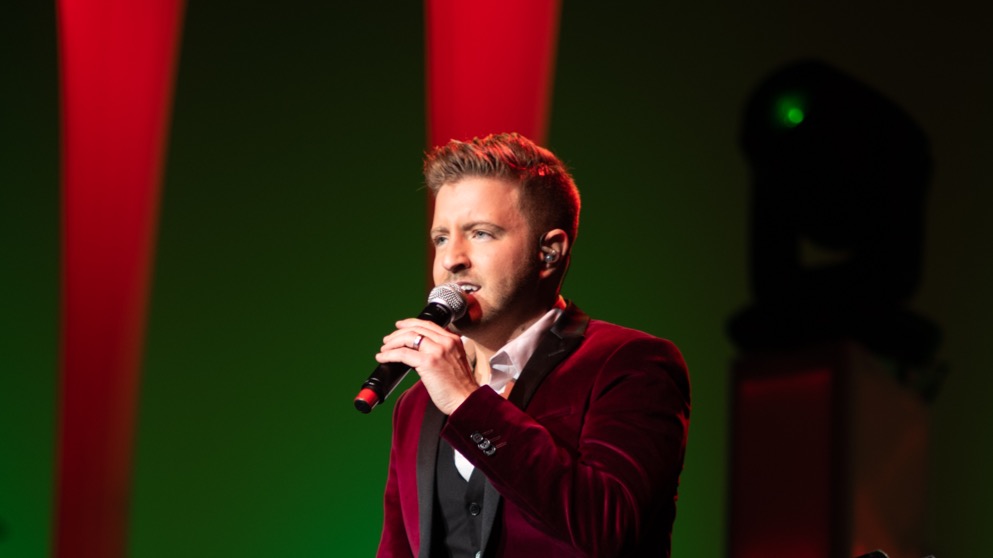
When Billy Gilman talks about Christmas, his voice does that thing his fans know so well—it softens, then swells, like he’s already halfway into a song.
“My accountant starts doing jumping jacks around November,” he laughs. “Christmas season hits and, for whatever reason, that music has just always resonated with my fans.”
This year, that seasonal magic is coming to Las Vegas with a purpose. On Sunday, Nov. 30, Gilman will headline Aid for AIDS of Nevada’s second annual Blue Christmas at House of Blues Las Vegas inside Mandalay Bay. The evening pairs holiday sparkle with serious heart, raising funds and awareness for AFAN’s HIV/AIDS services just as the community prepares to mark World AIDS Day on Dec. 1.
“It’s my favorite time of year,” Gilman says. “And when I heard what this event stands for and where the proceeds go, I was all in. I was honored. Truly.”
Christmas, but Make It Personal
For casual listeners, Gilman might forever be “the kid from ‘One Voice’” or the powerhouse runner-up from *The Voice*. But longtime fans know another truth: Billy Gilman and Christmas go way back.
He recorded *Classic Christmas* as a child star, and for many fans, his versions of “Angels We Have Heard on High” and “Warm and Fuzzy” are baked into their holiday memories. Even he’s still rediscovering those early recordings.
“Not long ago I was hosting a dinner party—I love to cook—and a friend said, ‘I love your rendition of “Angels We Have Heard on High.”’ I had honestly forgotten I recorded it,” he says, still amused. “We pulled it up, listened, and I thought, ‘Huh. Not too bad.’ You hear it differently because it feels like a different human. A different life.”
Back then, he was a kid singing the songs the adults picked. Now, holiday music hits deeper.
“Holiday music has changed for me,” he says. “I’ve lost grandparents who meant the world to me and basically started my career. I’ve lost friends. I’ve gained family—biological and chosen. So the holidays aren’t just jingle bells anymore. They’re grief and joy, nostalgia and hope all at once. And that’s what I try to bring onstage.”
Blue Christmas gives him room to pour all of that into a single night.
“When I do a Christmas show, I like to put all the emotions on the table,” he explains. “I want people to feel merry and happy, sure, but I also want to acknowledge the people we’ve lost and the true meaning of the season. I love when I look out and see the napkins come up to people’s faces. That’s when I know we’ve hit something real.”
Don’t worry—he’s not planning a funeral dirge. He grins describing his set list for House of Blues: “If you like Christmas music, we are Christmas-heavy. We’re doing everything from traditional carols to rock-and-roll Eagles-style Christmas. I just went into the studio for this show and cut some big band arrangements with a six-piece horn section. I’ve never done that before. It’s a total melting pot.”
Fans can expect touches from every era: the early hits, songs from *The Voice*, new arrangements that lean into jazz and country, and plenty of festive showmanship. And because this isn’t a rigid arena band show, he admits his set might not be locked in until minutes before curtain.
“I’m that guy who changes the set list 10 minutes before I go on,” he says. “I get a wind of inspiration, and suddenly I’m like, ‘Nope, we’re doing this instead.’ That’s the fun of a room like House of Blues—you have a little freedom to follow the moment.”
A Voice for Something Bigger Than Himself
For Gilman, Blue Christmas is about more than sleigh bells and big notes. It’s about the people in the room who need to hear, in some way, that they’re going to be okay.
“I’ve always tried to be a voice for something bigger than myself,” he says. “Even at 12 years old, I don’t know where that mentality came from, but it’s been there from the beginning.”
That shows up most clearly in his conversations with fans. He’s heard from queer kids thrown out of their homes, from people who came out because he did, from folks living with HIV who found courage in his music, and even from a mother who changed her mind about giving up her baby for adoption after hearing his hit “Oklahoma.”
“It’s heavy,” he admits. “I’m just doing what I feel like I’m supposed to do—use my voice. But then you’re in the meet-and-greet line and someone says, ‘You helped me survive living under a bridge,’ or ‘Your song made me keep my child,’ and it’s a lot. You carry those stories with you. You go back to your hotel or the bus and you still hear them.”
That’s part of why this AFAN partnership matters to him. HIV isn’t an abstract issue he’s lending his name to; it’s close to home.
“I’ve built really close friendships with people living with HIV. Some of them are my chosen family,” he says. “It’s very real, very personal.”
He also grew up seeing the example of Liza Minnelli, a close friend, and Elizabeth Taylor, who spoke out and showed up for people with HIV when it was dangerous and unpopular.
“Back then, people thought it was ugly to even hug someone with HIV,” he says. “Liza and Elizabeth walked straight into that stigma and said, ‘No. These are human beings.’ That stuck with me.”
Now, he’s grateful to live in a time when he can say, loudly and clearly, that HIV is not a death sentence.
“Because of all the footwork that’s been done, it’s more like a chronic condition,” he says. “There are treatments, there is hope. Events like Blue Christmas reinforce that—it’s not just fundraising, it’s visibility. It’s telling people, ‘You’re going to be okay. You’re not alone. There are resources and people who care.’”
He’s especially aware of the mental health side.
“I can’t even imagine what it must feel like in that first moment of diagnosis—mentally, emotionally,” he says. “If my being on that stage can help someone feel less alone, that matters to me. My voice gives me a platform; I want to use it to say, ‘It’s okay. There is a way forward.’”
Music as a Different Kind of Medicine
AFAN’s Blue Christmas is tied intentionally to World AIDS Day and the U=U message—“undetectable equals untransmittable,” a simple phrase that reshapes fear into empowerment for people living with HIV. Gilman believes music can carry those ideas places that statistics and public service announcements can’t always reach.
“Music transcends every difference,” he says. “You never know which lyric is going to hit which person. You can plan a set that you *hope* will touch everybody, but you don’t really know. And then suddenly that one song lands right in someone’s 20-year-old wound.”
For him, that’s the difference between a speech and a song.
“Spoken facts are crucial. PSAs are crucial. But a melody plus words? That bypasses some of the defenses,” he says. “People are more melodic than they realize. A line sung the right way will land in the heart differently than the same sentence read off a piece of paper.”
That’s why he doesn’t shrug off his work as just entertainment.
“Once you’ve seen what songs can do for people, you can’t pretend it’s just a fun night out,” he says. “You want people to have a blast, sure—but you also know that, for somebody out there, it’s going to be a turning point.”
Billy, Vegas, and the Long Game
Blue Christmas isn’t Gilman’s first brush with Las Vegas. He’s no stranger to local stages.
“I’ve performed at the South Point, did a five-night run at the Orleans—great theater, by the way—and a show at Caesars Palace with Josh Groban and Sheena Easton when Celine Dion was being named Woman of the Year,” he says. “That was pretty wild.”
For nearly a decade, he also spent part of every year living here to host the Jerry Lewis MDA Telethon, another cause-driven marathon of entertainment and emotion.
“From August 1 to September 10, like clockwork,” he recalls. “So there’s a lot of Vegas in me.”
It’s no surprise that a residency is on his wish list.
“I would love a residency in Vegas, bar none,” he says. “My fans already fly in from Germany to see me in Pennsylvania. I know they’d come here. The idea of settling into one room, building something special, and letting people come to *me*? That sounds like heaven.”
Until that day, he’s embracing the chance to return with a purpose—and maybe finally see more of queer Vegas now that he’s living his life openly.
“I haven’t really done the whole gay nightlife scene in Vegas because back when I was here regularly, I wasn’t out,” he says. “We need to change that. I’ve heard all about Piranha and Gipsy, so I’m ready for a proper tour.”
A Night to Feel Everything
If there’s a single thread that runs through Gilman’s story—from child star to openly gay artist, from “One Voice” to Blue Christmas—it’s that he refuses to treat music like something shallow.
“At the end of the day, I hope people sit down at Blue Christmas, have a cocktail, and forget their troubles for a little while,” he says. “We’re living in such a chaotic time. We all need a room where we can breathe.”
He wants that room to be as full of joy as it is of reflection.
“I want them to laugh, to cry, to feel merry, to remember the people they’ve lost and the people they love,” he says. “I want them to walk out feeling like they were part of something bigger than themselves.”
And that, for him, is the real gift of this season—and this show.
“Right now, more than ever, we need to come together for the greater good,” he says. “Blue Christmas is about exactly that. Amazing artists. Important messages. A community that cares. If people leave feeling even a little more hopeful and a little less alone, then it’s been a success.”
AFAN’s Blue Christmas may be draped in blue lights and holiday sparkle, but at its heart, it’s about red-hot connection: between queer artists and queer audiences, between people living with HIV and a community that refuses to let them stand alone, between one singer’s voice and the story of a city that knows how to party with purpose.
On Nov. 30, at House of Blues, Billy Gilman plans to give Las Vegas everything he’s got.
“I’m going to give my damnedest,” he promises. “And I think people will feel that. I just hope they come—because they won’t regret it.”