On most Saturday nights in Las Vegas, the dress code is “extra.” Sequins, feathers, something that says “I came to be seen.” The Human Rights Campaign’s annual Las Vegas Gala is no different—except that its shimmer isn’t only sartorial. It’s civic. It’s the moment when a city that runs on spectacle pauses to honor substance: the decades-long, grind-it-out work of protecting LGBTQ+ people at home, at work, and in public life.
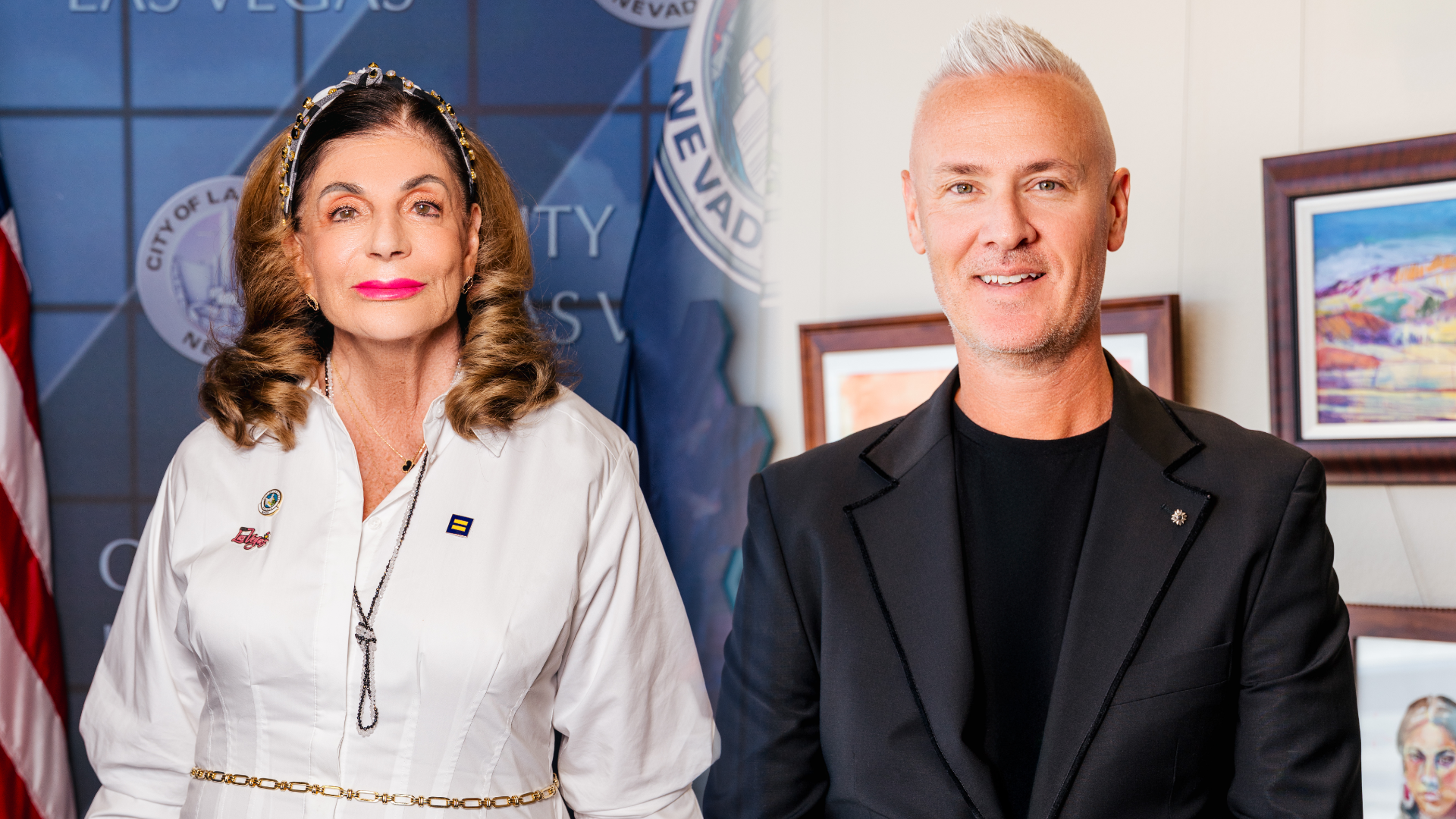
This year, two names at the center of that story share the spotlight: Mayor Shelley Berkley, a familiar face at HRC who’s gone from attendee to Equality Award honoree; and Fletcher Whitwell, Chief Media & Publishing Officer at R&R Partners and recipient of the Gavin J. Goorjian Visionary Leadership Award. One is the city’s top convener, the other a consummate bridge-builder between boardroom and grassroots. Together, they sketch a map of what leadership looks like when the cameras are gone: showing up, year after year, and saying the quiet part loudly—that equality is non-negotiable.
“This Is a Community That Accepts Everybody”
If there’s a single through-line in Mayor Shelley Berkley’s public life, it’s the way she speaks about Las Vegas as a mosaic—one that would be visibly diminished without LGBTQ+ people.
“I go to the HRC gala every year for as many decades as I can remember,” she says, still clearly delighted to be receiving HRC’s Equality Award. “It’s always top-drawer. You see everybody you know and love.” Then, in a shift from personal joy to public duty: “It’s very important for the mayor’s office to demonstrate that Las Vegas accepts everybody, values everybody, and encourages people to be part of the community. Especially now, the mayor has to be outspoken about that.”
Berkley can joke about the new era of “seersucker and summer dresses”—yes, she found a throwback D.C. suit in the back of her closet, and yes, it still fits—but the message underneath is serious. A city that became a global destination by welcoming the world doesn’t get to go wobbly on inclusion when the politics get loud. The ribbon-cuttings, the stadium openings, the parades down Fremont Street: none of it works without the full civic participation of LGBTQ+ Nevadans.
“I Wanted a Family. I Wanted the Same Rights.”
For Fletcher Whitwell, HRC wasn’t an abstraction—it was a road he walked. He first encountered the organization in Chicago, back when “a young state senator named Barack Obama” spoke at an event. The mission clicked. After moving to Las Vegas in 2006, Whitwell joined the local HRC steering committee in 2007 and served for seven years. What began as professional involvement quickly became personal.
“I wanted a family,” he says plainly. “I wanted the same rights and the same opportunity to have kids—through surrogacy or adoption—as my friends and allies. I didn’t know how to navigate that. I didn’t know what rights I had.” That path led Whitwell to become a plaintiff in Nevada’s marriage-equality lawsuit, a legal fight that helped make Nevada one of the earliest states to secure the freedom to marry—ultimately paving the way for him to adopt his two children.
The timing matters. With national protections facing renewed legal and political pressure, the idea that marriage equality is “settled” feels less certain. HRC has repeatedly warned that a wave of anti-LGBTQ+ bills is reshaping state-level protections nationwide; their most recent State Equality Index calls it a decisive moment to hold the line—a posture HRC underscored by declaring a national state of emergency for LGBTQ+ Americans as hostile legislation accelerated across multiple states.
Nevada, to its credit, remains one of the country’s more protective jurisdictions. The state’s legal framework has been steadily strengthened across nondiscrimination, family recognition, and health care access—part of why Las Vegas can credibly market itself as a haven for LGBTQ+ residents, workers, and visitors. HRC’s SEI captures that picture in macro; on the ground, people like Berkley and Whitwell have made it real.
Visionary Leadership, Defined
Ask Whitwell what “visionary leadership” actually looks like, and he points to the award’s namesake, Gavin J. Goorjian: someone who chose to leverage family prominence for community impact, particularly through HRC and The Center. “He didn’t have to,” Whitwell says. “He did because it was right.”
That’s Whitwell’s posture, too: use your seat—corporate, civic, cultural—to stand up, listen, and solve. At R&R Partners, that ethic is baked into policy: an in-house foundation (est. 2007), paid volunteer time each year, and an $800 match for employee giving. It’s the kind of scaffolding that makes community engagement less exceptional and more everyday. And it gives leaders permission to push their teams toward the work.
The payoff, he argues, is dual: yes, you meet people, build networks, trade ideas. But you also lend your technical skills to resource-strapped nonprofits—creative, media, legal, operations—where a little pro bono muscle can change the trajectory of a program year. It’s professional development with a soul.
What the Data Says: Corporate Inclusion Isn’t Dead—But It’s Changing
Step outside the ballroom and into the numbers, and a more complicated picture emerges—one that still tilts positive. In HRC’s 2025 Corporate Equality Index, a record 1,449 companies participated, and 765 of them earned a perfect 100—a 28% jump in top scorers year-over-year. Among the Fortune 500, 95% now include both “sexual orientation” and “gender identity” in their nondiscrimination policies, and over 72% offer transgender-inclusive health benefits. Those are not small victories; they’re the result of two decades of incremental, methodical work.
And yet, there’s headwind. In 2024, a handful of marquee brands backed away from active participation in the CEI amid anti-DEI pressure campaigns—moves that triggered public score deductions from HRC and broader coverage that amplified the controversy. Still, the arc in the 2025 report is clear: more employers are doubling down on inclusion, not fewer.
Vegas Check-In: How Strip-Size Employers Stack Up
For a city where hospitality is the heartbeat, the CEI’s company-level data reads like a balcony view of the Strip—every marquee in sight:
Caesars Entertainment: 100 (2025), earning HRC’s Equality 100 Award with full points across workforce protections, inclusive benefits (including parity in family-formation benefits), internal training, and corporate social responsibility. Caesars has been a bellwether in gaming for years, repeatedly publicizing its top score.
MGM Resorts International: 90 (2025), with full credit on workforce protections, training/culture, and CSR. The gap is in benefits parity for family formation, where MGM shows partial credit this year—an area to watch given its scale and brand influence.
Wynn Resorts Ltd.: 35 (2025). Wynn earns points for basic nondiscrimination and some data/ERG activity, but posts low scores in inclusive benefits and CSR, signaling significant room for improvement relative to peers on the Strip.
Southwest Airlines (huge LAS presence): 100 (2025) and Equality 100 Award—relevant not only for travelers but for the thousands who work the airport, gates, and routes that keep Vegas connected.
For civic leaders like Berkley, those deltas aren’t mere optics. They shape whether LGBTQ+ workers can build stable lives here: health care that actually covers what people need, family-formation benefits that don’t make queer parenthood a luxury, transition support that’s explicit, accessible, and stigma-free. And for executives like Whitwell, this is where the “vision” part of visionary leadership comes due: using vendor standards, sponsorship decisions, and RFP language to reward companies that walk the talk—and to nudge laggards forward.
The Case for Las Vegas: Culture, Policy, and the Practicalities of Belonging
One reason Las Vegas punches above its weight on LGBTQ+ inclusion is surprisingly simple: we’re a service economy that runs on talent. Hospitality, live entertainment, major-league sports, and a burgeoning creative and tech scene have all learned the same lesson—you can’t recruit and retain great people by telling them to shrink themselves.
That’s where the CEI is useful beyond the ranking. It’s a checklist. Do you protect employees based on sexual orientation and gender identity? Do you offer equitable medical benefits for same- and different-sex spouses/partners? Do your health plans affirm transition-related care? Do you publish gender transition guidelines, collect inclusive data, support LGBTQ ERGs, and show up in the broader community? Those are the nuts and bolts employers can move on this quarter.
At the city scale, Las Vegas benefits from Nevada’s relatively strong legal baseline captured in HRC’s State Equality Index. It’s not perfection; it’s permission—permission for the private sector to go farther, faster, without worrying that state law will undercut inclusive policy. In a national climate HRC characterizes as an emergency for LGBTQ+ people, that stability makes the city feel less like a bubble and more like a bulwark.
A Mayor’s North Star, A Father’s Why
Berkley speaks about the gala with affection—the hugs, the tradition—but when she pivots to a closing message for the community, it’s unscripted gratitude: “Thank you—for who you are, for what you do, and for embracing me over the last several decades.” The sentiment carries extra weight from a mayor who has, quite literally, been at HRC tables wearing every hat a public servant can wear.
Whitwell, for his part, keeps coming back to his kids. “They’re my focus and my inspiration,” he says. The digital-native generation they represent is steeped in both relentless connection and relentless scrutiny. He wants their world to be “better and a little easier,” which in practice looks like consistent, boring, effective advocacy: volunteering; board service; fundraising; pushing your company to do the right thing when the backlash is loud. And then doing it again next year.
When Allies Wobble
One of the Gala’s recurring themes this season is allyship in a moment of corporate backsliding. Whitwell is frank: some Pride sponsorships are harder to secure; a few legacy partners hit pause under political pressure. Nationally, a handful of brands retreated from active CEI participation. HRC responded with score deductions and a message that mirrors what so many LGBTQ+ leaders in Vegas say privately: We appreciate your statements. But your policies and your benefits are what count.
Here’s the good news: the 2025 CEI shows the mainstream still moving in the right direction. Hundreds of companies achieved the Equality 100 designation, and CEI criteria continue to normalize trans-inclusive health care, parity in family formation, and clear transition policies. The airport, the Strip, the broadcast trucks outside Allegiant Stadium—those workplaces are getting better, even if the social media rage cycle makes it feel like we’re losing.
The Playbook (Steal This)
If you run a business in Southern Nevada—or you advise one—here’s the pared-down to-do list pulled straight from the CEI rubric and the realities Berkley and Whitwell describe:
1. Protect in policy: Update your nondiscrimination clauses to include sexual orientation and gender identity across all operations. “U.S. only” carve-outs don’t cut it. (It’s table stakes across Fortune 500 employers.)
2. Cover what matters: Offer equivalent medical benefits for same- and different-sex spouses/partners, equal family-formation benefits, and explicit coverage for transition-related care—spelled out in your benefits guide.
3. Train and measure: Implement LGBTQ+ competency training (with intersectionality), publish gender transition guidelines, support ERGs, and collect inclusive data to see who thrives and who doesn’t.
4. Show up externally: Fund at least five distinct LGBTQ+ community efforts and adopt supplier nondiscrimination and inclusive philanthropy standards. In Las Vegas, that can mean HRC, The Center, AFAN, Trans Pride, and sports-inclusion orgs—pick partners, not photo ops.
5. Vendor leverage: If you buy, build, stage, or sponsor in this town, bake CEI-aligned standards into contracts. Reward Caesars-style leadership; nudge MGM-style “almost there” gaps; challenge Wynn-level underperformance. The market notices.
The Juggle Is the Job
Whitwell laughs about the reality of modern leadership: “It’s a juggling act.” Two teenagers with sports and theater schedules. A demanding C-suite role. Community boards. He does it anyway, because community work compounds. The volunteers you cheer at the gala? They show up again at Pride. The client you helped through a crisis? They call you at their next company. The intern who felt safe enough to be out at work? They’re a manager in three years—and they remember.
Berkley’s version of that same ethos is mayoral: make it safe and expected for LGBTQ+ people to belong here. Set the tone in rooms where tone becomes policy. Use the office as a megaphone, not a muzzle. And if that means wearing a “hideously bland” seersucker suit for one night to meet the moment with grace and humor—well, that’s Vegas, baby. Even the compromises sparkle.
Why This Gala Matters (Still)
Critics sometimes frame events like the HRC Gala as performative. But talk to the people on stage and in the crowd and you hear a different story: money raised funds legal fights and local programs; awards given tell young professionals exactly which leaders built the scaffolding they’re now climbing; data released (CEI, SEI) gives employers and city halls a standardized playbook to run, measure, and improve.
This year’s CEI, in particular, is both scoreboard and strategy guide. It tells us who’s doing the work (hello, Caesars at 100; Southwest at 100), who’s close (MGM at 90), and who needs to pick up the pace (Wynn at 35). It locates Las Vegas inside a national picture that—despite the noise—shows more companies moving toward inclusion than away from it. And it gives civic leaders like Berkley the data to cheer, challenge, and champion—often in the same speech.
Final Word
In a city that understands the price of a ticket and the value of a good seat, Shelley Berkley and Fletcher Whitwell are asking for something simple: show up. If you lead a company, show up in your policies and benefits. If you hold office, show up in your ordinances and budgets. If you live here, show up for The Center, AFAN, The Sisters, and HRC. And if you’re headed to the gala on August 23, show up in something fabulous—or seersucker. Either way, you’ll be in good company.
Because in Las Vegas, we don’t just sell inclusion. We practice it. We measure it. We improve it. Then we toast the people who keep doing the work—and get back to it on Monday.